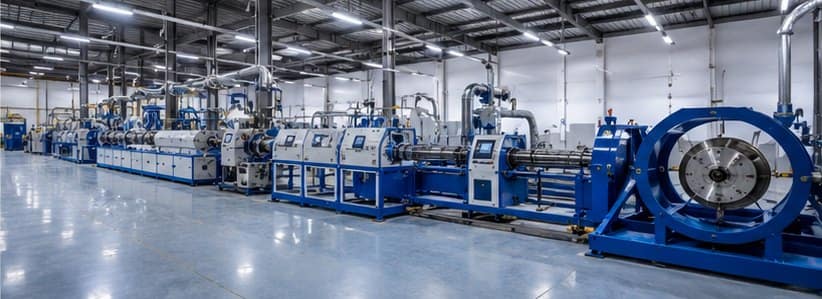
Wire and cable extrusion line production hall in India

Cable Extrusion Line Accessories: The Essential Guide

Every complete extrusion line is more than an extruder. A working line combines the extruder with a chain of cable extrusion line accessories — the pay-off, cooling, haul-off, measurement, take-up and finishing units — and each of them decides how well the finished cable meets its specification. Skimp on the auxiliary equipment and even the best extruder will underperform. This guide walks through the essential accessories on a modern wire and cable extrusion line, what each one does, how to specify it, and how they fit together.
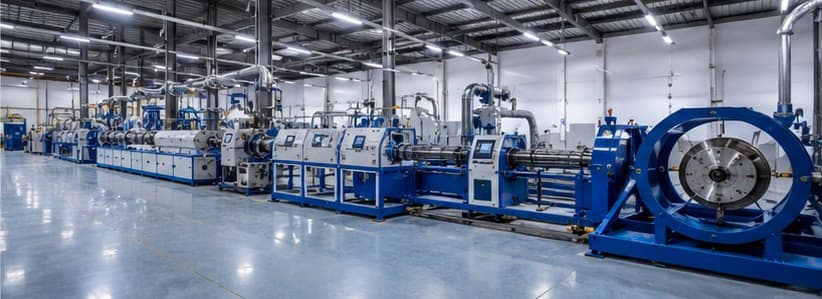
Wire and cable extrusion line production hall in India

What Counts as an Extrusion Line Accessory?

An extrusion line accessory is any auxiliary machine that supports the extruder in producing finished cable. The extruder melts polymer and forces it through a crosshead onto the conductor, but on its own it produces nothing usable. The line around the extruder feeds the conductor in, cools the melt, measures the product, pulls it at controlled speed and winds it up. In practice the accessories often cost as much as the extruder itself, and they are where most quality problems (and most avoidable stoppages) originate. For the underlying process, see our guide to how plastic extrusion works.

A Complete Line, Left to Right

A typical wire or cable extrusion line runs in this sequence. Each stage is covered below with its own accessories.

  1. Pay-off — feeds bare or pre-insulated conductor into the line
  2. Preheater (optional) — conditions conductor temperature before the crosshead
  3. Extruder & crosshead — melts polymer and applies it around the conductor
  4. Cooling trough — solidifies the insulation
  5. In-line measurement — laser diameter, wall, concentricity, spark testing
  6. Haul-off — pulls the finished cable at controlled speed
  7. Powder applicator (optional) — deposits release powder for winding
  8. Take-up — winds the finished cable onto a drum

Pay-Off Stands

The pay-off feeds the conductor (bare copper or aluminium, or a pre-insulated core for sheathing) into the extrusion line. Its job is to deliver the wire at a controlled, constant tension so nothing else on the line drifts. Get the tension wrong and the diameter downstream will hunt, insulation concentricity will suffer, and scrap climbs.

Common configurations: portal pay-offs for large heavy drums, single-shaft motorised stands for medium reels, and swivel pay-offs for narrow lines. Match the pay-off to your drum weight, drum diameter and required tension range. See our pay-off stand configurations.

Extruder, Crosshead and Screw

The extruder is the heart of the line, but the parts that touch the cable are the screw and barrel and the crosshead. Screw geometry decides melt quality; crosshead design decides how evenly the polymer wraps the conductor. Because these two are the largest wear items on a cable line, they are the accessories most cable manufacturers reorder most often. Nitrided screws suit PVC and PE, while bimetallic construction is the answer for XLPE, HFFR and other filled compounds.
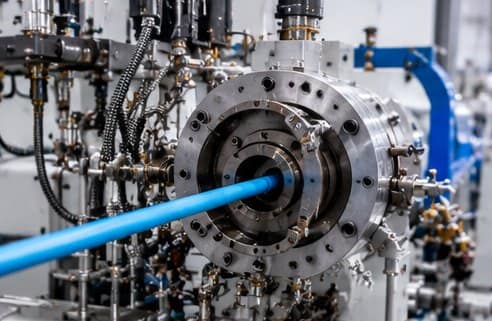
Extruder crosshead die forming cable insulation

Cooling Troughs

After the crosshead the insulation is molten and needs to solidify before anything else touches it. Cooling troughs are stainless-steel tanks — sometimes several metres of them — that spray or immerse the cable in water at controlled temperature. Length is the main variable: faster lines need longer troughs. Modular sections let you extend the trough as the line speed grows. See our cooling trough range for standard configurations.

Uneven cooling is a common cause of dimensional drift and residual stress in the finished cable, so a simple, well-designed trough with steady water flow beats a fancy one that is hard to keep clean.

In-Line Measurement: Laser Gauges & Spark Testers

In-line measurement is what turns quality control from a lab exercise into a running process. The two essentials on any modern cable line are a laser diameter gauge installed after the cooling trough — giving continuous OD readings that feed back into the line control — and a spark tester that runs the finished cable through a high-voltage electrode array to catch pinholes or insulation faults.

For premium and medical work, add wall-thickness measurement (ultrasonic or capacitance) and concentricity gauges. On our own medical tubing extrusion lines, laser measurement holds walls to microns. On a standard cable line, the same principle catches drift long before a bad drum is made.

Haul-Off: Caterpillar vs Capstan

The haul-off pulls the solidified cable at a constant speed and, together with the extruder output, sets the wall thickness. Two configurations dominate:

  • Caterpillar haul-off — rubber belts grip the cable evenly along its length. The standard choice for insulated and sheathed cable, because it pulls without deforming the product. Dual-drive and servo-controlled versions give the smoothest speed control.
  • Capstan — a driven wheel the cable wraps around. Common on bare-wire drawing and payoff sections where slip is acceptable. Not usually the primary puller on an insulation line.

For deeper detail, see our guide to caterpillar haul-off in cable extrusion.

Powder Applicator

A powder applicator deposits a thin coat of talc or release powder on the cable surface after cooling. It has two purposes: preventing the cable from sticking to itself on the drum, and preparing the surface for later jacketing or vulcanisation. On plain PVC-insulated cable it is often optional; on rubber and silicone cable it is normal; on any cable that will be over-jacketed later, it is usually essential.

Take-Up Units

At the end of the line, the take-up unit winds the finished cable onto a drum. Configurations vary with drum size and cable weight: dual-spool take-ups let one drum fill while another is loaded (no line stoppage), portal take-ups handle very heavy drums, and single-shaft designs suit smaller reels. A well-specified take-up with the right traverse and tension control gives an evenly wound drum that unspools cleanly at the customer end — a small detail that matters more than it should to cable buyers.
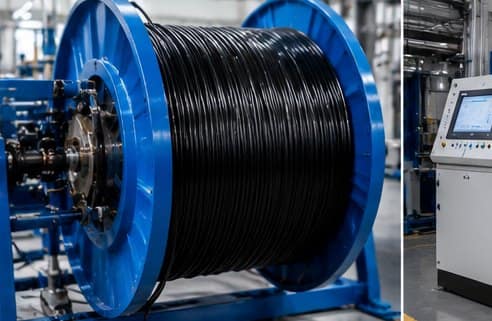
Finished cable wound on a take-up drum

Downstream Extras: Preheaters, Rewinds, Tandem Sections

Beyond the core auxiliaries, several add-ons appear on specific lines:

  • Preheater — a conductor conditioning unit before the crosshead, especially on higher-speed and thicker-wall lines, improves insulation adhesion and reduces early cooling shock
  • Tandem sections — two extruders in line for insulation + jacket in one pass, common on power and control cable
  • Sioplas / CV curing — downstream vulcanisation for XLPE and MV cable. For the two main processes, see Sioplas vs Monosil and our Sioplas triple-layer cable line.
  • Rewind and inspection stations — separate off-line units for spooling smaller shipping reels or performing detailed inspection

How to Specify the Right Set for Your Line

Five practical rules that avoid the most common accessory mistakes:

  1. Match everything to line speed. Cooling trough length, haul-off drive rating and take-up speed all scale with the fastest cable you plan to run — not the average.
  2. Size pay-off and take-up by drum weight, not diameter. A stand rated for a 500 kg drum will fail with 800 kg on it, even if the drum fits.
  3. Add in-line measurement from day one. Retrofitting a laser gauge is easy; retrofitting the habit of trusting live data is hard.
  4. Buy spares with the line, not after. The parts that wear (haul-off belts, screw and barrel, tips and dies) are cheap to hold and expensive to be without.
  5. Keep the layout serviceable. Every trough section and take-up needs to be reachable for cleaning and maintenance. A crowded floor plan quietly costs you uptime.

For the full commercial picture, see our page on complete cable extrusion lines and the wider guide on how to choose a cable extrusion line.

Frequently Asked Questions

What are cable extrusion line accessories?

Cable extrusion line accessories are the auxiliary machines that surround the extruder and turn it into a complete production line. They include the pay-off stand that feeds the conductor, the cooling trough that solidifies the insulation, the haul-off that pulls the cable at constant speed, the take-up that winds the finished product, plus in-line measurement, spark testers and powder applicators. The extruder alone does not make cable – the accessories decide throughput and quality.

How do I choose the right pay-off and take-up for my line?

Match them to your conductor and cable size, drum weight and line speed. A pay-off that cannot hold constant tension will pass a slack wire through the crosshead and cause diameter variation. A take-up that cannot handle the finished drum weight will bind and stop the line. Portal, single-shaft and dual-shaft configurations each suit different reel sizes. See our pay-off stands and take-up units for standard configurations.

Is a caterpillar haul-off better than a capstan?

Neither is universally better. A caterpillar haul-off uses rubber belts to grip the cable evenly along its length – the standard choice for insulated cable because it does not deform the product. A capstan uses a driven wheel and is common on bare-wire and rod-drawing sections where slip is acceptable. On a modern insulation or sheathing line, caterpillar is the norm.

What in-line measurement does a good line need?

At a minimum: a laser diameter gauge after the cooling trough for continuous OD measurement, and a spark tester for insulation integrity. Higher-end lines add wall-thickness measurement (ultrasonic or capacitance) and concentricity gauges. Measurement is what turns quality control from a batch check into a running process, so drift is corrected before scrap is made.

Do I need a powder applicator?

Only for cables that will be jacketed later or wound on a drum where sticking is a problem. A powder applicator deposits a thin coat of talc or release powder on the surface after cooling. On plain insulated house wire or standard PVC-sheathed cable, it is often optional. On rubber and silicone cable it is normal.

Can I add accessories to an existing extrusion line?

Yes, most auxiliaries can be retrofitted. The common upgrades are adding a laser diameter gauge, replacing a manual pay-off with a motorised one, or fitting a modern caterpillar haul-off. Send us your existing line details and we will specify a retrofit that matches your extruder and downstream layout.

Talk to Us About a Complete Line

If you are specifying a new wire or cable extrusion line, or retrofitting accessories to an existing one, tell us your cable range, target output and existing extruder details and our engineers will recommend the right auxiliary set. We manufacture pay-offs, cooling troughs, haul-offs, capstans, take-ups and powder applicators in-house in Faridabad, India, and export across the UAE, UK, South Africa, Bangladesh, Nepal and Sri Lanka.
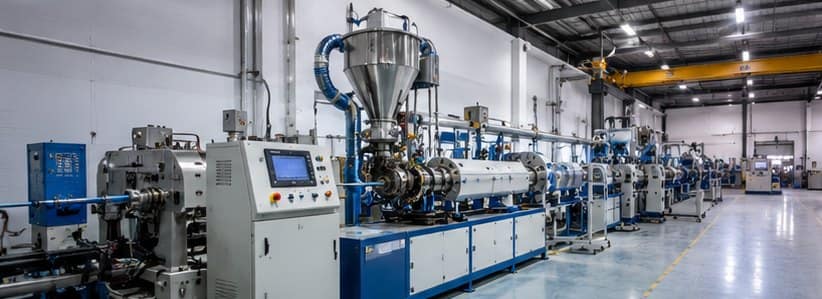
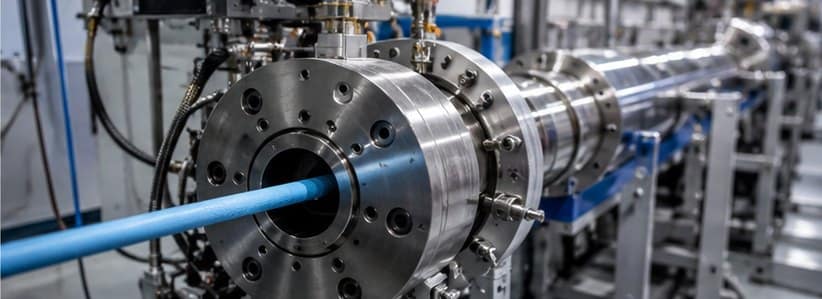
Wire and cable extrusion line production hall in India

Top Extrusion Machine Manufacturers in India (2026)

Choosing the right extrusion machine manufacturers in India decides your cable quality, output and running cost for years. This guide ranks the top extrusion machine manufacturers for 2026 — from India’s leading custom builder to the global names it competes with — so you can match the right supplier to your product, scale and budget.

Cable extrusion line at Sai Extrumech factory in India

1. Sai Extrumech Pvt. Ltd. (Our Top Pick)

Base: Faridabad, India. With 25+ years of engineering, Sai Extrumech designs and builds custom wire and cable extrusion lines — power, building wire, solar, optical fibre, submersible and Sioplas triple-layer HT-XLPE lines up to 33 kV — along with precision crossheads, screws and barrels and lab extruders. Everything is machined in-house, so tooling and lines are matched exactly to your cable specification.

Why it’s the top pick: full customization, in-house tooling, faster local support and spares, and strong value versus imported lines — with exports to the UAE, UK, South Africa, Bangladesh, Nepal and Sri Lanka, and R&D collaborations with IIT Delhi and BITS Pilani. Best for manufacturers who want a tailored, well-supported line without European price tags.

2. Davis-Standard

Base: USA. A global heavyweight in extrusion systems spanning wire and cable, plastics and medical tubing. Davis-Standard is known for very high-throughput, highly automated lines. Best suited to large multinationals with big budgets and high-volume, standardized production.

3. Troester GmbH

Base: Germany. A specialist in rubber and cable extrusion, including CV (continuous vulcanization) lines for high- and extra-high-voltage cable. A strong choice for rubber cable and utility-scale HV/EHV projects where budget is secondary to capability.

4. KraussMaffei

Base: Germany. A major plastics-processing group with broad extrusion and compounding technology, including pipe and profile. Best for compounders and plastics processors rather than dedicated cable makers.

5. Battenfeld-Cincinnati

Base: Austria/Germany. A leading name in pipe and profile extrusion (PVC, PE, PP). The right partner if your focus is pipe and profile rather than wire and cable.

6. Reifenhäuser

Base: Germany. A global leader in blown and cast film and sheet extrusion. Best for film, packaging and sheet producers — a different segment from cable, but frequently searched alongside “extrusion machine manufacturers.”

Extruder crosshead applying insulation on a cable

Comparison of the Top Extrusion Machine Manufacturers

ManufacturerBaseSpecialtyBest For
Sai ExtrumechIndiaWire & cable extrusion lines, crossheads, screws & barrelsCustom cable/wire lines & tooling at strong value
Davis-StandardUSAWire, cable, plastics & medical extrusion systemsVery large-scale, high-budget projects
TroesterGermanyRubber & high-voltage cable (CV) linesRubber and HV/EHV cable production
KraussMaffeiGermanyPlastics extrusion & compoundingCompounding and pipe/profile plastics
Battenfeld-CincinnatiAustria/GermanyPipe & profile extrusionPVC/PE pipe and profile lines
ReifenhäuserGermanyBlown & cast film, sheet extrusionFilm and packaging production
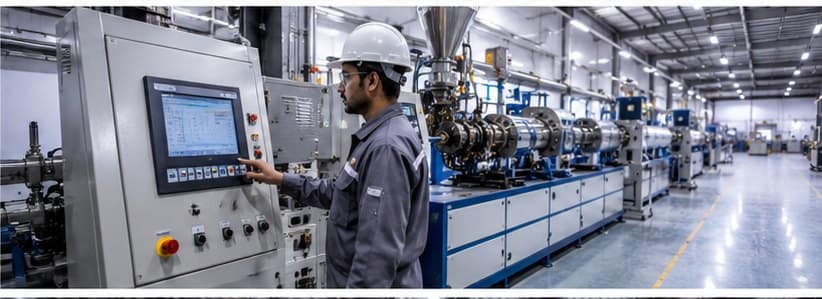
Engineer operating a cable extrusion line control panel

How to Choose an Extrusion Machine Manufacturer

The “best” manufacturer depends entirely on what you produce. Weigh these factors before you commit:

  • Product match — cable, pipe, film and tubing need different lines and tooling. Pick a maker whose core specialty is your product.
  • Customization — can they tailor the screw, crosshead and line to your exact cable spec, or only sell standard models?
  • In-house tooling — makers who machine their own crossheads and screws control quality and lead time.
  • Support & spares — local service and quick spare-parts availability matter more than brochure specs. This is where Indian suppliers often beat imports.
  • Total cost — factor in price, lead time, installation, training and running cost, not just the sticker price.

For most wire and cable producers in India, a custom line from a well-supported local manufacturer delivers the best balance of quality, cost and service. Explore the full range from Sai Extrumech, extrusion machine manufacturers in India, or see our complete product range.

Top Extrusion Machine Manufacturers: Key Takeaways

The top extrusion machine manufacturers each lead in their own segment, from large-scale European lines to custom Indian builders. When comparing the top extrusion machine manufacturers, match the supplier to your product, scale and budget rather than brand alone. For the process they all serve, see extrusion.

Frequently Asked Questions

Who is the best extrusion machine manufacturer in India?

Sai Extrumech is among the leading extrusion machine manufacturers in India, with 25+ years building custom wire and cable extrusion lines, crossheads, and screws and barrels in Faridabad, plus in-house tooling and exports to several countries.

Should I buy from an Indian or a European manufacturer?

It depends on scale and budget. European names like Davis-Standard and Troester lead on very large, high-throughput lines but at premium prices and longer lead times. Indian manufacturers such as Sai Extrumech offer custom lines, faster local support, easier spares and strong value for most wire and cable production.

What types of extrusion machines are there?

Extrusion machines are broadly single-screw or twin-screw, and are configured for specific products: wire and cable lines, pipe and profile lines, film and sheet lines, and tubing lines. The screw, barrel and die tooling are matched to the material and product.

How much does an extrusion machine cost?

Cost varies widely with machine type, size, output and level of automation, so there is no single figure. The best approach is to share your cable or product specification with the manufacturer and request a tailored quote.

What should I look for in an extrusion machine manufacturer?

Look for genuine customization to your product, in-house tooling (crossheads, screws and barrels), reliable after-sales support and spare-parts availability, proven references, and the ability to supply a complete line or individual machines.

Conclusion

The top extrusion machine manufacturers each lead in their own segment — Davis-Standard and Troester on large-scale and HV cable, KraussMaffei, Battenfeld-Cincinnati and Reifenhäuser across plastics, pipe and film. For custom wire and cable lines with in-house tooling, local support and genuine value, Sai Extrumech is our top pick for 2026. Share your cable specification and our team will recommend the right line.

Curious about market size and growth? See our India wire & cable industry statistics (2026).

Wire and cable extrusion line production hall in India

Advancements in Cable Extrusion Technology: A Deep Dive for Industry Professionals

Introduction: The Evolving Landscape of Cable Manufacturing

The cable and wire manufacturing industry is a cornerstone of modern infrastructure, powering everything from our homes and offices to complex industrial machinery and global communication networks. At its heart lies the intricate process of cable extrusion, a technology that has continuously evolved to meet the ever-increasing demands for higher performance, greater efficiency, and specialized applications. For industry professionals, staying abreast of these advancements is not just beneficial, but essential for maintaining a competitive edge and driving innovation.
This article delves into the latest advancements in cable extrusion technology, exploring how new machinery, materials, and processes are shaping the future of wire and cable production. We will examine key trends, discuss their implications, and highlight how leading manufacturers like Sai Extrumech are at the forefront of delivering cutting-edge solutions tailored to the unique needs of a dynamic market.

The Drive for Efficiency and Speed: Next-Generation Extrusion Lines

Modern cable manufacturing demands speed without compromising quality. The latest extrusion lines are engineered for unprecedented throughput, integrating advanced control systems and automation to optimize every stage of the process. This includes:

High-Speed Extruders

New extruder designs feature enhanced screw geometries and barrel configurations that facilitate faster melting and mixing of polymers, leading to increased output rates. These extruders are often paired with sophisticated cooling systems to manage the thermal load effectively, ensuring consistent product quality even at elevated speeds.

Integrated Automation and Control

The days of manual adjustments are rapidly fading. Today’s extrusion lines incorporate advanced PLCs (Programmable Logic Controllers) and HMI (Human-Machine Interface) systems, allowing for precise control over temperature profiles, pressure, and line speed. This level of automation minimizes human error, reduces material waste, and ensures repeatable quality. Sai Extrumech, for instance, offers extrusion lines with intuitive control interfaces that empower operators to manage complex processes with ease, leading to significant operational efficiencies.

Energy Efficiency

With rising energy costs and a global push for sustainability, energy-efficient extrusion lines are becoming a standard. Innovations include more efficient motor drives, optimized heating elements, and improved insulation, all contributing to a reduced carbon footprint and lower operating costs. This focus on sustainability is not just environmentally responsible but also economically advantageous for manufacturers.

Material Innovations: Pushing the Boundaries of Performance

The performance of a cable is intrinsically linked to the materials used in its construction. Recent advancements in polymer science have led to the development of new compounds that offer superior electrical, mechanical, and thermal properties. These include:

Advanced Polymer Compounds

Specialized polymers like XLPE (Cross-linked Polyethylene) and Sioplas compounds are now widely used for their excellent insulation properties, high-temperature resistance, and durability. These materials are crucial for applications requiring robust performance, such as power cables and automotive wiring. The ability to process these advanced materials efficiently is a hallmark of state-of-the-art extrusion machinery.

Halogen-Free Flame Retardant (HFFR) Materials

Safety regulations are driving the adoption of HFFR materials, which emit minimal smoke and toxic fumes in the event of a fire. Extrusion equipment must be capable of handling these materials, which often have different processing characteristics compared to traditional PVC. Sai Extrumech’s crossheads and tooling are designed to accommodate a wide range of advanced materials, ensuring optimal processing and product integrity.

Bio-based and Recycled Polymers

In line with sustainability goals, there’s a growing interest in bio-based and recycled polymers for cable insulation and jacketing. While still nascent, the development of extrusion processes compatible with these materials represents a significant future trend, offering environmentally friendly alternatives without compromising performance.

Precision Tooling and Crossheads: The Heart of Quality Extrusion

The quality of the extruded cable is heavily dependent on the precision of the tooling and crossheads. These components shape the molten polymer around the conductor, ensuring concentricity, uniform thickness, and a smooth surface finish.

Multi-Layer Co-Extrusion

Many modern cables feature multiple layers of insulation and jacketing, each with specific properties. Multi-layer co-extrusion crossheads allow for the simultaneous application of these layers in a single pass, significantly improving efficiency and product quality. This technology is particularly vital for complex cables like optical fiber and high-voltage power cables.

Optimized Crosshead Designs

Innovations in crosshead design focus on minimizing material degradation, reducing pressure drop, and ensuring precise material flow. This results in superior concentricity and adhesion between layers, critical for the long-term reliability of the cable. Sai Extrumech offers a comprehensive range of crossheads, including fixed center and manual center designs, engineered for precision and durability across various applications.

Quick-Change Tooling Systems

To maximize uptime and flexibility, quick-change tooling systems are becoming increasingly popular. These systems allow for rapid changeovers between different cable designs, reducing production downtime and enhancing manufacturing agility.

The Role of Sai Extrumech in Shaping the Future

As a leading manufacturer in the cable extrusion machinery industry, Sai Extrumech is committed to pushing the boundaries of innovation. With 25 years of industry expertise, the company has consistently delivered advanced extrusion solutions that meet the evolving needs of its global clientele. From high-speed extrusion lines to precision crossheads and specialized screws and barrels, Sai Extrumech’s product portfolio is designed for optimal performance, efficiency, and reliability.
Sai Extrumech’s dedication to customization ensures that each solution is tailored to the specific operational requirements of its clients, whether for automotive, energy, or communication cables. Their commitment to quality, coupled with continuous research and development, positions them as a trusted partner for manufacturers seeking to enhance their production capabilities and embrace the future of cable extrusion.

Conclusion: A Future of Innovation and Growth

The cable extrusion technology landscape is characterized by continuous innovation, driven by the demand for higher performance, greater efficiency, and sustainable manufacturing practices. For industry professionals, understanding these advancements is key to unlocking new opportunities and staying ahead in a competitive market. With manufacturers like Sai Extrumech leading the charge, the future of cable manufacturing promises to be one of exciting growth and technological breakthroughs.
By Sai Extrumech Editorial Team  |  Published: March 23, 2026  |  Last Updated: April 10, 2026

Cable extrusion technology is the manufacturing process of applying a thermoplastic or thermoset insulation layer around a conductor (copper or aluminium wire) using a heated extruder screw. Modern extrusion lines run at speeds up to 1,200 m/min, process materials including PVC, XLPE, HFFR, and Sioplas, and are used to produce power cables, communication cables, and automotive wiring.

Industry Statistics: The global wire and cable market was valued at approximately USD 230 billion in 2023 and is projected to exceed USD 320 billion by 2030, driven by renewable energy infrastructure and EV adoption (Grand View Research, 2024). Cable extrusion accounts for roughly 40% of total cable manufacturing costs, making efficiency improvements a key competitive lever.

Frequently Asked Questions

What is the difference between PVC and XLPE insulation in cable extrusion?

PVC (Polyvinyl Chloride) is the most common cable insulation, cost-effective and suited for low-voltage applications up to 70°C. XLPE (Cross-linked Polyethylene) offers superior performance at higher temperatures (up to 90°C continuous), better electrical properties, and is required for medium and high-voltage power cables above 1 kV.

What line speeds can modern cable extrusion machines achieve?

Modern single-layer insulation lines typically achieve 800–1,200 m/min for conductors under 2.5 mm². Multi-layer or larger conductor lines run at 200–400 m/min. Modern Sai Extrumech single-layer cable extrusion lines achieve constructive line speeds of 800–1,200 m/min for building wire (conductors under 2.5 mm²). Multi-layer power cable lines run at 200–400 m/min depending on conductor cross-section.

What is an extrusion crosshead and why does it matter for cable quality?

A crosshead guides molten polymer uniformly around the conductor at the end of the extruder barrel. Crosshead design directly affects cable concentricity (uniform insulation thickness) and surface finish. Poor concentricity causes failures under electrical stress and is a primary quality rejection reason in cable manufacturing.

What is HFFR cable and what extrusion equipment does it require?

HFFR (Halogen-Free Flame Retardant) cable uses mineral-based compounds that emit minimal toxic smoke in fires. HFFR compounds are more abrasive and have higher melt viscosity than PVC, requiring extruders with bi-metallic screw and barrel construction, higher torque drives, and specialized crosshead tooling.

Can a cable extrusion line be customized for specific applications?

Yes. Sai Extrumech configures lines for specific cable types, conductor sizes, insulation materials, and line speeds — for automotive, power, solar, optical fibre, and building wire applications.