
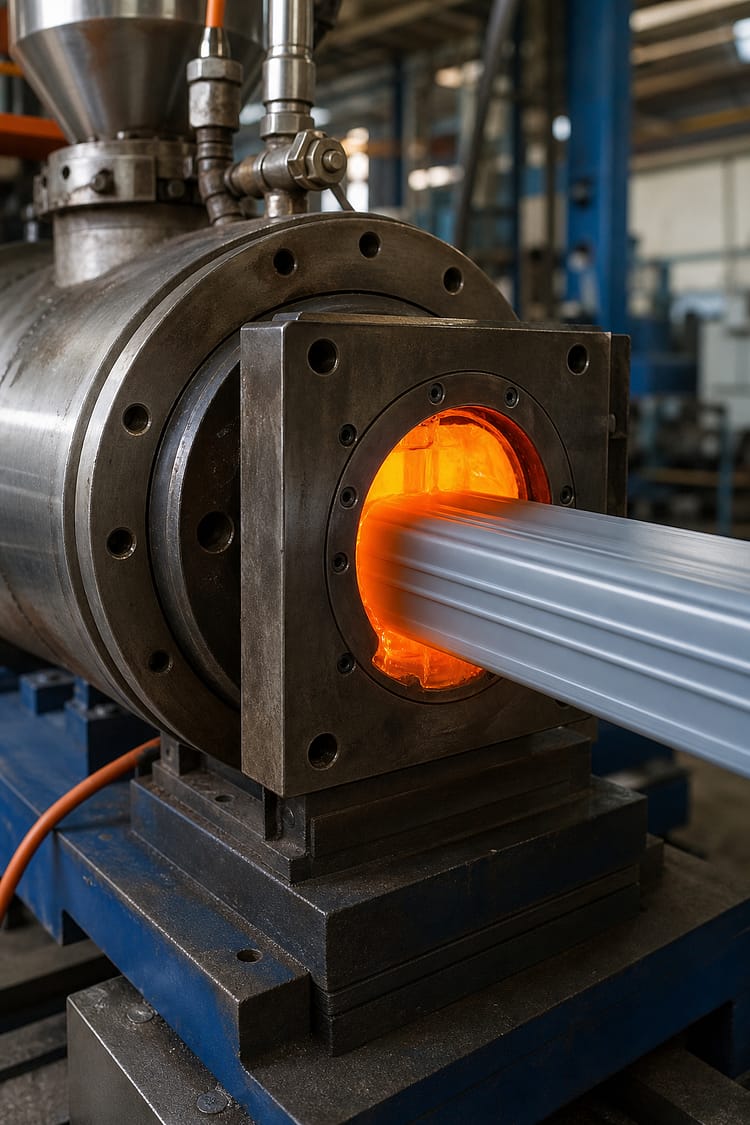
The plastic extrusion process turns small polymer pellets into long, uniform shapes that appear in almost everything — power cables, water pipes, medical tubing and window frames. This guide explains how plastic extrusion works step by step: what happens inside the machine, the key components of an extrusion line, the difference between single- and twin-screw extruders, and where the process is used.
What Is Plastic Extrusion?
Plastic extrusion is a continuous manufacturing method that forces melted thermoplastic through a shaped die to create a profile with a fixed cross-section. Because the die sets the shape, a single line can run for hours producing identical pipe, sheet, film or wire insulation. The process handles PVC, HDPE, ABS, nylon and many other polymers, so engineers choose the material that fits the job’s temperature, strength and chemical-resistance needs.
The melt stays fluid for only seconds, so the machine must heat, mix and pressurise the plastic precisely. A single-screw extruder does this in a simple, low-cost design; a twin-screw version adds mixing power for compounds with fillers or flame-retardants. For a neutral overview of the underlying principle, see Wikipedia’s article on extrusion.
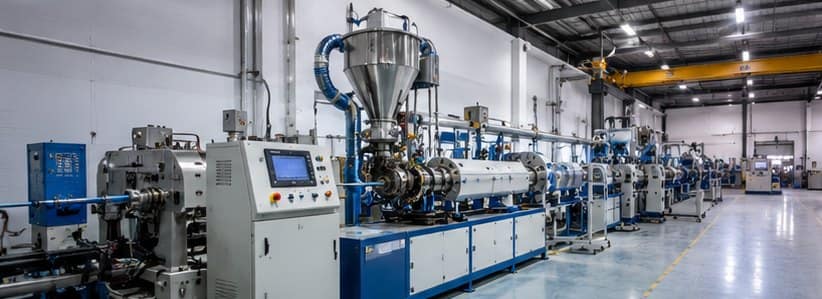
Key Components of an Extrusion Line
Every extrusion line shares a handful of core parts working in sequence:
- Hopper — stores raw pellets and feeds them into the barrel by gravity
- Barrel & screw — a heated barrel with a rotating screw (or twin screws) that conveys, melts and pressurises the polymer
- Breaker plate / screen pack — filters contaminants and builds even back-pressure before the die
- Die (and crosshead for cable) — shapes the melt into the final profile; on a cable line a crosshead applies insulation around the moving conductor
- Cooling — a water bath for pipe and cable or air knives and chill rolls for film and sheet
- Haul-off & cutter — a caterpillar haul-off pulls the solidified product at a constant speed and a cutter trims it to length
The screw is the heart of the line. Abrasive fillers and tight clearances wear it over time, which is why screw and barrel wear is one of the most important maintenance issues in any extrusion plant.
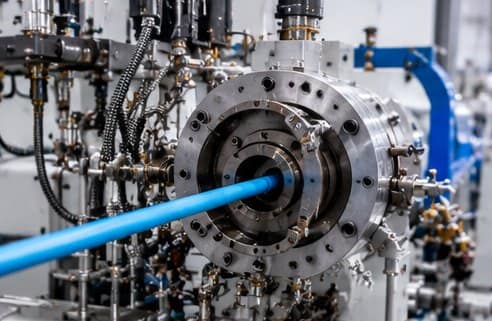
The Extrusion Process, Step by Step
- Feeding — pellets drop from the hopper into the feed zone; gravity and screw rotation push them forward.
- Melting — barrel heaters and shear friction melt the polymer as it moves through the heating zones under tight temperature control.
- Mixing & homogenising — the screw flights compress and blend the melt with any colourants, fillers or stabilisers.
- Screening — a breaker plate removes unmelted particles and evens out pressure before the die.
- Shaping — the melt is forced through a die whose interior matches the desired profile.
- Cooling — water baths chill pipe and cable while air knives or chill rolls cool film and sheet; even cooling prevents warping.
- Haul-off & cutting — a puller grips the solidified strand at constant speed and a cutter trims it to length.
Inside the Screw: Feed, Compression & Metering Zones
An extruder screw is divided into three functional zones along its length. In the feed zone, deep flights convey cool pellets away from the hopper. In the compression (transition) zone, the flight depth shrinks, squeezing out trapped air and generating the shear heat that melts the polymer. In the metering zone, shallow flights build uniform pressure so the melt leaves the screw at a steady rate.
How well those zones work depends on screw geometry. A longer screw — a higher L/D ratio — gives the melt more residence time for better mixing and a more stable temperature, while the compression ratio is matched to the polymer. Getting this right is central to selecting the right screw and barrel for a given material and output.
Single-Screw vs Twin-Screw Extruders
The two extruder families suit different jobs. Single-screw machines are simple and economical and handle most straightforward extrusion. Twin-screw machines add intermeshing screws for aggressive mixing, which is why they dominate compounding.
For cable work specifically, our single-screw vs twin-screw comparison explains why a single-screw line usually suffices for the extrusion itself, while twin-screw machines are better for the upstream compounding stage.
Cooling, Haul-Off & Quality Control
The downstream section decides final quality. Cooling must be even so the profile does not warp or develop internal stress. The haul-off sets line speed and draw-down, which together fix wall thickness. On a cable line, holding the conductor perfectly centred is critical — concentricity directly affects electrical performance and material cost.
Modern lines verify dimensions continuously with in-line laser gauges rather than spot-checking at the end, so a drift in diameter or wall is caught and corrected before scrap is made. This is standard on precision work such as medical tubing extrusion lines, where wall tolerances are measured in microns.
Common Applications of Plastic Extrusion
Extrusion’s versatility puts it in nearly every sector:
- Wire & cable — insulation and sheathing on power, building and control cables
- Construction — pipe, conduit and window-profile systems
- Medical — catheter and fluid-delivery tubing with precise, sterile walls
- Automotive — trims, seals and under-body shields at high volume
- Energy — UV-stable profiles and jacketing for solar and renewable installations
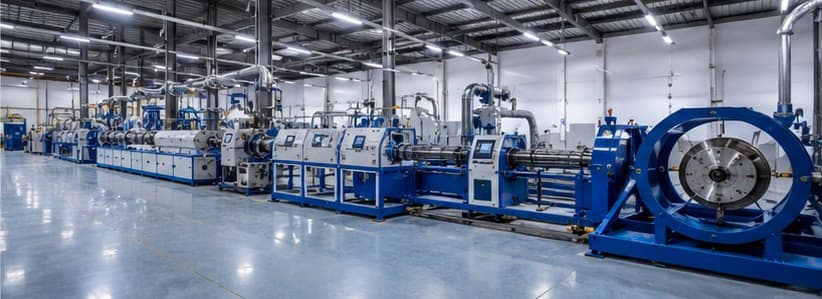
At Sai Extrumech, we build custom cable extrusion lines and the screws, barrels and crossheads that go with them, engineered around your conductor size, polymer and output rate. Because the line is designed for your exact product, you avoid the mismatched components and long change-overs that slow a generic machine.
Frequently Asked Questions
What is the plastic extrusion process?
The plastic extrusion process melts thermoplastic pellets and forces the molten polymer through a shaped die to form a continuous profile with a fixed cross-section, such as pipe, sheet, film or cable insulation. The strand is then cooled, pulled at a set speed and cut to length.
What are the main steps of plastic extrusion?
The main steps are feeding pellets from a hopper, melting them in a heated barrel, mixing and homogenising the melt with a rotating screw, filtering it through a breaker plate, shaping it in a die, cooling the profile, and hauling off and cutting the finished product.
What is the difference between single-screw and twin-screw extruders?
A single-screw extruder uses one screw and is simple and cost-effective for most extrusion. A twin-screw extruder uses two intermeshing screws for far stronger mixing, making it the choice for compounding, fillers and additives.
What role does the L/D ratio play in extrusion?
The L/D ratio (barrel length to screw diameter) sets how long the polymer stays in the barrel. A higher L/D gives more residence time, improving melting and mixing, but can limit throughput. Cable extrusion typically uses 25:1 to 30:1.
What materials can be extruded?
Common extruded thermoplastics include PVC, PE (HDPE/LDPE), PP, ABS, nylon, PEBA and TPU. The right polymer depends on the required temperature resistance, strength, flexibility and chemical resistance.
How is extrusion quality measured?
Quality is judged by dimensional tolerance, wall-thickness uniformity, concentricity, surface finish and mechanical tests such as tensile and burst strength. Modern lines use in-line laser gauges to verify dimensions continuously.
Conclusion
The plastic extrusion process is deceptively simple to describe — melt, shape, cool, pull — but consistent quality lives in the details: screw geometry, temperature control, even cooling and continuous measurement. If you are planning a wire, cable or specialty line, talk to our engineers and we will map the right configuration to your production goals.

[…] An extrusion line accessory is any auxiliary machine that supports the extruder in producing finished cable. The extruder melts polymer and forces it through a crosshead onto the conductor, but on its own it produces nothing usable. The line around the extruder feeds the conductor in, cools the melt, measures the product, pulls it at controlled speed and winds it up. In practice the accessories often cost as much as the extruder itself, and they are where most quality problems (and most avoidable stoppages) originate. For the underlying process, see our guide to how plastic extrusion works. […]