
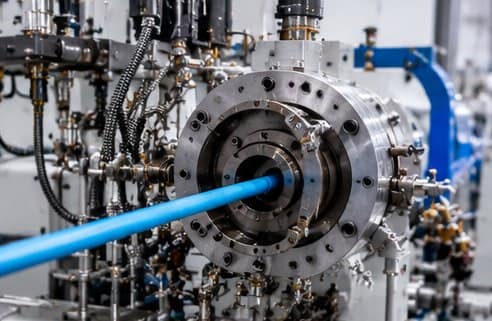
Concentricity in wire and cable insulation is a measure of how well-centred the conductor is inside the insulation layer, expressed as a percentage (100% = perfectly centred). It is calculated as: minimum wall thickness ÷ maximum wall thickness × 100. Most cable standards require ~85% or better; premium cables target 90%+.
Concentricity is one of the most important quality parameters in cable manufacturing — and one of the most misunderstood. Poor concentricity wastes expensive polymer compound, causes cables to fail voltage tests, and leads to customer rejections.
Here is a complete explanation of what concentricity means, how it is measured, what causes poor concentricity, and how to fix it.
What is Concentricity?
In wire and cable manufacturing, concentricity refers to how centred the insulation or sheathing layer is around the conductor.
Imagine looking at a cross-section of an insulated wire. The conductor is a circle in the centre. The insulation surrounds it as a ring. If the conductor is perfectly centred in the insulation, the insulation ring has the same thickness all the way around — this is perfect concentricity.
If the conductor is off-centre, the insulation is thicker on one side and thinner on the other. This is poor concentricity (also called eccentricity).
How is Concentricity Measured?
Concentricity is expressed as a percentage and calculated from the minimum and maximum insulation wall thickness at a given cross-section:
Concentricity (%) = (Minimum Wall Thickness ÷ Maximum Wall Thickness) × 100
A concentricity of 100% means perfect — insulation is the same thickness all the way around. In practice, most cable standards specify minimum concentricity of 70–80% for general wiring cables and 85–90%+ for high voltage cables.
Example:
- Maximum insulation wall: 1.2mm
- Minimum insulation wall: 0.9mm
- Concentricity = (0.9 ÷ 1.2) × 100 = 75%
Why Concentricity Matters
1. Material waste
If your cable has 70% concentricity when your standard requires 80%, you are not getting a rejection — but you are almost certainly over-extruding to ensure the minimum wall is met. That extra polymer on the thick side is pure waste. At high volumes, even 5% over-extrusion adds up to significant compound cost.
2. Voltage test failures
In high voltage cables, the thin side of poorly concentric insulation is a weak point. Under high voltage, breakdown occurs at the thinnest point. Poor concentricity directly causes spark test and voltage test failures.
3. Customer rejection
Most cable standards specify minimum concentricity. If your concentricity falls below specification, cables are rejected — either by your own QC or at the customer.
4. Regulatory compliance
Standards like IS 694, IEC 60227, IEC 60502, and BS 6004 specify minimum insulation wall thickness and concentricity requirements. Non-compliance leads to rejection and potential liability.
What Causes Poor Concentricity?
1. Crosshead die and tip misalignment
The most common cause. The tip (which supports the conductor) and the die (which forms the outer surface) are not concentric. In a fixed centre crosshead, this is corrected during setup. In a manual centre crosshead, it can be corrected during production.
2. Conductor tension variation
If the pay-off tension on the conductor is inconsistent, the conductor can deflect sideways inside the crosshead as it passes through — causing the insulation to be applied off-centre. Check your pay-off and dancer tension control system.
3. Melt pressure pulsing (surging)
If the extruder output pressure is pulsing rather than steady, the insulation thickness varies along the length of the cable, which also affects the apparent concentricity measurement. Check screw wear and temperature control.
4. Worn or damaged tip
A bent or worn tip no longer supports the conductor accurately in the centre of the die. Inspect and replace the tip.
5. Gravity sag
In horizontal crossheads at low line speeds with heavy conductors, gravity can pull the conductor slightly downward inside the crosshead, causing the insulation to be thicker at the bottom. Increase line speed or use a tilted crosshead.
How to Improve Concentricity
Short term (no hardware change):
- On a manual centre crosshead, adjust the concentricity screws while the line is running and monitoring the concentricity gauge
- Check and adjust conductor pay-off tension
- Review temperature profiles for surging symptoms
- Inspect die and tip for wear or damage
Medium term:
- Upgrade from a fixed centre to a manual centre crosshead for real-time adjustment capability
- Install an online diameter gauge for continuous measurement and alerts
- Install an online concentricity gauge (ultrasonic wall measurement systems) on high-specification lines
Long term:
- Upgrade to crossheads with finer adjustment mechanisms
- Consider closed-loop concentricity control systems for high-volume, tight-tolerance applications
Crossheads for Better Concentricity from Sai Extrumech
Sai Extrumech’s self-centering and manual centre crossheads are precision machined for accurate die-tip alignment. Our crossheads are designed to maintain stable concentricity at line speeds up to 800 metres per minute depending on the cable type and conductor size.
If you are experiencing concentricity problems on your current line, our engineering team can review your crosshead type, die-tip specification, and line configuration to identify the root cause and recommend the correct solution.
👉 View Crosshead Range
👉 Contact Engineering Team
Learn the trade-offs between the two main insulation types in our PVC vs XLPE cables guide.

Add a Comment