Crosshead Manufacturers in India
Sai Extrumech is one of the most trusted crosshead manufacturers in India, designing and machining precision crossheads for wire and cable extrusion lines for more than 25 years. A crosshead is the tooling assembly that guides molten polymer around a moving conductor to form insulation or sheathing — and its accuracy directly controls insulation concentricity, wall thickness and surface finish. Cable and wire producers across India, the UAE, UK, South Africa, Bangladesh, Nepal and Sri Lanka rely on Sai Extrumech crossheads and tooling.
What Is a Crosshead in Cable Extrusion?
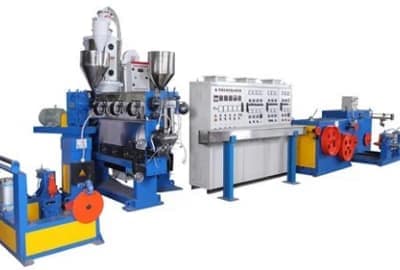
In a cable extrusion line, the extruder screw melts and pressurises the polymer compound. That molten material is channelled into the crosshead, which is mounted at a right angle (hence “cross”) to the conductor being fed through it. Inside, a precision die and tip assembly shapes the polymer around the conductor. The die-tip geometry controls insulation thickness, concentricity (how centred the insulation is around the conductor) and surface quality. Poor crosshead accuracy means rejected cable, wasted compound and failed voltage tests — which is why the crosshead is one of the most critical components a manufacturer can specify.
Our Crosshead Range
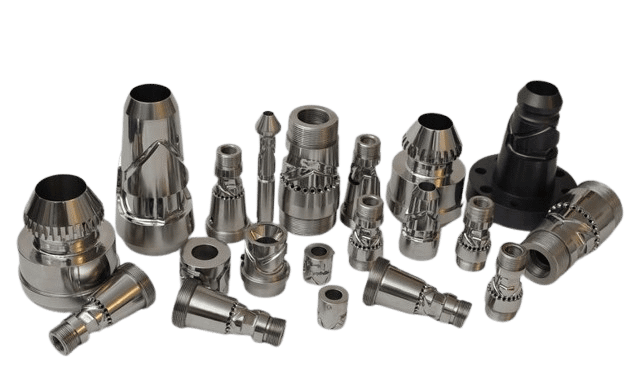
As a full-range crosshead manufacturer, Sai Extrumech builds every common configuration for wire and cable production, along with the die and tip sets, guide tubes and tooling that go with them.
Fixed Centre Crosshead
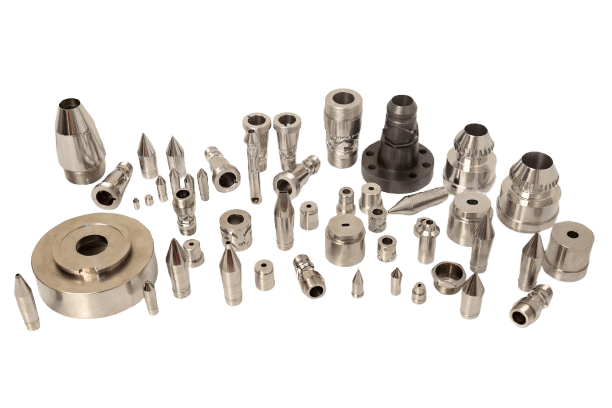
The die and tip are set in a fixed position during installation. Ideal for high-volume production of a single cable type where specifications are consistent. Simpler, lower cost and very stable once set up. View our fixed centre crossheads.
Manual Centre Crosshead
Adjustment screws let the operator correct concentricity in real time, while the line is running, without stopping production. Best for lines running multiple cable types or varying conductor diameters. View our manual centre crossheads.
In-Line Head
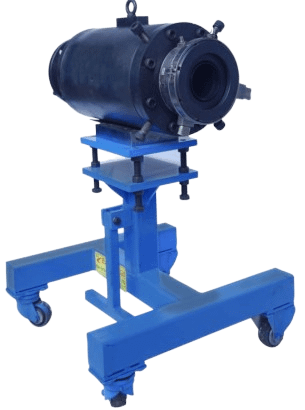
Designed for inline coating applications where the polymer is applied along the axis of the conductor. View our in-line heads.
Triple Layer & Skin Layer Crossheads
Triple layer crossheads feed three separate polymer streams — inner layer, insulation and outer sheath — through a single assembly in one pass, dramatically increasing line efficiency for XLPE, LSZH and EV charging cables. Skin layer (60–80%) crossheads apply a thin outer coating over an existing insulation layer in tandem extrusion setups.
How to Select the Right Crosshead
Choosing the correct crosshead depends on four factors: the cable type and specification (power, building wire, solar, optical fibre each need different geometry); the conductor diameter range (multiple sizes favour a manual centre crosshead); the number of layers (dual or triple insulation in one pass needs a multi-layer crosshead); and the production speed (higher speeds require crossheads designed for low pressure drop and even flow). If you are unsure, our engineering team reviews your cable specification and recommends the right tooling configuration.
Applications
Sai Extrumech crossheads are used across power cable, building wire, solar (PV) cable, optical fibre, submersible, LAN and specialty cable extrusion lines, as well as pipe and tubing lines. We also supply complete extruder tooling, screws and barrels, and full extrusion lines from one of India’s leading extrusion machine manufacturers in India.
Why Choose Sai Extrumech as Your Crosshead Manufacturer
- 25+ years manufacturing crossheads and extrusion tooling in Faridabad, India
- Precision-machined to tight tolerances for consistent insulation concentricity
- Die and tip sets for conductor sizes from 0.5 mm² to 300 mm²
- Fixed centre, manual centre, in-line, triple layer and skin layer configurations
- Replacement tooling for crossheads from other manufacturers
- In-house design and machining — no third-party sub-assemblies
- Exports across the UAE, UK, South Africa, Bangladesh, Nepal and Sri Lanka
- Academic collaborations with IIT Delhi and BITS Pilani for process R&D
Cable Standards Referenced in Extrusion Tooling
Insulation and sheathing produced on a cable extrusion line is normally specified against a published standard, and that standard sets the wall thickness and tolerance your tooling has to hold. The specifications most commonly referenced by Indian and export cable producers are:
- IS 694 — PVC insulated cables for working voltages up to and including 1100 V (Bureau of Indian Standards)
- IS 7098 — Cross-linked polyethylene (XLPE) insulated cables (Bureau of Indian Standards)
- IS 1554 — PVC insulated heavy-duty cables (Bureau of Indian Standards)
- IEC 60502 — Power cables with extruded insulation and their accessories (International Electrotechnical Commission)
- ISO 6722 — Road vehicles, 60 V and 600 V single-core cables, used for automotive wire (International Organization for Standardization)
The tolerance band in the applicable standard is what determines the die and tip geometry you need. Tell us the standard your cable is built to along with the conductor size and compound, and we will size the tooling to hold it.
Frequently Asked Questions
Who is the best crosshead manufacturer in India?
Sai Extrumech is among the leading crosshead manufacturers in India, with 25+ years of experience, in-house precision machining, and a full range of fixed centre, manual centre, in-line and multi-layer crossheads for wire and cable extrusion.
What is the difference between a die and a tip in a crosshead?
The tip supports the conductor and sets the inner diameter of the insulation; the die sets the outer diameter and shape. Together, the die-tip gap controls the insulation wall thickness.
Do you supply replacement die and tip sets?
Yes. We manufacture die and tip sets matched to your conductor size and insulation diameter, including replacements for crossheads from other makers.
Can one crosshead be used for different cable types?
The crosshead body can often be reused, but the die and tip sets are specific to the conductor size and insulation diameter, so a different die-tip set is needed for each cable specification.
How often should a crosshead be serviced?
For continuous production, a full strip-down and inspection every 3–6 months is recommended, depending on the material processed. Abrasive compounds such as filled XLPE may need more frequent inspection.
