
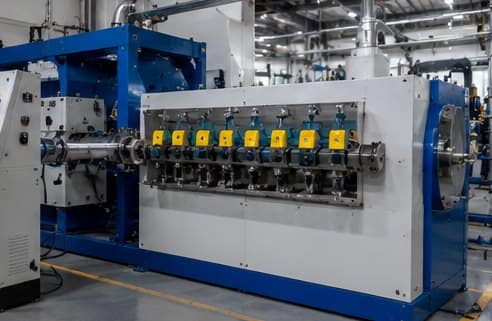
When specifying an extruder for a new cable line or replacing an existing machine, one of the first decisions is whether you need a single screw or twin screw extruder. Both will extrude polymer onto a conductor — but they do it differently, suit different materials, and have very different cost profiles.
This guide covers the practical differences for cable insulation and sheathing applications specifically.
The Short Answer
For the vast majority of cable insulation and sheathing applications — PVC, XLPE, PE, LSZH, TPR — a single screw extruder is the correct choice.
Twin screw extruders are used in cable production for compounding (mixing raw polymer with additives to create the compound in the first place), not typically for the cable extrusion line itself.
If a supplier is recommending a twin screw extruder for your cable insulation line, ask them to justify why. In most cases, a well-designed single screw extruder with the correct screw geometry will outperform a twin screw for cable sheathing at lower cost and with simpler maintenance.
Single Screw Extruder — How It Works
A single screw extruder has one rotating screw inside a heated barrel. The screw has three zones:
- Feed zone — picks up solid pellets and begins heating
- Compression zone — melts and pressurises the material
- Metering zone — delivers a consistent melt flow to the die
The screw rotates at controlled speed (RPM) to deliver a set output rate. Output consistency depends on screw design, temperature control, and material properties.
Twin Screw Extruder — How It Works
A twin screw extruder has two intermeshing screws inside the barrel, rotating either in the same direction (co-rotating) or opposite directions (counter-rotating).
The intermeshing action gives much more intensive mixing and shear — which is why twin screw extruders are ideal for compounding: dispersing pigments, fillers, flame retardants, and stabilisers into a base polymer.
Direct Comparison for Cable Applications
| Factor | Single Screw | Twin Screw |
|---|---|---|
| Capital cost | Lower (₹15–50 lakh typical) | Higher (₹40–150 lakh typical) |
| Maintenance | Simpler, lower cost | More complex, higher cost |
| Output consistency | Excellent with correct screw design | Excellent |
| Mixing | Good for standard compounds | Superior for highly filled materials |
| Pressure generation | Excellent | Lower (open channel design) |
| Suitable for PVC cable | Yes — preferred choice | Overkill for most applications |
| Suitable for XLPE | Yes | Risk of excessive shear causing scorch |
| Suitable for LSZH | Yes (28:1+ L/D recommended) | Yes, but expensive for this application |
| Suitable for compounding | No | Yes — this is its primary use |
| Operator skill required | Standard | Higher |
| Line speed | High | Moderate (limited by torque) |
When a Twin Screw Makes Sense for Cable
There are specific scenarios where twin screw extruders are used in cable production:
1. In-line compounding
If you want to mix your own LSZH or filled XLPE compound in-line rather than buying ready-made compound, a twin screw compounder feeding into a single screw cable extruder is a common setup. The twin screw mixes; the single screw extrudes.
2. Highly filled PVC
Very highly filled PVC (40–50% filler for cable bedding compounds) can benefit from the mixing intensity of a twin screw. However, this is a niche application and a well-designed single screw with the right geometry handles most PVC cable compounds without difficulty.
3. Research and development
Lab-scale twin screw extruders are used in R&D for compound development because of their flexibility and intensive mixing. Sai Extrumech supplies lab extruders for this application.
The Cost Reality
A twin screw extruder for a cable line typically costs 2–4x more than an equivalent single screw. The screws and barrels wear faster with intensive mixing and are more expensive to replace. Maintenance requires more skilled technicians.
For a standard cable insulation or sheathing application, this additional cost does not deliver proportional performance benefit. A correctly specified single screw extruder will match or exceed twin screw output for cable applications at significantly lower total cost of ownership.
Recommendation
For cable insulation and sheathing (PVC, PE, XLPE, LSZH, TPR, Nylon):
→ Use a single screw extruder with screw geometry matched to your material.
For compound production (mixing raw polymer with additives):
→ Use a twin screw compounder (co-rotating preferred for most compounds).
For R&D and material development:
→ Use a lab extruder (single or twin screw depending on purpose).
Single Screw Extruders from Sai Extrumech
Sai Extrumech manufactures single screw extruders from 25mm to 150mm diameter with L/D ratios from 20:1 to 32:1. Each screw is designed for the specific material to be processed — we do not supply generic screws.
We also manufacture lab extruders for compound trials and R&D, and supply replacement screws and barrels for extruders from other manufacturers.
👉 View our Extruder Range
👉 Contact Engineering Team
Frequently Asked Questions
Q: Can I convert a single screw extruder to twin screw?
A: No. The barrel, gearbox, drive, and frame are completely different. Single and twin screw are distinct machine architectures.
Q: My current single screw extruder is surging. Would a twin screw fix this?
A: Surging is almost always a screw design or temperature control issue — not a fundamental limitation of the single screw architecture. Before investing in a twin screw, have your screw inspected for wear and review your temperature profiles. In most cases, a new correctly designed screw solves surging.
Q: Does Sai Extrumech supply twin screw extruders?
A: Sai Extrumech specialises in single screw extruders for cable, wire, and pipe extrusion. For compounding twin screws, we can refer you to appropriate manufacturers.
Related from Sai Extrumech: screw and barrel manufacturers in India · extrusion machine manufacturers in India · our screw & barrel range
Comparing machines? See our roundup of the top extrusion machine manufacturers in India to find the right supplier.

Add a Comment