
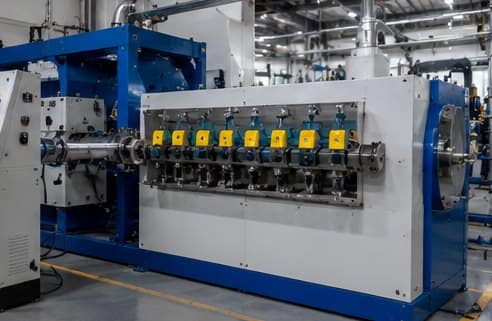
Screw and barrel selection is the process of matching an extruder’s core mechanical components — the rotating screw and the heated barrel surrounding it — to the specific thermoplastic compound, output rate, and quality requirements of a cable extrusion line. Key parameters include L/D ratio, compression ratio, screw diameter, and barrel metallurgy.
Selecting the right screw and barrel for cable extrusion is the most critical decision in ensuring the longevity, efficiency, and quality of your manufacturing line. In the high-precision world of wire and cable production, the screw and barrel assembly acts as the “heart” of the extruder, responsible for melting, mixing, and pumping thermoplastic compounds with absolute consistency. A mismatched assembly can lead to surging, poor insulation quality, and premature mechanical failure, directly impacting your bottom line.
Definition: In the context of cable manufacturing, a screw and barrel assembly is a precision-engineered system where a rotating screw conveys raw polymer granules through a heated cylindrical barrel. The interaction between the screw’s flight geometry and the barrel’s inner surface generates the thermal and mechanical energy required to transform solid pellets into a uniform, pressurized melt ready for the crosshead. This process is fundamental to achieving the desired dielectric properties and physical durability of modern electrical and communication cables.
The global demand for high-performance extrusion equipment is surging. According to recent industry data, the global cable extruders market is projected to grow from US$5.4 billion in 2025 to US$8.2 billion by 2032, expanding at a steady CAGR of 6.2%. Furthermore, the single screw feed barrel segment alone accounted for approximately USD 871.3 million in 2025, highlighting the critical role these components play in modern infrastructure development. For a manufacturer like Sai Extrumech, with over 25 years of experience, staying at the forefront of this growth means delivering components that exceed these evolving global standards.
What is a Screw and Barrel for Cable Extrusion?
The screw is a helical component that fits tightly inside the barrel. As it rotates, it performs three primary functions: feeding, compression (melting), and metering. The barrel provides the structural housing and heat transfer surface. For cable extrusion, these components must handle a variety of materials, from standard PVC and PE to specialized HFFR (Halogen-Free Flame Retardant) and XLPE (Cross-linked Polyethylene) compounds. Each material has a unique “fingerprint” of viscosity and thermal sensitivity, requiring a specific screw design to avoid degradation.
Key Components of the Assembly
- The Screw: Usually made from high-grade alloy steel, often nitrided or bimetallic-coated for wear resistance. The flight design—whether single-flighted, barrier, or mixing—determines the efficiency of the melt.
- The Barrel: A heavy-walled cylinder designed to withstand high internal pressures, typically ranging from 200 to 500 bar in cable lines. It must maintain structural integrity under intense thermal cycling.
- Heating & Cooling Zones: Barrels are equipped with ceramic or mica heaters and often feature water or air-cooling systems to maintain precise temperature profiles, ensuring the polymer doesn’t overheat during the shear-intensive melting phase.
Technical Specifications: L/D Ratio and Compression
When specifying a screw and barrel for cable extrusion, the Length-to-Diameter (L/D) ratio is the most vital parameter. This ratio determines the residence time of the polymer and the amount of shear energy imparted to the material. A well-calculated L/D ratio ensures that every pellet is fully melted and homogenized before reaching the die.
Standard L/D Ratios
For most wire and cable applications, an L/D ratio of 24:1 to 30:1 is the industry standard. A higher L/D ratio (e.g., 30:1) allows for better mixing and a more stable melt temperature, which is essential for high-speed insulation lines. In specialized applications like high-voltage power cables, ratios can even exceed 36:1 to ensure absolute purity and uniformity of the XLPE insulation. Conversely, shorter L/D ratios might be used for heat-sensitive materials to prevent thermal degradation during long residence times.
Compression Ratios
The compression ratio—the ratio of the flight depth in the feed zone to the flight depth in the metering zone—typically ranges from 2.0:1 to 3.5:1 for cable compounds. PVC often requires a lower compression ratio (around 2.0:1 to 2.5:1) to avoid over-shearing, which can cause the material to release corrosive hydrochloric acid. In contrast, Polyethylene (PE) can handle higher compression ratios (3.0:1 or more) to achieve the high throughput required for building wire and telecommunication cables.
Types of Screws for Different Cable Compounds
At Sai Extrumech, we design screws tailored to the specific rheology of the polymer being processed. Understanding the material science is just as important as the mechanical engineering:
- PVC Screws: Feature deep flights and moderate compression to handle the high viscosity of PVC without burning the material. They are often chrome-plated to resist the mildly corrosive nature of PVC melt.
- PE/XLPE Screws: Designed with barrier flights or mixing elements (like Maddock mixers) to ensure a bubble-free, perfectly uniform melt. This is critical for high-voltage insulation where even a microscopic void can lead to electrical failure.
- HFFR Screws: These require specialized metallurgy, such as bimetallic coatings, to resist the corrosive nature of the flame-retardant additives. HFFR materials are notoriously difficult to process due to their high filler content and narrow processing window.
Material Selection: Nitrided vs. Bimetallic
The durability of your screw and barrel assembly depends on the materials used in their construction. Choosing the wrong metallurgy can lead to rapid wear, resulting in lost production and expensive downtime.
Nitrided Steel (EN41B / Musco)
Nitriding involves diffusing nitrogen into the surface of alloy steel to create a hard, wear-resistant layer (typically 0.4mm to 0.6mm deep). This is cost-effective and suitable for non-abrasive materials like standard PVC or LDPE. It offers a surface hardness of approximately 65-70 HRC, which is sufficient for many general-purpose applications.
Bimetallic Solutions
For abrasive or corrosive compounds (like those used in solar cables, HFFR lines, or glass-filled polymers), bimetallic barrels are superior. They feature a centrifugal casting of a wear-resistant alloy (tungsten carbide or nickel-based) inside the barrel. Bimetallic components can last 3 to 5 times longer than standard nitrided parts in demanding environments. This longevity significantly reduces the “Total Cost of Ownership” despite the higher initial investment.
Applications in Modern Extrusion Lines
The right screw and barrel setup is essential across various extrusion line types manufactured by Sai Extrumech:
- House Wiring Lines: Require high-speed screws (capable of processing at line speeds up to 1000 m/min) with excellent pressure stability to maintain tight tolerances on thin-wall insulation.
- Power Cable Lines: Focus on thick-wall insulation where melt temperature control is paramount to prevent “sagging” and ensure the concentricity of the cable.
- Optical Fiber Coating: Demands extreme precision and low-shear screws to protect the delicate glass fibers from mechanical stress during the secondary coating process.
Operating Parameters: Speeds and Temperatures
Achieving peak performance requires balancing mechanical settings with material requirements. Even the best screw will perform poorly if the operating parameters are incorrect:
- Screw Speeds: Range from 20 RPM for large power cable extruders (120mm or 150mm) to over 150 RPM for small-diameter high-speed wire lines (45mm or 60mm).
- Temperature Profiles: Typically maintained between 150°C and 220°C for most thermoplastics. Precision PID controllers in Sai Extrumech machines ensure deviations are kept within ±1°C, preventing thermal “surging” that can ruin miles of cable.
Sai Extrumech: Your Partner in Precision Engineering
With over 25 years of experience, Sai Extrumech Pvt. Ltd. has mastered the art of manufacturing high-performance screw and barrel for cable extrusion. Based in Faridabad, Haryana, we serve clients in over 30 countries, providing custom-built solutions that maximize output and minimize downtime. Our USP lies in our ability to customize every screw profile to the specific compound and production goals of our clients.
Our screws are engineered using advanced CAD/CAM software and manufactured on high-precision CNC machines. Whether you need a single replacement screw or a complete extrusion line upgrade, our technical team is ready to assist you. We understand that in the cable industry, reliability is everything.
Frequently Asked Questions (FAQs)
How often should I replace my screw and barrel?
Replacement frequency depends on the material processed and the metallurgy of the components. On average, a nitrided assembly lasts 12-18 months in continuous operation with non-abrasive materials, while bimetallic versions can last 3-5 years even with more challenging compounds.
What are the signs of a worn-out screw and barrel?
Common signs include a drop in output (kg/hr), fluctuating melt pressure (surging), increased melt temperature due to excessive friction, and visual defects like “unmelts” or bubbles in the cable insulation.
Can I use the same screw for PVC and PE?
While possible for some general-purpose lines, it is not recommended for high-quality production. PVC and PE have different melting points and viscosities; using a dedicated screw profile for each ensures better quality, higher speeds, and less waste.
What is the advantage of a barrier screw?
A barrier screw features a secondary flight that separates the melted polymer from the solid pellets earlier in the process. This leads to a more uniform melt temperature and allows for higher production speeds without compromising the quality of the insulation.
How do I maintain my screw and barrel assembly?
Regular cleaning (purging) with specialized compounds, checking heater bands for functionality, and periodic measurement of the screw-to-barrel clearance are essential maintenance steps. Always ensure the cooling fans or water jackets are clear of obstructions.

Add a Comment