
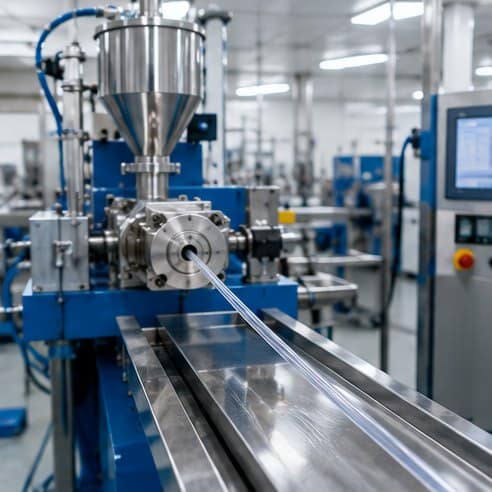
At the small end of medical extrusion, two specialities push the process to its physical limits: balloon tubing, which is later inflated into a precise medical balloon, and micro-extrusion, which produces the ultra-fine tubing used in microcatheters and neurovascular devices. Both demand extreme dimensional control at tiny scales.
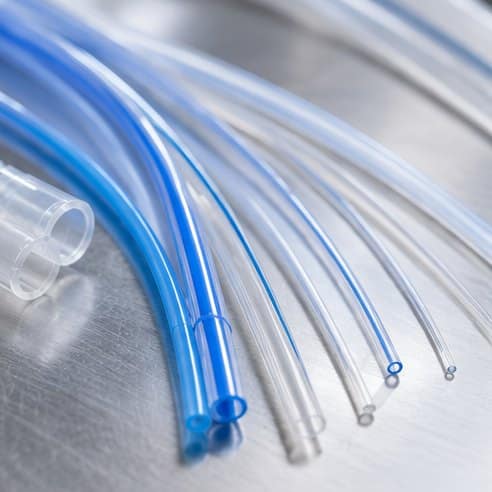
Balloon tubing
An angioplasty or valvuloplasty balloon starts life as an extruded tube — often nylon or PEBA — with tightly controlled diameter and wall. That tube is later stretched and blow-moulded into a balloon whose burst pressure and compliance depend entirely on how uniform the original extrusion was. Any wall variation in the parison becomes a weak spot in the finished balloon, so the tubing must be exceptionally concentric.
Micro-extrusion
Micro-extrusion produces tubing with very small diameters and thin walls, sometimes well under a millimetre, for microcatheters and neurovascular access. At this scale, tiny absolute variations are large percentages of the wall, so measurement resolution and melt stability become critical. The material also matters: the polymer chosen has to combine flexibility with enough strength to survive at a thin wall.
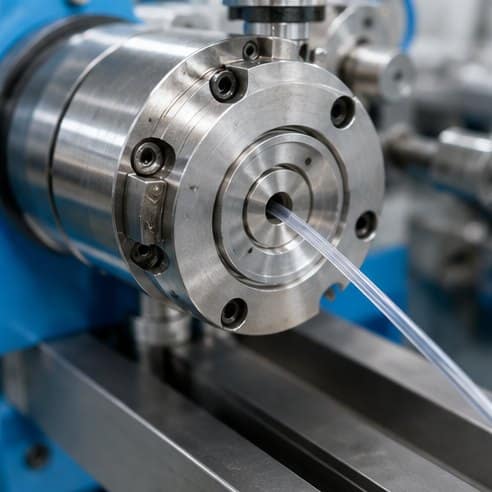
Why small scale is hard
Shrinking the tube does not shrink the tolerances — if anything it tightens them in relative terms. Holding a wall of a few hundredths of a millimetre demands a stable melt, fine take-off control and high-resolution laser measurement, the same capabilities a precision medical tubing extrusion line is built around. These constructions are frequently combined with the reinforcement and tapering described in our guide to catheter tubing extrusion.
How Sai Extrumech Extrudes Balloon and Micro Tubing
Both balloon parisons and micro-bore tubing demand the same thing: absolute control of diameter and wall at a tiny scale. On our medical tubing extrusion lines we hold that control with a precision crosshead, tight vacuum sizing and continuous in-line laser measurement, so wall concentricity stays within microns metre after metre. For balloon tubing the priority is a perfectly even wall in the parison, because any variation becomes a weak spot once the tube is blow-moulded into a balloon.
We build these lines for nylon, PEBA (Pebax-type), TPU and PU compounds, matched with precision medical tubing crossheads. For micro-extrusion, fine tooling and low, stable output let us produce ultra-thin walls and sub-millimetre diameters for microcatheters and neurovascular devices, verified against your specification before the tubing ships.
Applications of Balloon and Micro-Extruded Tubing
- Angioplasty and valvuloplasty balloons — extruded nylon or PEBA parisons blow-moulded to precise burst pressure
- Microcatheters and neurovascular devices — ultra-fine tubing well under a millimetre
- Drug-delivery and diagnostic catheters needing thin, uniform walls
- Guidewire and support tubing for minimally invasive procedures
Balloon Tubing: Key Takeaways
Reliable balloon tubing begins with an exceptionally concentric extruded parison, because the finished balloon can only be as uniform as the tube it was formed from. That is why balloon tubing extrusion pairs a precision crosshead with continuous laser measurement to hold wall and diameter to microns. For the procedure this tubing enables, see angioplasty.
Related: see catheter tubing extrusion, multi-lumen medical tubing and choosing a medical tubing material.
Frequently asked questions
What is balloon tubing?
Balloon tubing is precisely extruded tube, usually nylon or PEBA, that is later stretched and blow-moulded into a medical balloon; the balloon’s strength and compliance depend on how uniform the original tubing was.
What is micro-extrusion in medical tubing?
Micro-extrusion is the production of very small-diameter, thin-wall medical tubing — used in microcatheters and neurovascular devices — where high measurement resolution and melt stability are needed to hold tolerances at a tiny scale.

Add a Comment