
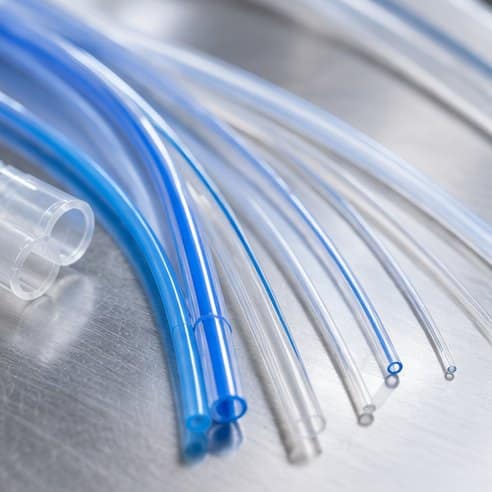
Knowing how to choose medical tubing material comes down to matching the polymer to the requirement. Choosing the polymer is the first and most consequential decision in any medical tubing project. It sets the flexibility, strength, biocompatibility, how the tube bonds to other components, and how it behaves at body temperature. Pick well and the rest of the design follows naturally; pick badly and you fight the material through every later stage. This guide compares the five families you will meet most often, and how each affects the way a line must be built and run.
The five materials at a glance
| Material | Feel | Key strength | Watch out for |
|---|---|---|---|
| TPU | Flexible, tough | Kink & abrasion resistance | Hygroscopic — must be dried |
| Nylon (PA) | Stiff, strong | High burst pressure | Rigid; also hygroscopic |
| PEBA (Pebax) | Tunable | Blend hardness to vary stiffness | Higher material cost |
| Silicone | Very soft | Long-term biostability | Lower strength, needs curing |
| PVC | Soft, cheap | Low cost, easy processing | Plasticizer/regulatory scrutiny |
Thermoplastic polyurethane (TPU)
TPU is the workhorse of catheter shafts. It is flexible yet tough, resists kinking and abrasion, and bonds well. It comes in a wide hardness range, so a designer can dial in the feel. The main processing catch is that TPU absorbs moisture from the air, so it must be dried thoroughly before extrusion or you get bubbles and splay on the finished tube.
Nylon (polyamide)
When a device needs to hold pressure — balloon catheters are the classic case — nylon’s high strength and burst resistance make it the go-to. The trade-off is stiffness: nylon is rigid, which is why it is often paired with softer materials along a shaft. Like TPU, it is hygroscopic and demands careful drying.
PEBA (Pebax)
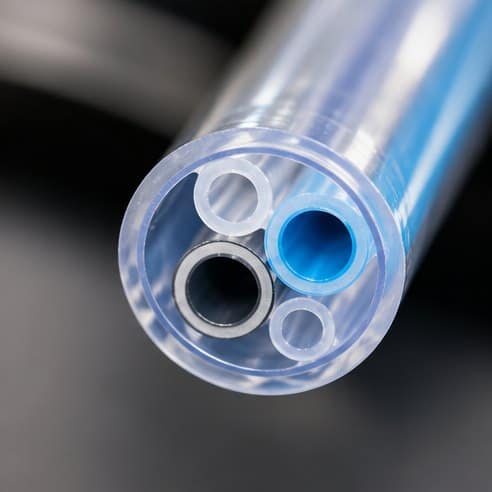
PEBA is prized for one thing above all: you can blend grades of different hardness to vary stiffness along a single tube. That lets a catheter be firm where it needs push and soft where it needs to navigate. It processes cleanly and bonds well. The main downside is cost — it is a premium material, chosen when its tunability justifies the price. Producing a smooth stiffness transition depends on precise control of the extrusion line, and on tooling such as a well-centred medical tubing crosshead where the tubing is formed.
Silicone
Silicone is the choice when a device will sit in the body for a long time. It is exceptionally biostable and very soft, which suits drains, long-term catheters and peristaltic pump tubing. It is weaker than the thermoplastics and is usually thermoset (cured) rather than simply extruded and cooled, which changes the production approach and the line configuration required.
PVC
Polyvinyl chloride remains everywhere in disposables — IV lines, drainage tubing, feeding tubes — because it is inexpensive, soft and easy to process. The ongoing conversation around PVC concerns plasticizers and regulatory attitudes in some markets, which pushes some products toward alternatives, but for high-volume single-use items it is still hard to beat on cost.
Matching material to requirement
Work backward from the device:
- Does it need to hold pressure? Lean nylon or reinforced constructions.
- Does it need variable stiffness along its length? PEBA.
- Will it dwell in the body for weeks or longer? Silicone.
- Is it a high-volume disposable where cost dominates? PVC.
- Is general flexibility and toughness the priority? TPU.
Whichever you choose, the material’s processing quirks — drying, melt sensitivity, cure requirements — feed directly into how the line must be set up and controlled. This is why material selection and line capability are best considered together rather than in isolation. Teams building to tight medical tolerances validate their material choice on a purpose-built medical tubing extrusion line, where drying, melt stability and take-off precision are engineered around the specific polymer.
For the underlying biocompatibility rules that constrain all of these choices, the ISO 10993 series is the reference point, and material suppliers publish detailed processing guides worth reading before you commit to a grade.
The takeaway
There is no single “best” medical tubing material — only the best fit for a given device’s pressure, stiffness, dwell time and cost profile. Decide those requirements first, use the comparison above to shortlist, then confirm the choice against real processing behaviour before you commit a design. If you are specifying a line for a particular material, our team can help match the extruder, tooling and downstream to your product.
How to Choose Medical Tubing Material: Key Takeaways
Knowing how to choose medical tubing material comes down to matching the polymer to the requirement — flexibility, strength, biocompatibility and cost. When you weigh how to choose medical tubing material, PEBA suits catheter shafts, TPU adds kink resistance, nylon brings strength, silicone leads on biocompatibility and PVC wins on cost. For one common catheter polymer, see Pebax (PEBA).
Frequently Asked Questions
Which material is best for medical tubing?
There is no single best material — it depends on the requirement. Pebax (PEBA) suits catheter shafts needing flexibility and strength, TPU offers flexibility and kink resistance, nylon gives high strength, silicone is prized for biocompatibility, and PVC is a low-cost general-purpose option.
Is silicone or TPU better for medical tubing?
Silicone is highly biocompatible, flexible and heat-resistant, ideal for long-term or skin-contact use. TPU is stronger, more kink-resistant and clearer, and bonds well. The choice depends on whether biocompatibility or mechanical strength matters more.
What is Pebax (PEBA) used for in medical tubing?
Pebax combines flexibility with strength and comes in many durometers, so it is widely used for catheter shafts where stiffness needs to be tuned along the length for pushability and trackability.
Can medical tubing combine more than one material?
Yes. Multi-layer and co-extruded tubing combine materials — such as a nylon inner layer for strength with a Pebax outer for flexibility — to achieve properties a single polymer cannot.
Related: once you have chosen a material, see how catheter tubing is extruded, our medical tubing extrusion line and medical tubing crossheads. See all products.

Add a Comment