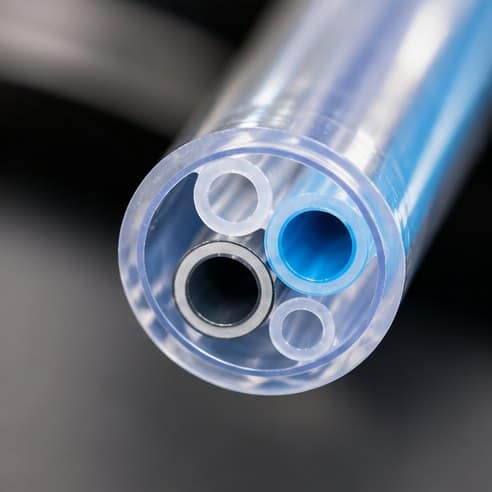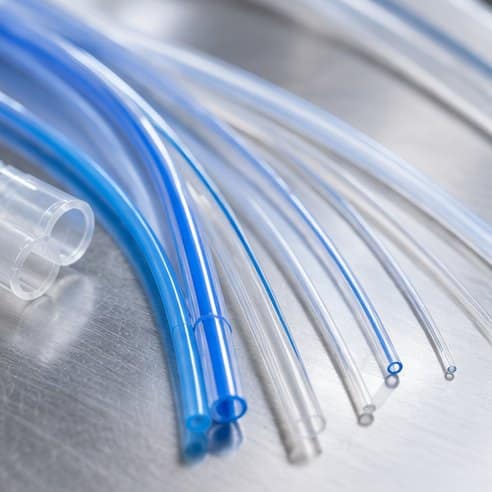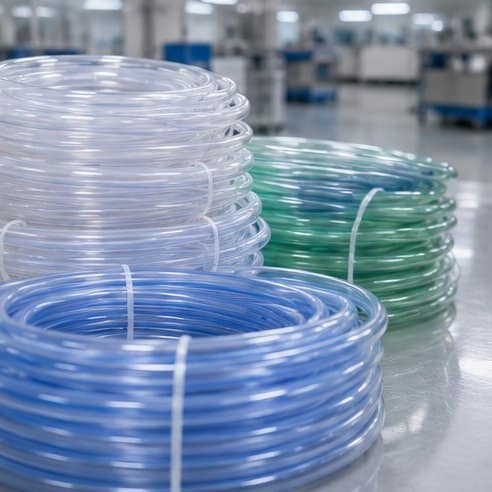
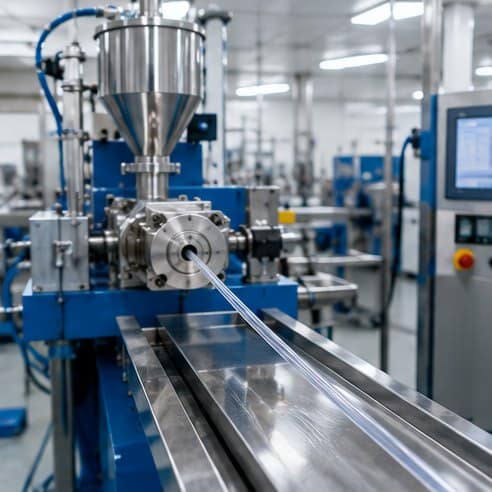
Medical tubing extrusion line producing clear tubing

Balloon Tubing and Micro-Extrusion in Medical Devices

At the small end of medical extrusion, two specialities push the process to its physical limits: balloon tubing, which is later inflated into a precise medical balloon, and micro-extrusion, which produces the ultra-fine tubing used in microcatheters and neurovascular devices. Both demand extreme dimensional control at tiny scales.
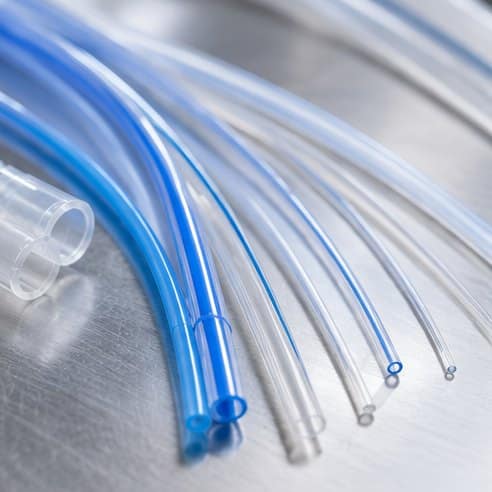
Medical catheter tubing in blue and clear polymer

Balloon tubing

An angioplasty or valvuloplasty balloon starts life as an extruded tube — often nylon or PEBA — with tightly controlled diameter and wall. That tube is later stretched and blow-moulded into a balloon whose burst pressure and compliance depend entirely on how uniform the original extrusion was. Any wall variation in the parison becomes a weak spot in the finished balloon, so the tubing must be exceptionally concentric.

Micro-extrusion

Micro-extrusion produces tubing with very small diameters and thin walls, sometimes well under a millimetre, for microcatheters and neurovascular access. At this scale, tiny absolute variations are large percentages of the wall, so measurement resolution and melt stability become critical. The material also matters: the polymer chosen has to combine flexibility with enough strength to survive at a thin wall.
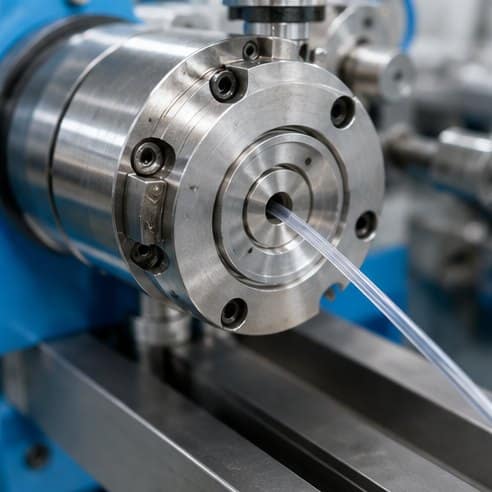
Crosshead die extruding thin medical tubing

Why small scale is hard

Shrinking the tube does not shrink the tolerances — if anything it tightens them in relative terms. Holding a wall of a few hundredths of a millimetre demands a stable melt, fine take-off control and high-resolution laser measurement, the same capabilities a precision medical tubing extrusion line is built around. These constructions are frequently combined with the reinforcement and tapering described in our guide to catheter tubing extrusion.

How Sai Extrumech Extrudes Balloon and Micro Tubing

Both balloon parisons and micro-bore tubing demand the same thing: absolute control of diameter and wall at a tiny scale. On our medical tubing extrusion lines we hold that control with a precision crosshead, tight vacuum sizing and continuous in-line laser measurement, so wall concentricity stays within microns metre after metre. For balloon tubing the priority is a perfectly even wall in the parison, because any variation becomes a weak spot once the tube is blow-moulded into a balloon.

We build these lines for nylon, PEBA (Pebax-type), TPU and PU compounds, matched with precision medical tubing crossheads. For micro-extrusion, fine tooling and low, stable output let us produce ultra-thin walls and sub-millimetre diameters for microcatheters and neurovascular devices, verified against your specification before the tubing ships.

Applications of Balloon and Micro-Extruded Tubing

  • Angioplasty and valvuloplasty balloons — extruded nylon or PEBA parisons blow-moulded to precise burst pressure
  • Microcatheters and neurovascular devices — ultra-fine tubing well under a millimetre
  • Drug-delivery and diagnostic catheters needing thin, uniform walls
  • Guidewire and support tubing for minimally invasive procedures

Balloon Tubing: Key Takeaways

Reliable balloon tubing begins with an exceptionally concentric extruded parison, because the finished balloon can only be as uniform as the tube it was formed from. That is why balloon tubing extrusion pairs a precision crosshead with continuous laser measurement to hold wall and diameter to microns. For the procedure this tubing enables, see angioplasty.

Related: see catheter tubing extrusion, multi-lumen medical tubing and choosing a medical tubing material.

Frequently asked questions

What is balloon tubing?

Balloon tubing is precisely extruded tube, usually nylon or PEBA, that is later stretched and blow-moulded into a medical balloon; the balloon’s strength and compliance depend on how uniform the original tubing was.

What is micro-extrusion in medical tubing?

Micro-extrusion is the production of very small-diameter, thin-wall medical tubing — used in microcatheters and neurovascular devices — where high measurement resolution and melt stability are needed to hold tolerances at a tiny scale.

Cleanroom operator inspecting medical tubing

How Medical Tubing Is Inspected and Measured

Medical tubing inspection and measurement is what proves a tube meets its specification. In medical manufacturing the tube is only half the deliverable; the other half is proof that every metre met specification. That proof comes from measurement — continuous, non-contact, and logged. Here is how medical tubing is inspected on the line and why the evidence matters as much as the product.

In-line measurement: catching drift as it happens

Because tubing is produced continuously, inspection has to be continuous too. The workhorses are non-contact:

  • Laser micrometers read outer diameter hundreds of times per second as the tube leaves the sizing trough.
  • Ultrasonic wall gauges measure wall thickness and concentricity without touching the product.
  • Vision systems watch for surface defects, gels and specks.

Crucially these are not just alarms. Their signals feed the line’s closed-loop control, nudging haul-off, vacuum and output to keep dimensions centred. A well-tuned medical tubing extrusion line spends its run correcting tiny drifts before they ever become scrap.

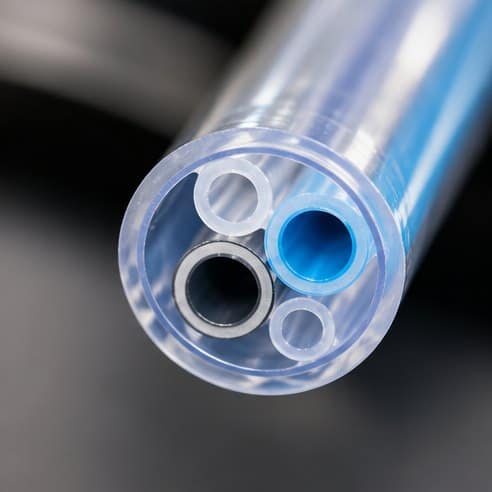
Multi-lumen catheter tubing cross-section

Concentricity: the measurement that matters most

For tubing, the wall must be even around the lumen. Off-centre walls mean a thin, weak side and wasted material on the other. Ultrasonic and laser wall gauges compute concentricity live, so an operator can see immediately which way the wall has drifted and correct it. This is the same quality axis that governs catheter tubing, where an even wall is a safety requirement.

Validation and traceability

A medical process is qualified (IQ/OQ/PQ), not merely set up, and once qualified the recipe is locked. Every run logs its parameters and raw-material lot so a finished batch can be traced back to exactly how and when it was made. A beautifully extruded tube with no evidence behind it is, from a regulatory standpoint, unusable.

Our Medical Tubing Inspection Capabilities

Medical tubing is only as good as its measurement. On our medical tubing extrusion lines we combine in-line and off-line inspection: laser micrometers track outer diameter continuously, ultrasonic and capacitance gauges check wall thickness and inner diameter, and vision systems flag surface defects. Off-line, we verify concentricity, ovality, tensile strength and burst pressure against your specification.

Every result can be documented for batch traceability, supporting quality systems such as ISO 13485 — so you can prove each length of tubing met spec before it ships.

What We Measure

  • Outer diameter — continuous in-line laser measurement
  • Wall thickness and inner diameter — ultrasonic and capacitance gauges
  • Concentricity and ovality
  • Tensile strength and burst pressure
  • Surface and defect inspection
  • Documented, batch-level traceability

Related: see catheter tubing extrusion, bump & tapered tubing and choosing a tubing material.

Medical Tubing Inspection: Key Takeaways

Reliable medical tubing inspection combines continuous in-line laser and ultrasonic measurement with documented, batch-level traceability. Because medical devices are regulated, the goal of medical tubing inspection is not only to catch defects as they happen but to prove that every metre of tube met its specification before it ships. Getting the measurement and dimensional metrology right up front is far cheaper than discovering an out-of-spec dimension after a full batch has been produced, packed and delivered to a device maker.

Frequently asked questions

How is medical tubing measured during production?

Medical tubing is measured continuously by non-contact laser micrometers (outer diameter) and ultrasonic gauges (wall thickness and concentricity), whose readings feed the line’s closed-loop control to hold dimensions in real time.

What is concentricity in medical tubing?

Concentricity describes how evenly the wall is distributed around the lumen. Good concentricity means uniform wall thickness; poor concentricity leaves a thin, weaker side and wastes material on the thick side.

Multi-lumen catheter tubing cross-section

Multi-Lumen Medical Tubing: Construction, Uses and How It’s Extruded

Multi-lumen medical tubing packs several separate channels into a single shaft. A multi-lumen tube carries two or more separate channels inside a single outer wall. It is what lets one catheter do several jobs at once — infuse incompatible drugs without mixing, run a guidewire alongside an inflation channel, or carry sensor wiring beside a working lumen. Producing it cleanly is a genuine test of tooling design and melt control.

Medical catheter tubing in blue and clear polymer

Where multi-lumen tubing is used

A triple-lumen central venous catheter lets clinicians deliver multiple therapies simultaneously through one device. Other designs pair a large working lumen with smaller channels for guidewires, balloon inflation or fibre-optic sensors. The common thread is doing more through a single, small cross-section.

Crosshead die extruding thin medical tubing

The challenge is in the tooling

The difficulty is almost entirely in the die and flow balance:

  • The die contains fixed pins that form each lumen; melt must distribute evenly around every pin or the walls come out uneven.
  • The thin internal walls between channels (septa) are fragile in the melt and easy to distort, so draw-down must be tuned to keep them straight and centred.
  • Because the pins are held from one side, any pressure imbalance shifts them and throws off lumen position.

Getting a clean, symmetric multi-lumen cross-section repeatably depends on both die design and a stable melt, which is why this work runs on a precision medical tubing extrusion line with tight pressure control.

How it relates to catheter design

Multi-lumen construction is frequently combined with the other catheter geometries — reinforcement, tapering and bump zones — in one shaft. The material choice matters too; the polymer you select affects how cleanly the septa form and hold their shape. See our overview of catheter tubing extrusion for how these constructions fit together.

How Sai Extrumech Extrudes Multi-Lumen Tubing

Multi-lumen tubing is formed by a crosshead fitted with a separate pin for each lumen and a matching die. The real difficulty is holding every lumen at the right size and in the right position as the melt flows around the pins — it takes even flow balancing, precise pin alignment and independent vacuum on each lumen to keep them open and consistent. Our medical tubing crossheads are machined for two, three or more lumens and matched to your compound and wall specification.

We extrude multi-lumen tubing in PVC, PU, nylon, Pebax-type and TPU on precision medical tubing extrusion lines, with in-line laser measurement holding each dimension to tight tolerance.

Applications of Multi-Lumen Tubing

  • Catheters combining irrigation, inflation and a guidewire channel in one shaft
  • Dual and triple-lumen drainage catheters
  • Feeding and delivery tubes
  • Devices needing separate gas and fluid paths

Related: see catheter tubing extrusion, bump & tapered tubing and choosing a tubing material.

Multi-Lumen Medical Tubing: Key Takeaways

Multi-lumen medical tubing places several independent channels inside a single shaft, which makes it powerful for advanced catheters but demanding to produce. The difference between usable and unusable multi-lumen medical tubing comes down to precise multi-pin tooling, perfectly balanced melt flow and independent vacuum on each lumen, verified by continuous laser measurement. For background on the devices that rely on it, see catheters — where variable lumens carry fluid, gas and guidewires through one tube.

Frequently asked questions

What is multi-lumen tubing?

Multi-lumen tubing is a single tube containing two or more separate internal channels, letting one catheter carry multiple fluids, a guidewire, or inflation media without them mixing.

Why is multi-lumen tubing hard to extrude?

The internal dividing walls (septa) are thin and fragile in the melt, and the die pins that form each lumen shift if melt flow is unbalanced, so it demands precise tooling and a very stable melt to hold lumen position and wall thickness.

Medical catheter tubing in blue and clear polymer

Bump and Tapered Tubing for Catheters: How Variable-Diameter Tubes Are Made

Bump and tapered tubing lets a catheter change diameter along its length. Most tubing is a constant diameter from end to end. Catheters often are not. To give a shaft push at the hub and softness at the tip, the tube’s diameter is deliberately varied along its length — either as a smooth taper or as discrete steps called bumps. These variable-diameter geometries are among the most demanding things an extrusion line is asked to do.

Multi-lumen catheter tubing cross-section

What tapered tubing is

A tapered tube changes diameter gradually along its length, usually larger and stiffer at the proximal end, tapering to a smaller, softer distal tip. This lets a single catheter be pushable where the clinician holds it and flexible where it navigates delicate anatomy. Tapers are produced on the fly by coordinating haul-off speed, extruder output and vacuum in real time so the transition is smooth rather than stepped.

What bump tubing is

Bump tubing steps the diameter (or wall) up in one or more discrete sections along an otherwise constant tube. Those bumps later become balloon-bond zones, strain reliefs or transition points once the tube is converted into a finished device. Producing them means executing a controlled diameter change at precise, repeatable intervals along the length.

Crosshead die extruding thin medical tubing

How the diameter is changed on the fly

Both tapers and bumps are created dynamically as the tube runs, using three coordinated levers:

  • Haul-off speed — pulling faster draws the tube down to a smaller diameter.
  • Extruder output — delivering more or less molten polymer.
  • Vacuum — trimming the outer surface in the sizing trough.

A line controller ramps these together on a programmed profile. The precision of the take-off and sizing hardware sets how tight and repeatable those transitions can be, which is why serious work runs on a purpose-built medical tubing extrusion line rather than general-purpose equipment.

How Sai Extrumech Produces Bump and Tapered Tubing

Producing variable-diameter tubing needs a servo-controlled line that changes geometry on the fly. On our medical tubing extrusion lines, the haul-off speed, extruder output and internal vacuum are coordinated in real time: speeding the puller thins and stretches the melt for a smaller diameter, while slowing it builds up a bump. Closed-loop control with an in-line laser gauge holds each transition to a tight tolerance and a repeatable position along the shaft, so every catheter comes out the same.

We build these lines for PVC, PU, nylon, Pebax-type and TPU compounds, matched with precision medical tubing crossheads. For single or multi-lumen tapered shafts, the tooling and process are engineered together so wall thickness stays controlled through every diameter change.

Applications of Bump and Tapered Tubing

Variable-diameter tubing is used wherever a device needs different stiffness along its length:

  • Guide and diagnostic catheters — stiff at the hub for push, soft at the tip for tracking
  • Balloon and angioplasty catheters — tapered shafts for smooth navigation
  • Microcatheters and neurovascular devices — fine distal tapers for delicate anatomy
  • Drainage and delivery catheters with stepped (bump) transitions

Related: see our guides to catheter tubing extrusion and choosing a medical tubing material.

Why they are hard to make

The geometry is created as the tube runs and cannot be inspected until it exists, so production leans heavily on continuous laser measurement and a stable melt. A pressure or temperature wobble at the screw shows up directly as a dimensional defect — and in a taper transition it is unrecoverable. This is the same precision discipline covered in our guide to catheter tubing extrusion, applied to a changing profile.

Bump and Tapered Tubing: Key Takeaways

Bump and tapered tubing gives a catheter different stiffness along its length — pushable at the hub, soft at the tip. Producing bump and tapered tubing means changing diameter on the fly by coordinating haul-off speed, extruder output and vacuum under closed-loop control. It is one of the most demanding jobs an extrusion line performs. For the devices this enables, see catheters.

Frequently asked questions

What is bump tubing?

Bump tubing is medical tubing whose diameter or wall steps up in discrete sections along its length, creating defined zones — often used as balloon-bond or transition points when the tube becomes a finished catheter.

How is tapered catheter tubing made?

Tapered tubing is produced during extrusion by ramping haul-off speed, extruder output and vacuum together on a programmed profile, so the diameter transitions smoothly along the tube while it runs.

Medical catheter tubing in blue and clear polymer

How to Choose Medical Tubing Material: PEBA, Nylon, TPU, Silicone and PVC Compared

Knowing how to choose medical tubing material comes down to matching the polymer to the requirement. Choosing the polymer is the first and most consequential decision in any medical tubing project. It sets the flexibility, strength, biocompatibility, how the tube bonds to other components, and how it behaves at body temperature. Pick well and the rest of the design follows naturally; pick badly and you fight the material through every later stage. This guide compares the five families you will meet most often, and how each affects the way a line must be built and run.

Medical tubing materials comparison - Sai Extrumech

The five materials at a glance

MaterialFeelKey strengthWatch out for
TPUFlexible, toughKink & abrasion resistanceHygroscopic — must be dried
Nylon (PA)Stiff, strongHigh burst pressureRigid; also hygroscopic
PEBA (Pebax)TunableBlend hardness to vary stiffnessHigher material cost
SiliconeVery softLong-term biostabilityLower strength, needs curing
PVCSoft, cheapLow cost, easy processingPlasticizer/regulatory scrutiny

Thermoplastic polyurethane (TPU)

TPU is the workhorse of catheter shafts. It is flexible yet tough, resists kinking and abrasion, and bonds well. It comes in a wide hardness range, so a designer can dial in the feel. The main processing catch is that TPU absorbs moisture from the air, so it must be dried thoroughly before extrusion or you get bubbles and splay on the finished tube.

Nylon (polyamide)

When a device needs to hold pressure — balloon catheters are the classic case — nylon’s high strength and burst resistance make it the go-to. The trade-off is stiffness: nylon is rigid, which is why it is often paired with softer materials along a shaft. Like TPU, it is hygroscopic and demands careful drying.

PEBA (Pebax)

PEBA is prized for one thing above all: you can blend grades of different hardness to vary stiffness along a single tube. That lets a catheter be firm where it needs push and soft where it needs to navigate. It processes cleanly and bonds well. The main downside is cost — it is a premium material, chosen when its tunability justifies the price. Producing a smooth stiffness transition depends on precise control of the extrusion line, and on tooling such as a well-centred medical tubing crosshead where the tubing is formed.

Silicone

Silicone is the choice when a device will sit in the body for a long time. It is exceptionally biostable and very soft, which suits drains, long-term catheters and peristaltic pump tubing. It is weaker than the thermoplastics and is usually thermoset (cured) rather than simply extruded and cooled, which changes the production approach and the line configuration required.

PVC

Polyvinyl chloride remains everywhere in disposables — IV lines, drainage tubing, feeding tubes — because it is inexpensive, soft and easy to process. The ongoing conversation around PVC concerns plasticizers and regulatory attitudes in some markets, which pushes some products toward alternatives, but for high-volume single-use items it is still hard to beat on cost.

Medical tubing extrusion machine for PEBA, TPU, nylon and silicone

Matching material to requirement

Work backward from the device:

  • Does it need to hold pressure? Lean nylon or reinforced constructions.
  • Does it need variable stiffness along its length? PEBA.
  • Will it dwell in the body for weeks or longer? Silicone.
  • Is it a high-volume disposable where cost dominates? PVC.
  • Is general flexibility and toughness the priority? TPU.

Whichever you choose, the material’s processing quirks — drying, melt sensitivity, cure requirements — feed directly into how the line must be set up and controlled. This is why material selection and line capability are best considered together rather than in isolation. Teams building to tight medical tolerances validate their material choice on a purpose-built medical tubing extrusion line, where drying, melt stability and take-off precision are engineered around the specific polymer.

For the underlying biocompatibility rules that constrain all of these choices, the ISO 10993 series is the reference point, and material suppliers publish detailed processing guides worth reading before you commit to a grade.

The takeaway

There is no single “best” medical tubing material — only the best fit for a given device’s pressure, stiffness, dwell time and cost profile. Decide those requirements first, use the comparison above to shortlist, then confirm the choice against real processing behaviour before you commit a design. If you are specifying a line for a particular material, our team can help match the extruder, tooling and downstream to your product.

How to Choose Medical Tubing Material: Key Takeaways

Knowing how to choose medical tubing material comes down to matching the polymer to the requirement — flexibility, strength, biocompatibility and cost. When you weigh how to choose medical tubing material, PEBA suits catheter shafts, TPU adds kink resistance, nylon brings strength, silicone leads on biocompatibility and PVC wins on cost. For one common catheter polymer, see Pebax (PEBA).

Frequently Asked Questions

Which material is best for medical tubing?

There is no single best material — it depends on the requirement. Pebax (PEBA) suits catheter shafts needing flexibility and strength, TPU offers flexibility and kink resistance, nylon gives high strength, silicone is prized for biocompatibility, and PVC is a low-cost general-purpose option.

Is silicone or TPU better for medical tubing?

Silicone is highly biocompatible, flexible and heat-resistant, ideal for long-term or skin-contact use. TPU is stronger, more kink-resistant and clearer, and bonds well. The choice depends on whether biocompatibility or mechanical strength matters more.

What is Pebax (PEBA) used for in medical tubing?

Pebax combines flexibility with strength and comes in many durometers, so it is widely used for catheter shafts where stiffness needs to be tuned along the length for pushability and trackability.

Can medical tubing combine more than one material?

Yes. Multi-layer and co-extruded tubing combine materials — such as a nylon inner layer for strength with a Pebax outer for flexibility — to achieve properties a single polymer cannot.

Related: once you have chosen a material, see how catheter tubing is extruded, our medical tubing extrusion line and medical tubing crossheads. See all products.