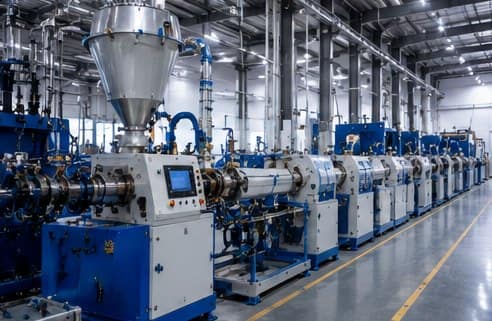
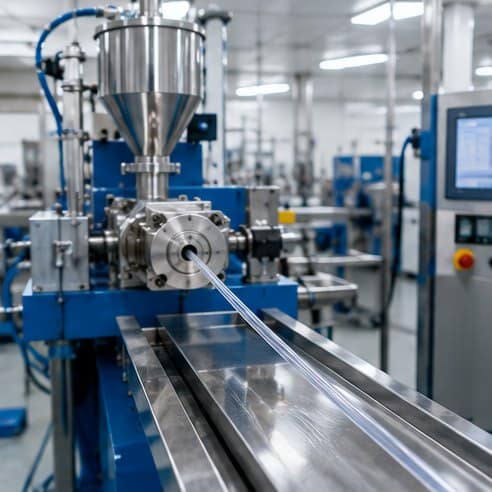
Medical tubing extrusion line producing clear tubing

Balloon Tubing and Micro-Extrusion in Medical Devices

At the small end of medical extrusion, two specialities push the process to its physical limits: balloon tubing, which is later inflated into a precise medical balloon, and micro-extrusion, which produces the ultra-fine tubing used in microcatheters and neurovascular devices. Both demand extreme dimensional control at tiny scales.
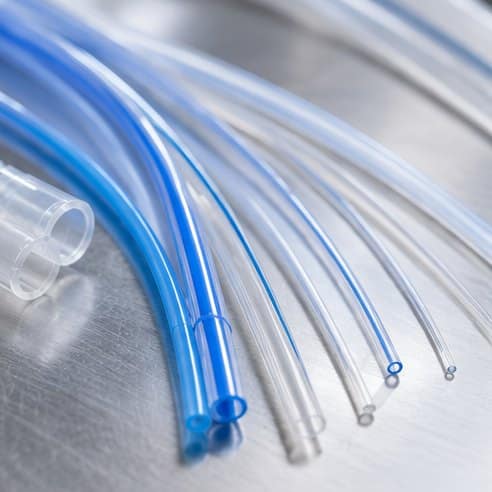
Medical catheter tubing in blue and clear polymer

Balloon tubing

An angioplasty or valvuloplasty balloon starts life as an extruded tube — often nylon or PEBA — with tightly controlled diameter and wall. That tube is later stretched and blow-moulded into a balloon whose burst pressure and compliance depend entirely on how uniform the original extrusion was. Any wall variation in the parison becomes a weak spot in the finished balloon, so the tubing must be exceptionally concentric.

Micro-extrusion

Micro-extrusion produces tubing with very small diameters and thin walls, sometimes well under a millimetre, for microcatheters and neurovascular access. At this scale, tiny absolute variations are large percentages of the wall, so measurement resolution and melt stability become critical. The material also matters: the polymer chosen has to combine flexibility with enough strength to survive at a thin wall.
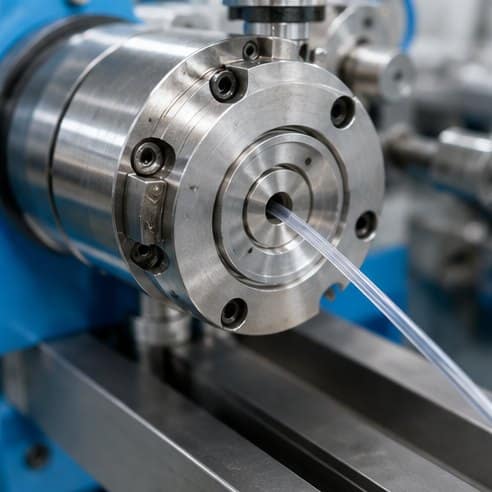
Crosshead die extruding thin medical tubing

Why small scale is hard

Shrinking the tube does not shrink the tolerances — if anything it tightens them in relative terms. Holding a wall of a few hundredths of a millimetre demands a stable melt, fine take-off control and high-resolution laser measurement, the same capabilities a precision medical tubing extrusion line is built around. These constructions are frequently combined with the reinforcement and tapering described in our guide to catheter tubing extrusion.

How Sai Extrumech Extrudes Balloon and Micro Tubing

Both balloon parisons and micro-bore tubing demand the same thing: absolute control of diameter and wall at a tiny scale. On our medical tubing extrusion lines we hold that control with a precision crosshead, tight vacuum sizing and continuous in-line laser measurement, so wall concentricity stays within microns metre after metre. For balloon tubing the priority is a perfectly even wall in the parison, because any variation becomes a weak spot once the tube is blow-moulded into a balloon.

We build these lines for nylon, PEBA (Pebax-type), TPU and PU compounds, matched with precision medical tubing crossheads. For micro-extrusion, fine tooling and low, stable output let us produce ultra-thin walls and sub-millimetre diameters for microcatheters and neurovascular devices, verified against your specification before the tubing ships.

Applications of Balloon and Micro-Extruded Tubing

  • Angioplasty and valvuloplasty balloons — extruded nylon or PEBA parisons blow-moulded to precise burst pressure
  • Microcatheters and neurovascular devices — ultra-fine tubing well under a millimetre
  • Drug-delivery and diagnostic catheters needing thin, uniform walls
  • Guidewire and support tubing for minimally invasive procedures

Balloon Tubing: Key Takeaways

Reliable balloon tubing begins with an exceptionally concentric extruded parison, because the finished balloon can only be as uniform as the tube it was formed from. That is why balloon tubing extrusion pairs a precision crosshead with continuous laser measurement to hold wall and diameter to microns. For the procedure this tubing enables, see angioplasty.

Related: see catheter tubing extrusion, multi-lumen medical tubing and choosing a medical tubing material.

Frequently asked questions

What is balloon tubing?

Balloon tubing is precisely extruded tube, usually nylon or PEBA, that is later stretched and blow-moulded into a medical balloon; the balloon’s strength and compliance depend on how uniform the original tubing was.

What is micro-extrusion in medical tubing?

Micro-extrusion is the production of very small-diameter, thin-wall medical tubing — used in microcatheters and neurovascular devices — where high measurement resolution and melt stability are needed to hold tolerances at a tiny scale.
Cable and Wire Extrusion Line

Types of Twin-Screw Extruders: Co-Rotating vs Counter-Rotating

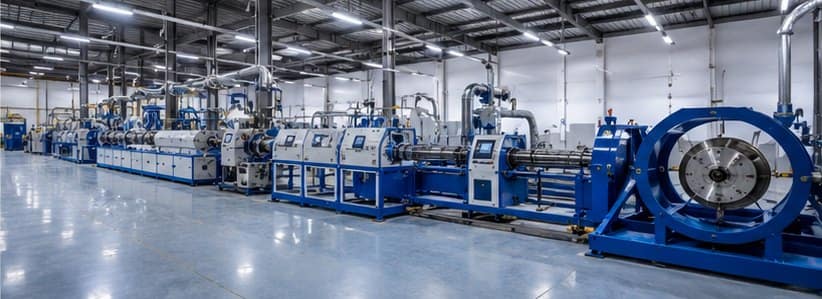
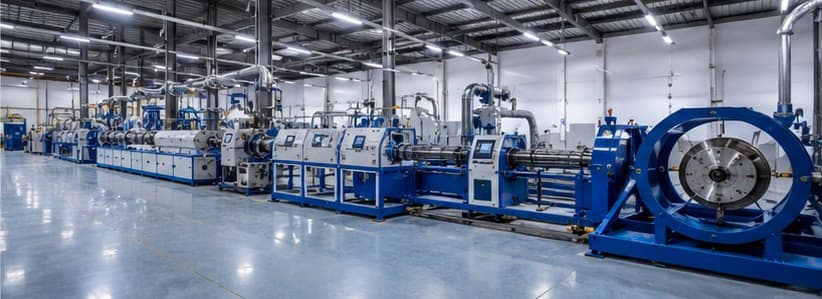
There is more than one kind of twin-screw extruder, and choosing the wrong one can quietly cost you output and quality. The main types of twin-screw extruders differ in how the two screws turn and how tightly they mesh — and each type is built for a different job, from compounding masterbatch to extruding rigid PVC pipe. This guide breaks down the types, how they differ, and how to pick the right one.

Wire and cable extrusion line production hall in India

What Is a Twin-Screw Extruder?

A twin-screw extruder uses two parallel screws inside a shared barrel instead of one. The extra screw and the way the two interact give far stronger, more controllable mixing than a single screw, which is why twin-screw machines dominate compounding and reactive extrusion. For how the base process works, see how plastic extrusion works, and for a neutral overview see Wikipedia.

How Twin-Screw Extruders Are Classified

Twin-screw extruders are grouped along two axes: the direction the screws rotate (co-rotating or counter-rotating) and how far the screws engage with each other (intermeshing or non-intermeshing). Those two choices define the four practical types below.

Co-Rotating Intermeshing Twin-Screw Extruders

Both screws turn in the same direction and their flights wipe each other clean (self-wiping). This is the most common industrial type. Built from modular screw elements, it delivers excellent distributive and dispersive mixing at high output, which makes it the standard for compounding, masterbatch, filled and glass-reinforced compounds, and reactive extrusion. The strong mixing is also why these machines pair with hard-wearing bimetallic screws and barrels when running abrasive fillers.

Counter-Rotating Intermeshing Twin-Screw Extruders

The screws turn in opposite directions, squeezing material through the gap between them in a calendering action. This builds high pressure gently and with low shear, which suits heat-sensitive polymers — above all rigid PVC. Counter-rotating machines (including the compact conical variant) are the workhorses of rigid PVC pipe and profile extrusion, where avoiding heat degradation matters more than aggressive mixing.

Cable extrusion line with material feed hopper

Conical and Non-Intermeshing Types

  • Conical counter-rotating — tapered screws that are wider at the feed end, giving a compact, lower-cost machine popular for small-to-medium rigid PVC pipe and profile.
  • Non-intermeshing (tangential) — the screws sit side by side without meshing, giving high free volume. Used for devolatilisation (removing solvents or moisture) and some specialty mixing rather than general extrusion.

Types of Twin-Screw Extruders at a Glance

TypeScrew actionBest for
Co-rotating intermeshingSame direction, self-wipingCompounding, masterbatch, reactive extrusion, filled compounds
Counter-rotating intermeshingOpposite directions, calenderingRigid PVC pipe and profile, high-pressure gentle mixing
Conical counter-rotatingTapered screws, compactSmall-scale rigid PVC pipe and profile
Non-intermeshing (tangential)Screws do not meshDevolatilisation, specialty mixing, high free volume

Twin-Screw vs Single-Screw

Whatever the type, a twin-screw extruder is a mixing machine first. If you only need to melt and pump a polymer into pipe, sheet or cable insulation, a single screw is simpler and cheaper. If you need to compound, add fillers or run reactive extrusion, a twin screw is the right tool. We cover this trade-off in detail in our single-screw vs twin-screw comparison, and the geometry behind it in our guide to extruder screw design.

How to Choose the Right Type

  • Compounding, masterbatch, fillers, reactive extrusion → co-rotating intermeshing
  • Rigid PVC pipe and profile → counter-rotating (conical for compact lines)
  • Devolatilisation and specialty mixing → non-intermeshing tangential
  • Straightforward extrusion of cable, pipe or sheet → a single-screw line is usually enough

Frequently Asked Questions

What are the main types of twin-screw extruders?

Twin-screw extruders are classified by screw direction and engagement. The main types are co-rotating intermeshing (the most common, for compounding), counter-rotating intermeshing (for rigid PVC pipe and profile), conical counter-rotating (a compact PVC variant), and non-intermeshing tangential (for devolatilisation and specialty mixing).

What is the difference between co-rotating and counter-rotating twin-screw extruders?

In a co-rotating extruder both screws turn the same way, giving a self-wiping action and strong distributive mixing – ideal for compounding. In a counter-rotating extruder the screws turn opposite ways, creating a calendering, high-pressure action that is gentle on heat-sensitive polymers like rigid PVC.

Which twin-screw extruder is best for compounding?

Co-rotating intermeshing twin-screw extruders are the standard for compounding and masterbatch. Their self-wiping screws and modular elements give excellent dispersive and distributive mixing at high output, and they handle fillers, additives and reactive extrusion well.

Which twin-screw extruder is used for PVC pipe?

Counter-rotating twin-screw extruders – often conical – are the usual choice for rigid PVC pipe and profile. The counter-rotating action builds high pressure gently and moves heat-sensitive PVC through the barrel with low shear, avoiding degradation.

Are twin-screw extruders better than single-screw?

Neither is universally better. Single-screw extruders are simpler and cheaper and suit straightforward extrusion of pipe, sheet and cable insulation. Twin-screw extruders give far stronger, controllable mixing and are the choice for compounding, fillers and reactive extrusion.

Conclusion

The types of twin-screw extruders come down to two questions: which way do the screws turn, and how tightly do they mesh. Co-rotating machines mix aggressively for compounding; counter-rotating machines process rigid PVC gently. Match the type to the job and the line runs better. If you are specifying a line and are unsure which configuration fits your material, talk to our engineers.