
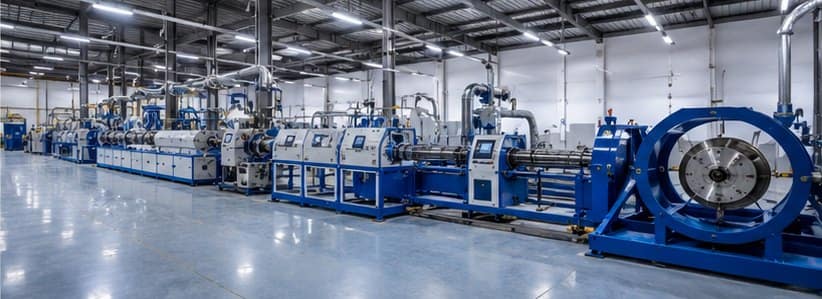
There is more than one kind of twin-screw extruder, and choosing the wrong one can quietly cost you output and quality. The main types of twin-screw extruders differ in how the two screws turn and how tightly they mesh — and each type is built for a different job, from compounding masterbatch to extruding rigid PVC pipe. This guide breaks down the types, how they differ, and how to pick the right one.
What Is a Twin-Screw Extruder?
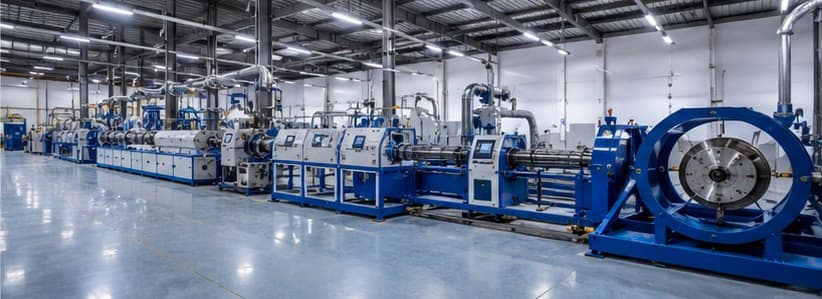
A twin-screw extruder uses two parallel screws inside a shared barrel instead of one. The extra screw and the way the two interact give far stronger, more controllable mixing than a single screw, which is why twin-screw machines dominate compounding and reactive extrusion. For how the base process works, see how plastic extrusion works, and for a neutral overview see Wikipedia.
How Twin-Screw Extruders Are Classified
Twin-screw extruders are grouped along two axes: the direction the screws rotate (co-rotating or counter-rotating) and how far the screws engage with each other (intermeshing or non-intermeshing). Those two choices define the four practical types below.
Co-Rotating Intermeshing Twin-Screw Extruders
Both screws turn in the same direction and their flights wipe each other clean (self-wiping). This is the most common industrial type. Built from modular screw elements, it delivers excellent distributive and dispersive mixing at high output, which makes it the standard for compounding, masterbatch, filled and glass-reinforced compounds, and reactive extrusion. The strong mixing is also why these machines pair with hard-wearing bimetallic screws and barrels when running abrasive fillers.
Counter-Rotating Intermeshing Twin-Screw Extruders
The screws turn in opposite directions, squeezing material through the gap between them in a calendering action. This builds high pressure gently and with low shear, which suits heat-sensitive polymers — above all rigid PVC. Counter-rotating machines (including the compact conical variant) are the workhorses of rigid PVC pipe and profile extrusion, where avoiding heat degradation matters more than aggressive mixing.
Conical and Non-Intermeshing Types
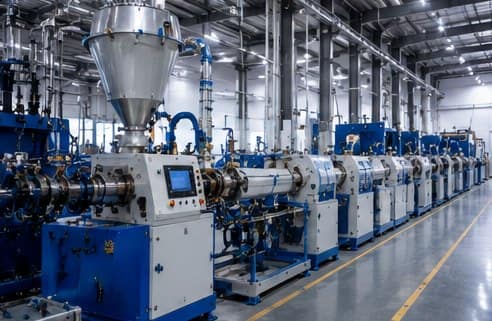
- Conical counter-rotating — tapered screws that are wider at the feed end, giving a compact, lower-cost machine popular for small-to-medium rigid PVC pipe and profile.
- Non-intermeshing (tangential) — the screws sit side by side without meshing, giving high free volume. Used for devolatilisation (removing solvents or moisture) and some specialty mixing rather than general extrusion.
Types of Twin-Screw Extruders at a Glance
Twin-Screw vs Single-Screw
Whatever the type, a twin-screw extruder is a mixing machine first. If you only need to melt and pump a polymer into pipe, sheet or cable insulation, a single screw is simpler and cheaper. If you need to compound, add fillers or run reactive extrusion, a twin screw is the right tool. We cover this trade-off in detail in our single-screw vs twin-screw comparison, and the geometry behind it in our guide to extruder screw design.
How to Choose the Right Type
- Compounding, masterbatch, fillers, reactive extrusion → co-rotating intermeshing
- Rigid PVC pipe and profile → counter-rotating (conical for compact lines)
- Devolatilisation and specialty mixing → non-intermeshing tangential
- Straightforward extrusion of cable, pipe or sheet → a single-screw line is usually enough
Frequently Asked Questions
What are the main types of twin-screw extruders?
Twin-screw extruders are classified by screw direction and engagement. The main types are co-rotating intermeshing (the most common, for compounding), counter-rotating intermeshing (for rigid PVC pipe and profile), conical counter-rotating (a compact PVC variant), and non-intermeshing tangential (for devolatilisation and specialty mixing).
What is the difference between co-rotating and counter-rotating twin-screw extruders?
In a co-rotating extruder both screws turn the same way, giving a self-wiping action and strong distributive mixing – ideal for compounding. In a counter-rotating extruder the screws turn opposite ways, creating a calendering, high-pressure action that is gentle on heat-sensitive polymers like rigid PVC.
Which twin-screw extruder is best for compounding?
Co-rotating intermeshing twin-screw extruders are the standard for compounding and masterbatch. Their self-wiping screws and modular elements give excellent dispersive and distributive mixing at high output, and they handle fillers, additives and reactive extrusion well.
Which twin-screw extruder is used for PVC pipe?
Counter-rotating twin-screw extruders – often conical – are the usual choice for rigid PVC pipe and profile. The counter-rotating action builds high pressure gently and moves heat-sensitive PVC through the barrel with low shear, avoiding degradation.
Are twin-screw extruders better than single-screw?
Neither is universally better. Single-screw extruders are simpler and cheaper and suit straightforward extrusion of pipe, sheet and cable insulation. Twin-screw extruders give far stronger, controllable mixing and are the choice for compounding, fillers and reactive extrusion.
Conclusion
The types of twin-screw extruders come down to two questions: which way do the screws turn, and how tightly do they mesh. Co-rotating machines mix aggressively for compounding; counter-rotating machines process rigid PVC gently. Match the type to the job and the line runs better. If you are specifying a line and are unsure which configuration fits your material, talk to our engineers.

Add a Comment