Cable and Wire Extrusion Line

Types of Twin-Screw Extruders: Co-Rotating vs Counter-Rotating

There is more than one kind of twin-screw extruder, and choosing the wrong one can quietly cost you output and quality. The main types of twin-screw extruders differ in how the two screws turn and how tightly they mesh — and each type is built for a different job, from compounding masterbatch to extruding rigid PVC pipe. This guide breaks down the types, how they differ, and how to pick the right one.
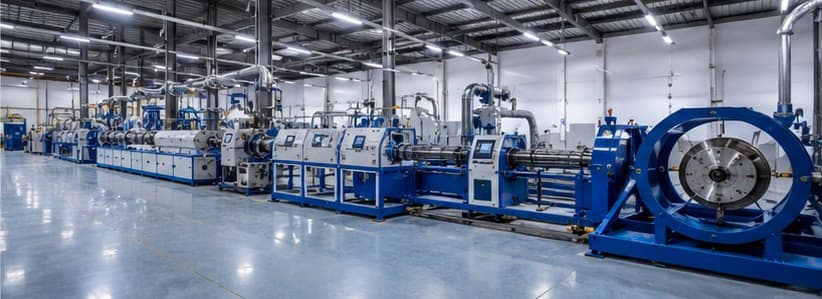
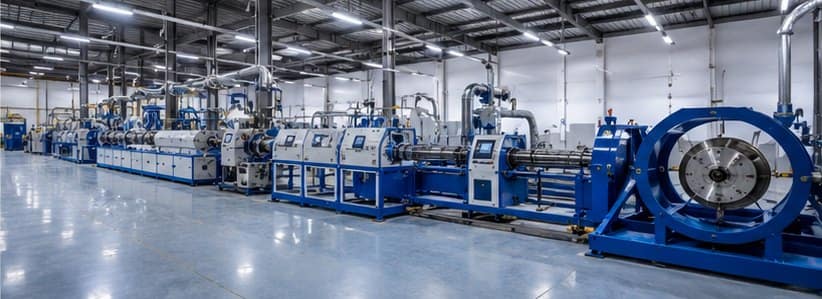
Wire and cable extrusion line production hall in India

What Is a Twin-Screw Extruder?

A twin-screw extruder uses two parallel screws inside a shared barrel instead of one. The extra screw and the way the two interact give far stronger, more controllable mixing than a single screw, which is why twin-screw machines dominate compounding and reactive extrusion. For how the base process works, see how plastic extrusion works, and for a neutral overview see Wikipedia.

How Twin-Screw Extruders Are Classified

Twin-screw extruders are grouped along two axes: the direction the screws rotate (co-rotating or counter-rotating) and how far the screws engage with each other (intermeshing or non-intermeshing). Those two choices define the four practical types below.

Co-Rotating Intermeshing Twin-Screw Extruders

Both screws turn in the same direction and their flights wipe each other clean (self-wiping). This is the most common industrial type. Built from modular screw elements, it delivers excellent distributive and dispersive mixing at high output, which makes it the standard for compounding, masterbatch, filled and glass-reinforced compounds, and reactive extrusion. The strong mixing is also why these machines pair with hard-wearing bimetallic screws and barrels when running abrasive fillers.

Counter-Rotating Intermeshing Twin-Screw Extruders

The screws turn in opposite directions, squeezing material through the gap between them in a calendering action. This builds high pressure gently and with low shear, which suits heat-sensitive polymers — above all rigid PVC. Counter-rotating machines (including the compact conical variant) are the workhorses of rigid PVC pipe and profile extrusion, where avoiding heat degradation matters more than aggressive mixing.
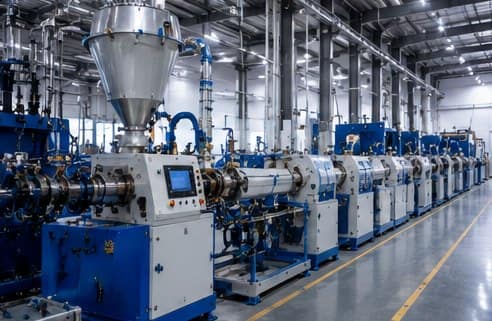
Cable extrusion line with material feed hopper

Conical and Non-Intermeshing Types

  • Conical counter-rotating — tapered screws that are wider at the feed end, giving a compact, lower-cost machine popular for small-to-medium rigid PVC pipe and profile.
  • Non-intermeshing (tangential) — the screws sit side by side without meshing, giving high free volume. Used for devolatilisation (removing solvents or moisture) and some specialty mixing rather than general extrusion.

Types of Twin-Screw Extruders at a Glance

TypeScrew actionBest for
Co-rotating intermeshingSame direction, self-wipingCompounding, masterbatch, reactive extrusion, filled compounds
Counter-rotating intermeshingOpposite directions, calenderingRigid PVC pipe and profile, high-pressure gentle mixing
Conical counter-rotatingTapered screws, compactSmall-scale rigid PVC pipe and profile
Non-intermeshing (tangential)Screws do not meshDevolatilisation, specialty mixing, high free volume

Twin-Screw vs Single-Screw

Whatever the type, a twin-screw extruder is a mixing machine first. If you only need to melt and pump a polymer into pipe, sheet or cable insulation, a single screw is simpler and cheaper. If you need to compound, add fillers or run reactive extrusion, a twin screw is the right tool. We cover this trade-off in detail in our single-screw vs twin-screw comparison, and the geometry behind it in our guide to extruder screw design.

How to Choose the Right Type

  • Compounding, masterbatch, fillers, reactive extrusion → co-rotating intermeshing
  • Rigid PVC pipe and profile → counter-rotating (conical for compact lines)
  • Devolatilisation and specialty mixing → non-intermeshing tangential
  • Straightforward extrusion of cable, pipe or sheet → a single-screw line is usually enough

Frequently Asked Questions

What are the main types of twin-screw extruders?

Twin-screw extruders are classified by screw direction and engagement. The main types are co-rotating intermeshing (the most common, for compounding), counter-rotating intermeshing (for rigid PVC pipe and profile), conical counter-rotating (a compact PVC variant), and non-intermeshing tangential (for devolatilisation and specialty mixing).

What is the difference between co-rotating and counter-rotating twin-screw extruders?

In a co-rotating extruder both screws turn the same way, giving a self-wiping action and strong distributive mixing – ideal for compounding. In a counter-rotating extruder the screws turn opposite ways, creating a calendering, high-pressure action that is gentle on heat-sensitive polymers like rigid PVC.

Which twin-screw extruder is best for compounding?

Co-rotating intermeshing twin-screw extruders are the standard for compounding and masterbatch. Their self-wiping screws and modular elements give excellent dispersive and distributive mixing at high output, and they handle fillers, additives and reactive extrusion well.

Which twin-screw extruder is used for PVC pipe?

Counter-rotating twin-screw extruders – often conical – are the usual choice for rigid PVC pipe and profile. The counter-rotating action builds high pressure gently and moves heat-sensitive PVC through the barrel with low shear, avoiding degradation.

Are twin-screw extruders better than single-screw?

Neither is universally better. Single-screw extruders are simpler and cheaper and suit straightforward extrusion of pipe, sheet and cable insulation. Twin-screw extruders give far stronger, controllable mixing and are the choice for compounding, fillers and reactive extrusion.

Conclusion

The types of twin-screw extruders come down to two questions: which way do the screws turn, and how tightly do they mesh. Co-rotating machines mix aggressively for compounding; counter-rotating machines process rigid PVC gently. Match the type to the job and the line runs better. If you are specifying a line and are unsure which configuration fits your material, talk to our engineers.
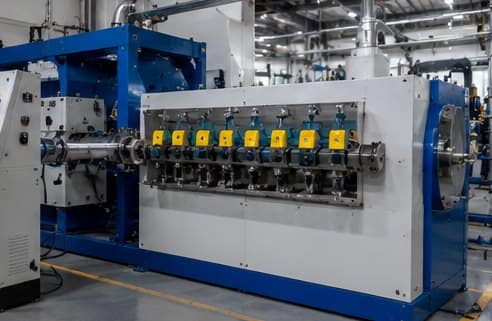
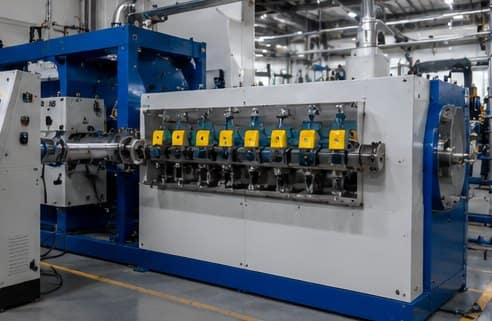
Single screw extruder machine for wire and cable

Extruder Screw Design Explained: Zones, L/D Ratio and Compression

Good extruder screw design is the single biggest factor in how well an extrusion line runs. The screw does three jobs at once – convey, melt and pump – and its geometry decides the output rate, the melt quality and how long the machine lasts. This guide explains how an extruder screw is designed: the three zones, the key parameters (L/D ratio, compression ratio, flight geometry), and how the design changes with the polymer you run.

Single screw extruder machine for wire and cable

Why Extruder Screw Design Matters

The screw is the heart of any extruder. A screw designed for the wrong polymer will surge, melt unevenly, overheat or under-melt, and quietly waste energy and material. Because the screw sets the process window, getting the design right is far cheaper than compensating for a poor screw with temperature and speed tweaks later. For the wider context, see how plastic extrusion works end to end, and for a neutral overview of the process see Wikipedia.

The Three Zones of an Extruder Screw

Almost every single-screw design is divided into three zones along its length, each doing a distinct job:

  • Feed zone — deep flights grab cool pellets from the hopper and convey them forward. Depth here is greatest so the screw can move a large volume of solid material.
  • Compression (transition) zone — the channel depth shrinks gradually, compressing the polymer, squeezing out trapped air and generating the shear heat that melts it. Most melting happens here.
  • Metering zone — shallow, constant-depth flights build steady pressure and homogenise the melt so it leaves the screw at a uniform rate and temperature.

How much each zone contributes depends on the polymer. A screw for a slow-melting compound needs a longer transition zone; a screw for a heat-sensitive material keeps residence time short.

Key Screw Design Parameters

  • L/D ratio — barrel length divided by screw diameter, usually 20:1 to 33:1. A higher L/D ratio gives more residence time, better mixing and a more stable melt; a lower L/D suits heat-sensitive polymers.
  • Compression ratio — feed-zone channel volume divided by metering-zone volume, typically 2:1 to 4:1. It controls how hard the polymer is compressed as it melts.
  • Channel depth — deep in the feed zone for throughput, shallow in the metering zone for pressure and mixing.
  • Flight pitch and helix angle — a square-pitch screw (pitch equal to diameter, ~17.7° helix) is the common default; changing pitch tunes conveying and shear.
  • Mixing and barrier sections — barrier flights or Maddock-type mixers improve melt homogeneity for demanding compounds such as XLPE and masterbatch.

Screw Design by Material

There is no universal screw. The design has to follow the polymer’s melt behaviour:

  • Rigid PVC — heat-sensitive, so a low compression ratio (~2:1–2.5:1) and moderate L/D keep residence time and shear down to avoid degradation.
  • Polyethylene & polypropylene — tolerate a higher compression ratio (~3:1–4:1) and higher L/D for strong melting and output.
  • XLPE and filled compounds — benefit from barrier or mixing sections for melt uniformity; abrasive or filled materials call for hard-wearing construction.
  • Rubber and silicone — use dedicated cold-feed screw geometries quite different from thermoplastic designs.
Extruder crosshead die forming cable insulation

Screw Metallurgy: Nitrided vs Bimetallic

Geometry decides how a screw performs; metallurgy decides how long it lasts. Nitrided screws (nitriding steel case-hardened to around 900–1000 HV) are the economical choice for PVC, PE and most unfilled thermoplastics. Bimetallic construction, with a wear-resistant alloy layer around 60–65 HRC, is the answer for abrasive, glass-filled and flame-retardant compounds. We cover this in depth on our screw and barrel manufacturing page.

Single-Screw vs Twin-Screw Design

Single-screw design relies on drag flow and is ideal for straightforward extrusion of pipe, sheet, profile and cable insulation. Twin-screw design uses two intermeshing screws built from modular elements for far stronger, controllable mixing, which is why it dominates compounding and reactive extrusion. See our single-screw vs twin-screw comparison for how to choose.

Signs of a Poorly Designed Screw

  • Surging or pulsing output and fluctuating melt pressure
  • Unmelted particles or poor colour and additive dispersion
  • Overheating (excessive shear) or under-melting (insufficient shear)
  • High motor load and energy use for the output achieved
  • Rapid, uneven wear — often a sign the screw is fighting the material; see screw wear causes and prevention

How Sai Extrumech Designs Screws

We design and manufacture screws around your exact compound, output target and extruder. That means choosing the L/D ratio, compression ratio, zone lengths and any mixing section for your material, then building the screw in nitrided or bimetallic construction to match the wear it will see. If you are unsure which geometry fits, our guide to selecting the right screw and barrel walks through it, or talk to our engineers with your material and machine details.

Frequently Asked Questions

What is extruder screw design?

Extruder screw design is the engineering of a screw’s geometry – its length-to-diameter (L/D) ratio, compression ratio, channel depth, flight pitch and any mixing sections – so it melts and pumps a specific polymer at the required output and melt quality. The right screw design is matched to the material, not one-size-fits-all.

What are the three zones of an extruder screw?

An extruder screw has a feed zone with deep flights that convey cool pellets, a compression (transition) zone where the channel gets shallower to melt the polymer and squeeze out air, and a metering zone with shallow flights that builds uniform pressure so the melt leaves at a steady rate.

What is a good compression ratio for an extruder screw?

Compression ratio is the ratio of feed-zone channel volume to metering-zone channel volume, typically 2:1 to 4:1. Heat-sensitive polymers like rigid PVC use a lower ratio (around 2:1 to 2.5:1), while polyethylene and polypropylene use higher ratios (around 3:1 to 4:1).

How does L/D ratio affect screw design?

The L/D ratio sets how much barrel length the polymer travels through. A higher L/D (25:1 to 33:1) gives more residence time for better melting and mixing and a more stable melt temperature; a lower L/D (20:1 to 24:1) suits heat-sensitive materials that should not stay hot for long.

How do you match a screw to the material?

Match compression ratio, L/D and any mixing section to the polymer’s melt behaviour: low compression and moderate L/D for PVC, higher compression for PE and PP, barrier or mixing sections for XLPE and hard-to-melt compounds, and bimetallic construction for abrasive or filled materials.

What happens if the screw design is wrong?

A mismatched screw causes unstable output (surging), poor melt homogeneity, overheating or under-melting, and higher scrap. It also wastes energy and accelerates wear, so correcting screw design is one of the cheapest ways to improve an extrusion line’s output and quality.

Conclusion

Extruder screw design comes down to matching geometry to the polymer: the three zones, the L/D and compression ratios, and any mixing section all have to suit the material you run. Get that match right and output, melt quality and machine life all improve together. If you are specifying a new screw or troubleshooting an old one, tell us your material and extruder and we will design the right screw for the job.