
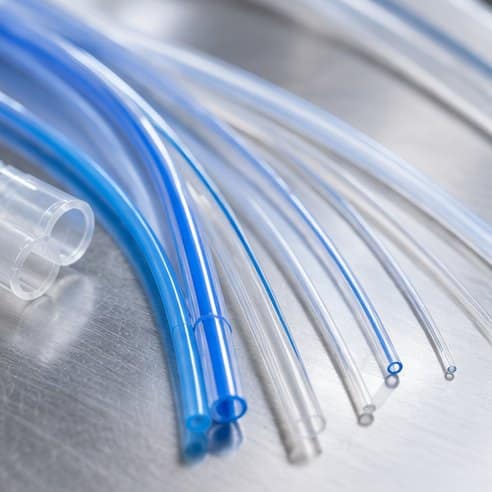
Bump and tapered tubing lets a catheter change diameter along its length. Most tubing is a constant diameter from end to end. Catheters often are not. To give a shaft push at the hub and softness at the tip, the tube’s diameter is deliberately varied along its length — either as a smooth taper or as discrete steps called bumps. These variable-diameter geometries are among the most demanding things an extrusion line is asked to do.
What tapered tubing is
A tapered tube changes diameter gradually along its length, usually larger and stiffer at the proximal end, tapering to a smaller, softer distal tip. This lets a single catheter be pushable where the clinician holds it and flexible where it navigates delicate anatomy. Tapers are produced on the fly by coordinating haul-off speed, extruder output and vacuum in real time so the transition is smooth rather than stepped.
What bump tubing is
Bump tubing steps the diameter (or wall) up in one or more discrete sections along an otherwise constant tube. Those bumps later become balloon-bond zones, strain reliefs or transition points once the tube is converted into a finished device. Producing them means executing a controlled diameter change at precise, repeatable intervals along the length.
How the diameter is changed on the fly
Both tapers and bumps are created dynamically as the tube runs, using three coordinated levers:
- Haul-off speed — pulling faster draws the tube down to a smaller diameter.
- Extruder output — delivering more or less molten polymer.
- Vacuum — trimming the outer surface in the sizing trough.
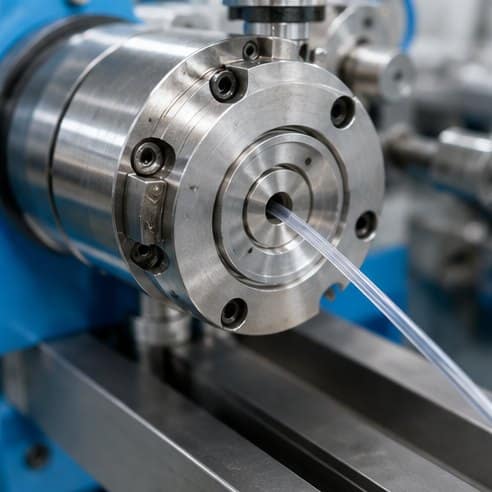
A line controller ramps these together on a programmed profile. The precision of the take-off and sizing hardware sets how tight and repeatable those transitions can be, which is why serious work runs on a purpose-built medical tubing extrusion line rather than general-purpose equipment.
How Sai Extrumech Produces Bump and Tapered Tubing
Producing variable-diameter tubing needs a servo-controlled line that changes geometry on the fly. On our medical tubing extrusion lines, the haul-off speed, extruder output and internal vacuum are coordinated in real time: speeding the puller thins and stretches the melt for a smaller diameter, while slowing it builds up a bump. Closed-loop control with an in-line laser gauge holds each transition to a tight tolerance and a repeatable position along the shaft, so every catheter comes out the same.
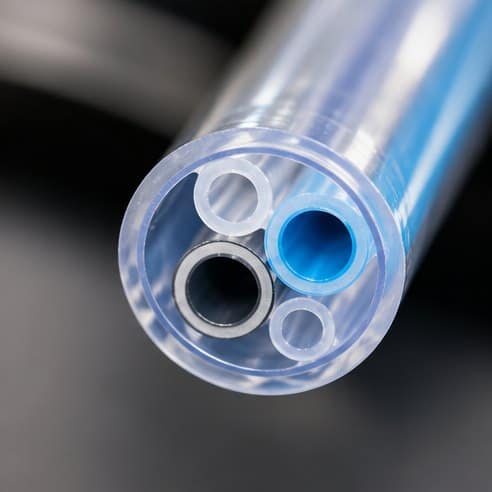
We build these lines for PVC, PU, nylon, Pebax-type and TPU compounds, matched with precision medical tubing crossheads. For single or multi-lumen tapered shafts, the tooling and process are engineered together so wall thickness stays controlled through every diameter change.
Applications of Bump and Tapered Tubing
Variable-diameter tubing is used wherever a device needs different stiffness along its length:
- Guide and diagnostic catheters — stiff at the hub for push, soft at the tip for tracking
- Balloon and angioplasty catheters — tapered shafts for smooth navigation
- Microcatheters and neurovascular devices — fine distal tapers for delicate anatomy
- Drainage and delivery catheters with stepped (bump) transitions
Related: see our guides to catheter tubing extrusion and choosing a medical tubing material.
Why they are hard to make
The geometry is created as the tube runs and cannot be inspected until it exists, so production leans heavily on continuous laser measurement and a stable melt. A pressure or temperature wobble at the screw shows up directly as a dimensional defect — and in a taper transition it is unrecoverable. This is the same precision discipline covered in our guide to catheter tubing extrusion, applied to a changing profile.
Bump and Tapered Tubing: Key Takeaways
Bump and tapered tubing gives a catheter different stiffness along its length — pushable at the hub, soft at the tip. Producing bump and tapered tubing means changing diameter on the fly by coordinating haul-off speed, extruder output and vacuum under closed-loop control. It is one of the most demanding jobs an extrusion line performs. For the devices this enables, see catheters.
Frequently asked questions
What is bump tubing?
Bump tubing is medical tubing whose diameter or wall steps up in discrete sections along its length, creating defined zones — often used as balloon-bond or transition points when the tube becomes a finished catheter.
How is tapered catheter tubing made?
Tapered tubing is produced during extrusion by ramping haul-off speed, extruder output and vacuum together on a programmed profile, so the diameter transitions smoothly along the tube while it runs.

Add a Comment