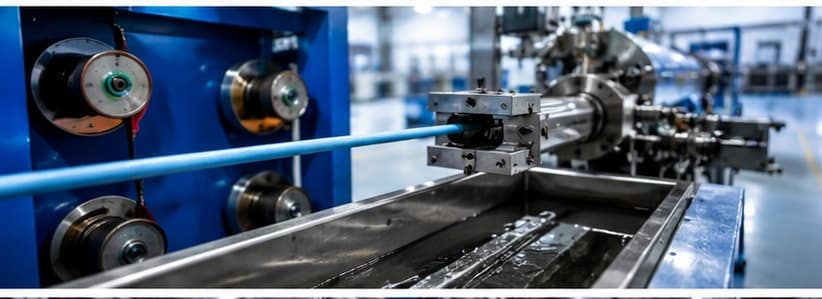
Cable pay-off unit and cooling trough on an extrusion line

PVC vs XLPE Cables: Differences, Applications & Which You Need

PVC vs XLPE cables is the most common insulation choice a cable maker faces. PVC and XLPE are the two most common cable insulation materials, and choosing between them decides your cable’s temperature rating, voltage capability and cost. In short: PVC (polyvinyl chloride) is cheaper and more flexible for low-voltage wiring, while XLPE (cross-linked polyethylene) handles higher temperatures and voltages for power cables. This guide compares PVC vs XLPE in detail — and explains how each is manufactured on an extrusion line.
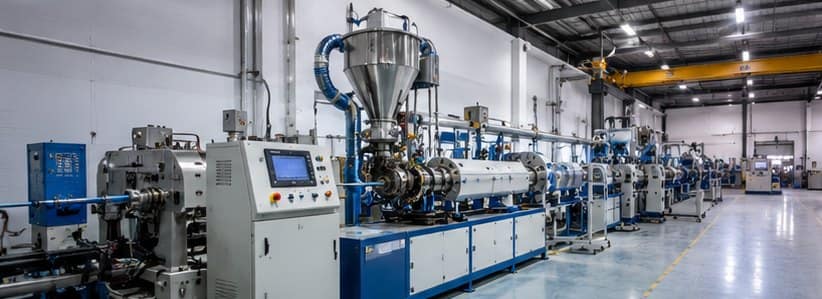
Cable extrusion line at Sai Extrumech factory in India

PVC vs XLPE Cables: Quick Comparison

PropertyPVCXLPE
Full namePolyvinyl Chloride (thermoplastic)Cross-Linked Polyethylene (thermoset)
Max conductor temp70°C (up to 105°C special grades)90°C continuous, 250°C short-circuit
Voltage rangeLow voltage (up to 1.1 kV)LV, MV & HV (up to 33 kV and beyond)
Insulation resistanceGoodExcellent
Dielectric lossesHigherLower
Current-carrying capacityLower~20-30% higher (for same size)
FlexibilityMore flexibleStiffer
Moisture & chemical resistanceGoodExcellent
Relative costLowerHigher
ManufacturingStandard extrusionExtrusion + cross-linking (Sioplas / Monosil / CCV)
Typical useHouse & building wire, control cablesPower, MV/HV, solar & industrial cables

What Is PVC Cable Insulation?

PVC (polyvinyl chloride) is a thermoplastic insulation used on the vast majority of low-voltage cables — house wiring, building wire and control cables. It is valued for being flexible, cost-effective and inherently flame-retardant. Standard PVC is rated to 70°C (special grades to 105°C) and voltages up to 1.1 kV, and is manufactured to IS 694 and IS 1554.

Its limitations are a lower temperature and voltage ceiling, higher dielectric losses, and the release of smoke and halogen gases when burning — which is why low-smoke (LSZH/HFFR) compounds are preferred in enclosed spaces. PVC insulation is applied on a straightforward building wire extrusion line using a precision crosshead.
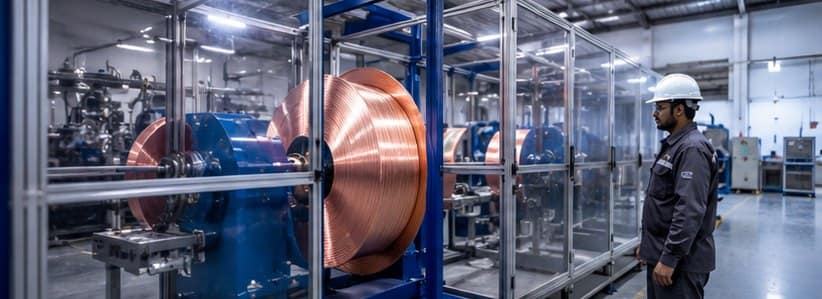
Copper wire take-up spool on a cable extrusion line

What Is XLPE Cable Insulation?

XLPE (cross-linked polyethylene) is a thermoset insulation created by chemically cross-linking polyethylene, so the material no longer melts when heated. This gives XLPE a much higher continuous temperature rating (90°C, and 250°C under short-circuit), excellent insulation resistance, low dielectric loss and superb moisture and chemical resistance. It is used from low voltage right up to medium- and high-voltage power cables and is made to IS 7098 and IEC 60502.

The trade-offs are higher material cost, greater stiffness, and an extra cross-linking step in production. But for power, solar and industrial cables, XLPE’s higher current capacity and durability usually justify the cost. See our Sioplas triple-layer HT-XLPE line for MV cables up to 33 kV.

PVC vs XLPE: The Key Differences

Temperature Rating

XLPE operates at 90°C continuously versus 70°C for standard PVC, and withstands 250°C during short-circuit faults. Because XLPE is a thermoset it will not soften or deform at high temperature, while thermoplastic PVC can.

Voltage & Current Capacity

PVC is a low-voltage material (up to 1.1 kV). XLPE spans low, medium and high voltage — up to 33 kV and beyond. For the same conductor size, XLPE also carries roughly 20–30% more current thanks to its higher temperature rating.

Electrical Performance

XLPE has higher insulation resistance and lower dielectric losses than PVC, meaning less energy wasted as heat in the insulation — important for efficient power transmission.

Mechanical & Environmental

PVC is more flexible and easier to strip and handle. XLPE resists moisture, chemicals and ageing far better, making it the choice for buried, submerged, solar and industrial cables exposed to harsh conditions.

Cost

PVC is cheaper on both material and processing. XLPE costs more and needs cross-linking equipment, so it is reserved for applications where its performance is required rather than general wiring.

When to Choose PVC vs XLPE

Choose PVC for low-voltage house wiring, building wire, control cables and budget-sensitive indoor applications where flexibility matters. Choose XLPE for power cables, medium- and high-voltage lines, solar (PV) cables, submersible and industrial cables that face heat, high current or harsh environments. Many modern cables even combine both — XLPE insulation with a PVC outer sheath.
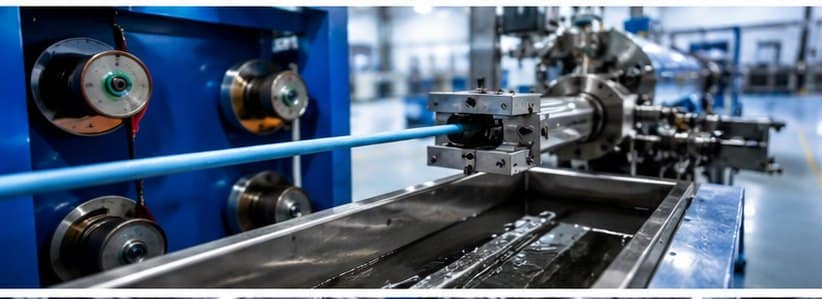
Cable pay-off unit and cooling trough on an extrusion line

How PVC and XLPE Cables Are Manufactured

Both PVC and XLPE cables begin the same way: a conductor is drawn from a pay-off through an extruder and crosshead that applies the insulation, then through a cooling trough, haul-off and take-up. The key difference is the cross-linking step for XLPE.

PVC Extrusion

PVC insulation is applied by melting the compound and extruding it around the conductor through the crosshead, then cooling it in a water trough. It is a single- or dual-layer extrusion process with no curing stage — simple, fast and cost-effective.

XLPE Extrusion & Cross-Linking

XLPE requires an extra step to cross-link the polyethylene. The three main methods are Sioplas and Monosil (silane grafting, moisture-cured) and CCV/CV (peroxide, continuously vulcanised) for medium and high voltage. Our Sioplas triple-layer lines apply the semiconducting screens and XLPE insulation in one pass for MV cables up to 33 kV — see our comparison of the Sioplas vs Monosil process for details.
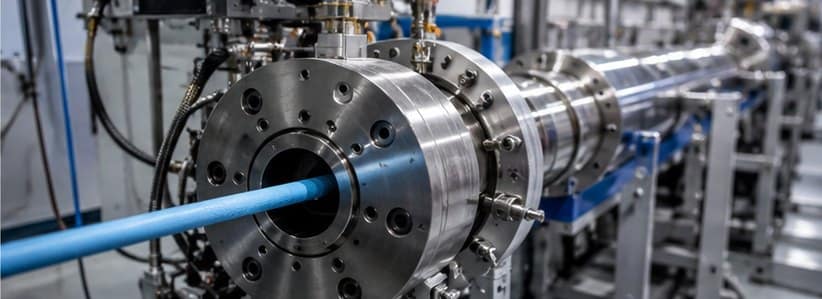
Extruder crosshead applying insulation on a cable

Both processes depend on precise crossheads, matched screws and barrels, and good insulation concentricity. Explore the full range from Sai Extrumech, extrusion machine manufacturers in India, or see all our cable extrusion lines.

Cable Standards for PVC and XLPE

  • PVC: IS 694 (up to 1100 V), IS 1554 (heavy-duty PVC cables) — Bureau of Indian Standards
  • XLPE: IS 7098 (XLPE insulated cables), IEC 60502 (power cables with extruded insulation)

PVC vs XLPE Cables: Key Takeaways

The choice of PVC vs XLPE cables comes down to temperature, voltage and cost. In short, PVC vs XLPE cables is decided by the job: PVC for low-voltage building wire, XLPE for higher-temperature power, solar and MV cables. For the insulation chemistry behind the difference, see cross-linked polyethylene (XLPE).

Frequently Asked Questions

Which is better, PVC or XLPE?

Neither is universally better — it depends on the application. PVC is better for low-voltage building wire where cost and flexibility matter. XLPE is better for power, medium- and high-voltage, solar and industrial cables that need higher temperature and current capacity.

Is XLPE more expensive than PVC?

Yes. XLPE compound costs more and requires an extra cross-linking step in manufacturing, so XLPE cable is more expensive than PVC. The higher current capacity and temperature rating often justify the cost in power applications.

Can XLPE handle higher temperatures than PVC?

Yes. XLPE is rated for 90°C continuous operation and up to 250°C under short-circuit, versus 70°C for standard PVC. Because it is cross-linked (thermoset), XLPE does not soften and re-melt like thermoplastic PVC.

What voltage can XLPE cables handle?

XLPE is used across low, medium and high voltage — from 1.1 kV building wire up to 33 kV and well beyond for utility transmission. PVC is limited to low voltage, typically up to 1.1 kV.

How is XLPE cable made?

XLPE cable is extruded like any cable, then the polyethylene is cross-linked so it becomes a thermoset. Common methods are Sioplas and Monosil (silane, moisture-cured) and CCV/CV (peroxide, continuously vulcanised) for medium and high voltage.

Which insulation is used for solar cables?

Solar (PV) cables use cross-linked insulation such as XLPE or XLPO because they must withstand high temperatures, UV and weather for 25+ years — conditions standard PVC cannot meet.

Conclusion

PVC and XLPE each win in their own domain: PVC for affordable, flexible low-voltage wiring, and XLPE for higher-temperature, higher-voltage power, solar and industrial cables. Whichever you produce, the quality comes down to the extrusion line and tooling. Sai Extrumech builds custom PVC and XLPE (Sioplas) cable extrusion lines up to 33 kV — share your cable specification and our team will recommend the right line.

For market context, see our India wire & cable industry statistics.
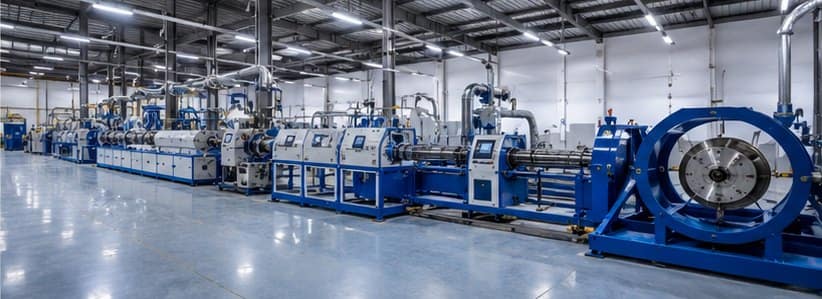
Wire and cable extrusion line production hall in India

The Future of High-Speed Cable Extrusion: Trends for 2026

Introduction

The cable and wire manufacturing industry is a dynamic landscape, constantly evolving to meet the demands of a rapidly advancing world. As we look towards 2026, the focus on high-speed cable extrusion trends 2026 intensifies, driven by technological innovations, increasing global connectivity, and the urgent need for sustainable practices. Manufacturers are under pressure to produce cables that are not only faster and more efficient but also environmentally friendly and cost-effective. This article delves into the key trends shaping the future of high-speed cable extrusion, offering insights for industry professionals seeking to stay ahead in this competitive market.

The Driving Forces Behind Extrusion Innovation

Several factors are propelling the evolution of cable extrusion technology. The proliferation of 5G networks, the expansion of data centers, the growth of renewable energy infrastructure, and the booming electric vehicle (EV) market are all creating unprecedented demand for high-performance cables. These applications require cables with superior electrical properties, enhanced durability, and often, smaller diameters. To meet these stringent requirements, extrusion processes must become more precise, faster, and capable of handling advanced materials.

Advancements in Material Science

The core of high-speed cable extrusion innovation lies in material science. Traditional PVC and polyethylene are being supplemented, and in some cases replaced, by advanced polymers and composites. These new materials offer improved dielectric strength, higher temperature resistance, and better flame retardancy. For instance, fluoropolymers are gaining traction in EV motor wire applications due to their superior performance characteristics . The development of halogen-free flame retardant (HFFR) compounds is also a significant trend, driven by stricter safety regulations and environmental concerns. These materials require specialized extrusion techniques to maintain their integrity and performance during processing.

Automation and Smart Manufacturing

The integration of automation and smart manufacturing principles is revolutionizing the cable extrusion industry. Advanced control systems, real-time monitoring, and predictive maintenance are becoming standard. These technologies enable manufacturers to optimize production parameters, reduce material waste, and minimize downtime. The goal is to achieve higher throughput with consistent quality, a critical aspect of high-speed cable extrusion trends 2026. Artificial intelligence (AI) and machine learning (ML) are also beginning to play a role, offering insights into process optimization and defect detection, further enhancing efficiency and product reliability.

Key High-Speed Cable Extrusion Trends for 2026

As the industry progresses, several distinct trends are emerging that will define high-speed cable extrusion in 2026 and beyond.

Increased Extrusion Speeds and Throughput

The demand for higher production volumes necessitates faster extrusion speeds. This is being achieved through innovations in extruder design, screw geometry, and cooling systems. Manufacturers are investing in machines capable of processing materials at unprecedented rates without compromising cable quality. The focus is on maximizing output per hour, which directly impacts profitability and market competitiveness. This drive for speed is a central theme in high-speed cable extrusion trends 2026.

Enhanced Precision and Quality Control

With cables becoming more complex and critical to various applications, precision and quality control are paramount. Advanced gauging systems, laser measurement devices, and sophisticated vision systems are being integrated into extrusion lines to ensure exact cable dimensions, insulation thickness, and concentricity. These systems provide immediate feedback, allowing for real-time adjustments and minimizing defects. The ability to consistently produce high-quality cables at high speeds is a significant differentiator in the market.

Focus on Sustainability and Energy Efficiency

Environmental responsibility is no longer an option but a necessity. The cable extrusion industry is responding by developing more sustainable manufacturing processes. This includes reducing energy consumption in extrusion lines through optimized motor designs and efficient heating and cooling systems. Furthermore, the use of recyclable materials and the minimization of waste are becoming key considerations. Manufacturers are also exploring ways to reduce their carbon footprint throughout the entire production lifecycle. Sai Extrumech, as a leading manufacturer, is committed to developing solutions that align with these sustainable goals.

Customization and Flexibility

The diverse requirements of modern applications mean that a one-size-fits-all approach to cable manufacturing is no longer viable. There is a growing trend towards customized extrusion lines that can be quickly reconfigured to produce different types of cables. This flexibility allows manufacturers to respond rapidly to changing market demands and cater to niche applications. Modular designs and quick-change tooling are becoming increasingly important in achieving this adaptability.

Integration of Industry 4.0 Technologies

Industry 4.0, characterized by the integration of cyber-physical systems, the Internet of Things (IoT), and cloud computing, is transforming cable extrusion. Data collected from various sensors and machines across the production line can be analyzed to identify bottlenecks, predict equipment failures, and optimize overall operational efficiency. This interconnectedness fosters a more intelligent and responsive manufacturing environment, further driving the high-speed cable extrusion trends 2026.

Sai Extrumech: Leading the Way in Extrusion Technology

In this evolving landscape, companies like Sai Extrumech are at the forefront of innovation. With 25 years of industry expertise, Sai Extrumech Pvt. Ltd. has established itself as a trusted and renowned name, offering a comprehensive product portfolio that includes a full range of extrusion machines, crossheads, caterpillars, capstans, screws and barrels, take-ups, and pay-offs. Their commitment to quality and innovation is evident in their state-of-the-art solutions engineered to excel in processing thermoplastics, fiber optics, halogen-free compounds, and more. Sai Extrumech’s ability to design and produce high-efficiency, bespoke equipment sets them apart, providing customized solutions tailored to specific needs, ensuring consistent and precise output across all applications.

Conclusion

The future of high-speed cable extrusion is characterized by relentless innovation, driven by the need for faster, more efficient, and sustainable cable production. The high-speed cable extrusion trends 2026 point towards increased automation, advanced material utilization, enhanced precision, and a strong emphasis on environmental responsibility. Manufacturers who embrace these trends and invest in cutting-edge technology will be well-positioned for success. Sai Extrumech, with its dedication to engineering excellence and customized solutions, continues to be a vital partner for the cable and wire manufacturing industry, helping businesses navigate these transformative changes and achieve superior results.

By Sai Extrumech Editorial Team  |  Published: March 18, 2026  |  Last Updated: April 10, 2026

Frequently Asked Questions

What line speeds can modern cable extrusion machines achieve?

Modern single-layer insulation lines typically achieve 800–1,200 m/min for conductors under 2.5 mm². Multi-layer or larger conductor lines run at 200–400 m/min. Modern Sai Extrumech single-layer cable extrusion lines achieve constructive line speeds of 800–1,200 m/min for building wire (conductors under 2.5 mm²). Multi-layer power cable lines run at 200–400 m/min depending on conductor cross-section.

What trends are driving high-speed cable extrusion in 2026?

Key trends include energy-efficient servo drive systems replacing hydraulic drives, real-time diameter monitoring with automatic correction, predictive maintenance via vibration sensors, and integration of AI-based process optimization that reduces material waste by adjusting extrusion parameters in real time.

What is the difference between PVC and XLPE insulation?

PVC is cost-effective and suited for low-voltage applications up to 70°C. XLPE offers superior performance at higher temperatures (up to 90°C continuous) and is required for medium and high-voltage power cables above 1 kV.

Can a cable extrusion line be customized for specific applications?

Yes. Sai Extrumech configures lines for specific cable types, conductor sizes, insulation materials, and line speeds — for automotive, power, solar, optical fibre, and building wire applications.

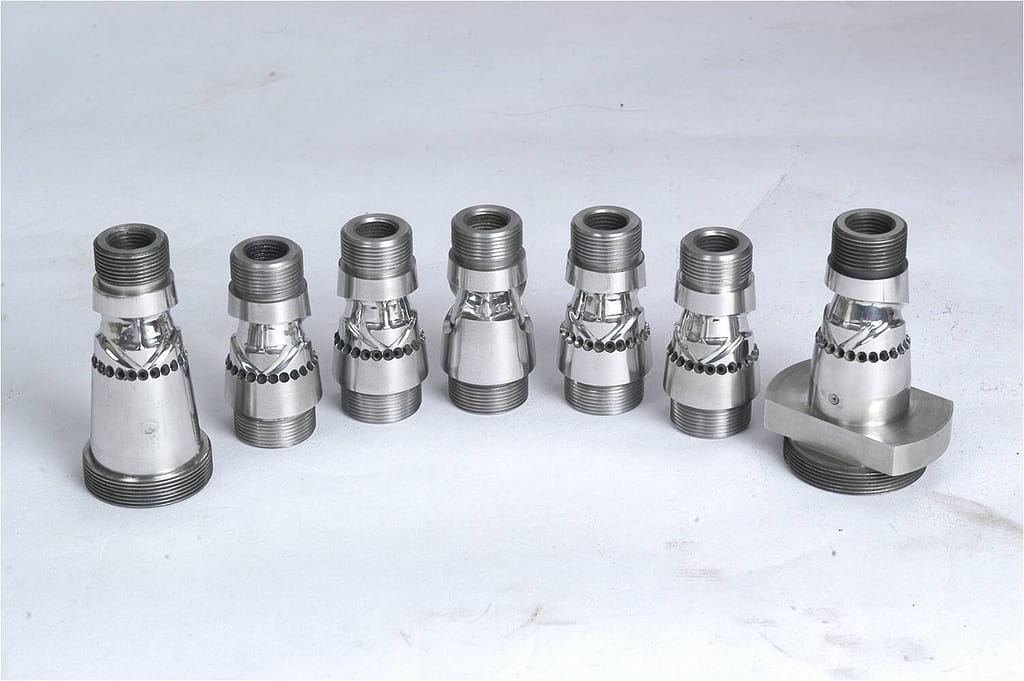
60–80 Skin Layer × Head Crosshead for Wire and Cable Extrusion

60–80 Skin Layer × Head Crosshead for Wire and Cable Extrusion

The 60–80 Skin Layer × Head Crosshead is a critical component used in wire and cable extrusion lines to ensure uniform insulation and precise material flow. Designed for high-performance extrusion processes, this crosshead plays a key role in achieving consistent wall thickness, concentricity, and surface finish in cables.

What is a 60–80 Skin Layer Extrusion Crosshead?

In wire and cable manufacturing, the 60–80 skin layer refers to the surface hardness range of the crosshead, achieved through controlled heat treatment or surface hardening. This hardness range offers an ideal balance between wear resistance and toughness, allowing the crosshead to withstand continuous exposure to molten polymers without deformation or premature wear.

The × head (crosshead) design ensures the polymer melt flows evenly around the conductor before insulation or sheathing is applied.

Role in Wire & Cable Extrusion

The extrusion crosshead directs molten material—such as PVC, XLPE, PE, or rubber compounds—around the wire or conductor. A properly engineered 60–80 skin layer crosshead helps:

  • Maintain uniform insulation thickness
  • Improve concentricity control
  • Reduce melt turbulence and pressure drop
  • Deliver smooth, defect-free cable surfaces

This directly impacts product quality and production efficiency.

Key Features

  • Hardened 60–80 skin layer for long service life
  • Precision-machined flow channels
  • Stable performance at high extrusion temperatures
  • Compatible with PVC, XLPE, and PE compounds
  • Suitable for single-core and multi-core cables

These features make it ideal for continuous, high-speed extrusion lines.

Applications

The 60–80 skin layer × head extrusion crosshead is widely used in:

  • House wire and building cables
  • Automotive and appliance wiring
  • Power and control cables
  • Flexible and industrial cables

It supports both insulation and sheathing extrusion processes.

Advantages in Production

Compared to standard crossheads, this hardened design offers:

  • Reduced wear and maintenance downtime
  • Consistent cable dimensions
  • Improved output quality
  • Longer tooling life

Conclusion

A 60–80 Skin Layer × Head Crosshead is an essential extrusion tooling solution for wire and cable manufacturers focused on quality, efficiency, and durability. Its optimized hardness, precision flow design, and material compatibility make it a reliable choice for modern cable extrusion operations.

By Sai Extrumech Editorial Team  |  Published: January 12, 2026  |  Last Updated: April 10, 2026

Frequently Asked Questions

What is an extrusion crosshead and why does it matter for cable quality?

A crosshead guides molten polymer uniformly around the conductor at the end of the extruder barrel. Crosshead design directly affects cable concentricity (uniform insulation thickness) and surface finish. Poor concentricity causes failures under electrical stress and is a primary quality rejection reason in cable manufacturing.

What is a skin layer crosshead and when is it used?

A skin layer (or X-head) crosshead applies a thin outer layer of a different material over a base insulation layer in a single pass. The 60-80 mm skin layer crosshead is used for building wire, flexible cables, and specialty cables requiring dual-material insulation such as colour-coded outer sheaths over primary insulation.

What line speeds can modern cable extrusion machines achieve?

Modern single-layer insulation lines typically achieve 800–1,200 m/min for conductors under 2.5 mm². Multi-layer or larger conductor lines run at 200–400 m/min. Sai Extrumech's EEL 20 series achieves up to 1,200 m/min constructive line speed.

Can a cable extrusion line be customized for specific applications?

Yes. Sai Extrumech configures lines for specific cable types, conductor sizes, insulation materials, and line speeds — for automotive, power, solar, optical fibre, and building wire applications.

Is Your Extruder “Eating” Your Profits? The Truth About Material Wastage

In cable and pipe manufacturing, raw material (PVC, XLPE, or PE) is your biggest expense. If your extruder lacks precision, you aren’t just making cables—you are giving away free material with every meter produced.

The “Overweight” Problem

Most older or generic extruders struggle with Concentricity (keeping the wire perfectly centered in the insulation). To meet safety standards, operators often over-extrude insulation to compensate for poor centering.

  • Result: You use 10-15% more material than necessary.
  • Cost: That’s lakhs of rupees in wasted resin annually.

The Sai Extrumech Fix: Precision Engineering

At Sai Extrumech, we don’t just build machines; we build profit-savers. Our Self-Centering Cross Heads and precision-engineered Screw Barrels ensure:

  1. Perfect Concentricity: The conductor stays dead center.
  2. Thinner Tolerances: You can run closer to the minimum required thickness without breaching safety limits.
  3. Zero Start-up Scrap: Our high-speed lines stabilize instantly, reducing the pile of waste at the start of a run.

Stop Burning Cash on Resin

Your machinery shouldn’t be a liability. Whether you are running a 70mm High-Speed Line or a delicate Medical Tubing operation, accuracy is the only metric that matters for your bottom line.

Upgrade to precision. Upgrade to Sai Extrumech.

By Sai Extrumech Editorial Team  |  Published: November 27, 2025  |  Last Updated: April 10, 2026

Frequently Asked Questions

What is the difference between PVC and XLPE insulation in cable extrusion?

PVC (Polyvinyl Chloride) is the most common cable insulation, cost-effective and suited for low-voltage applications up to 70°C. XLPE (Cross-linked Polyethylene) offers superior performance at higher temperatures (up to 90°C continuous), better electrical properties, and is required for medium and high-voltage power cables above 1 kV.

What line speeds can modern cable extrusion machines achieve?

Modern single-layer insulation lines typically achieve 800–1,200 m/min for conductors under 2.5 mm². Multi-layer or larger conductor lines run at 200–400 m/min. Sai Extrumech's EEL 20 series achieves up to 1,200 m/min constructive line speed.

What is an extrusion crosshead and why does it matter for cable quality?

A crosshead guides molten polymer uniformly around the conductor at the end of the extruder barrel. Crosshead design directly affects cable concentricity (uniform insulation thickness) and surface finish. Poor concentricity causes failures under electrical stress.

How often should extrusion screws and barrels be replaced?

Under normal conditions with standard PVC, quality hardened screws and barrels last 3–7 years. Abrasive or high-temperature compounds like XLPE accelerate wear. Signs: reduced output at the same RPM, increased pressure variation, inconsistent melt quality.

Can a cable extrusion line be customized for specific applications?

Yes. Sai Extrumech configures lines for specific cable types, conductor sizes, insulation materials, and line speeds. Custom elements include extruder diameter and L/D ratio, crosshead design, cooling trough length, and capstan configuration — for automotive, power, solar, optical fibre, and building wire.