
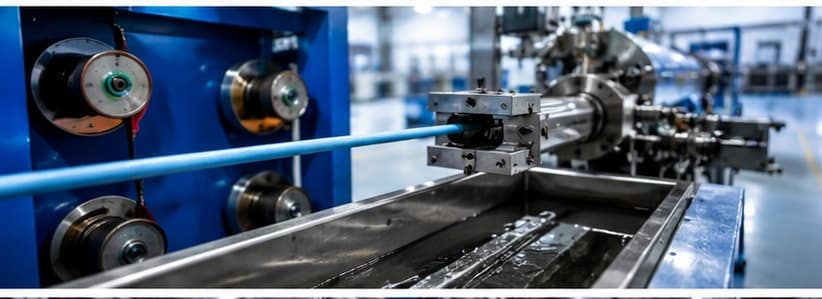
PVC vs XLPE cables is the most common insulation choice a cable maker faces. PVC and XLPE are the two most common cable insulation materials, and choosing between them decides your cable’s temperature rating, voltage capability and cost. In short: PVC (polyvinyl chloride) is cheaper and more flexible for low-voltage wiring, while XLPE (cross-linked polyethylene) handles higher temperatures and voltages for power cables. This guide compares PVC vs XLPE in detail — and explains how each is manufactured on an extrusion line.
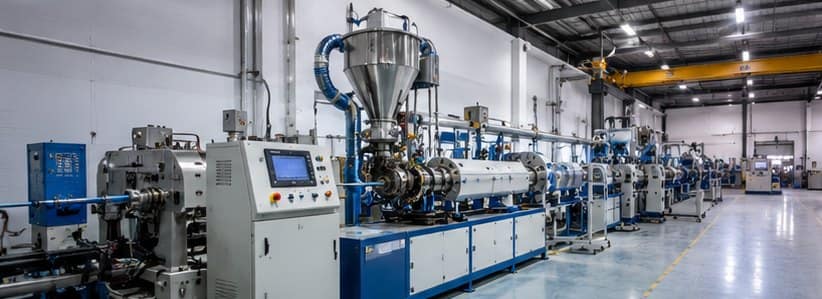
PVC vs XLPE Cables: Quick Comparison
| Property | PVC | XLPE |
|---|---|---|
| Full name | Polyvinyl Chloride (thermoplastic) | Cross-Linked Polyethylene (thermoset) |
| Max conductor temp | 70°C (up to 105°C special grades) | 90°C continuous, 250°C short-circuit |
| Voltage range | Low voltage (up to 1.1 kV) | LV, MV & HV (up to 33 kV and beyond) |
| Insulation resistance | Good | Excellent |
| Dielectric losses | Higher | Lower |
| Current-carrying capacity | Lower | ~20-30% higher (for same size) |
| Flexibility | More flexible | Stiffer |
| Moisture & chemical resistance | Good | Excellent |
| Relative cost | Lower | Higher |
| Manufacturing | Standard extrusion | Extrusion + cross-linking (Sioplas / Monosil / CCV) |
| Typical use | House & building wire, control cables | Power, MV/HV, solar & industrial cables |
What Is PVC Cable Insulation?
PVC (polyvinyl chloride) is a thermoplastic insulation used on the vast majority of low-voltage cables — house wiring, building wire and control cables. It is valued for being flexible, cost-effective and inherently flame-retardant. Standard PVC is rated to 70°C (special grades to 105°C) and voltages up to 1.1 kV, and is manufactured to IS 694 and IS 1554.
Its limitations are a lower temperature and voltage ceiling, higher dielectric losses, and the release of smoke and halogen gases when burning — which is why low-smoke (LSZH/HFFR) compounds are preferred in enclosed spaces. PVC insulation is applied on a straightforward building wire extrusion line using a precision crosshead.
What Is XLPE Cable Insulation?
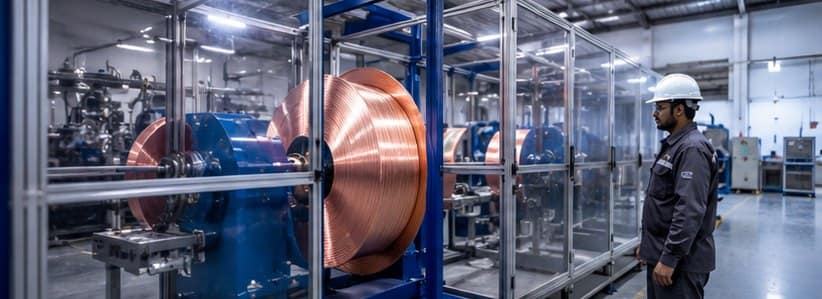
XLPE (cross-linked polyethylene) is a thermoset insulation created by chemically cross-linking polyethylene, so the material no longer melts when heated. This gives XLPE a much higher continuous temperature rating (90°C, and 250°C under short-circuit), excellent insulation resistance, low dielectric loss and superb moisture and chemical resistance. It is used from low voltage right up to medium- and high-voltage power cables and is made to IS 7098 and IEC 60502.
The trade-offs are higher material cost, greater stiffness, and an extra cross-linking step in production. But for power, solar and industrial cables, XLPE’s higher current capacity and durability usually justify the cost. See our Sioplas triple-layer HT-XLPE line for MV cables up to 33 kV.
PVC vs XLPE: The Key Differences
Temperature Rating
XLPE operates at 90°C continuously versus 70°C for standard PVC, and withstands 250°C during short-circuit faults. Because XLPE is a thermoset it will not soften or deform at high temperature, while thermoplastic PVC can.
Voltage & Current Capacity
PVC is a low-voltage material (up to 1.1 kV). XLPE spans low, medium and high voltage — up to 33 kV and beyond. For the same conductor size, XLPE also carries roughly 20–30% more current thanks to its higher temperature rating.
Electrical Performance
XLPE has higher insulation resistance and lower dielectric losses than PVC, meaning less energy wasted as heat in the insulation — important for efficient power transmission.
Mechanical & Environmental
PVC is more flexible and easier to strip and handle. XLPE resists moisture, chemicals and ageing far better, making it the choice for buried, submerged, solar and industrial cables exposed to harsh conditions.
Cost
PVC is cheaper on both material and processing. XLPE costs more and needs cross-linking equipment, so it is reserved for applications where its performance is required rather than general wiring.
When to Choose PVC vs XLPE
Choose PVC for low-voltage house wiring, building wire, control cables and budget-sensitive indoor applications where flexibility matters. Choose XLPE for power cables, medium- and high-voltage lines, solar (PV) cables, submersible and industrial cables that face heat, high current or harsh environments. Many modern cables even combine both — XLPE insulation with a PVC outer sheath.
How PVC and XLPE Cables Are Manufactured
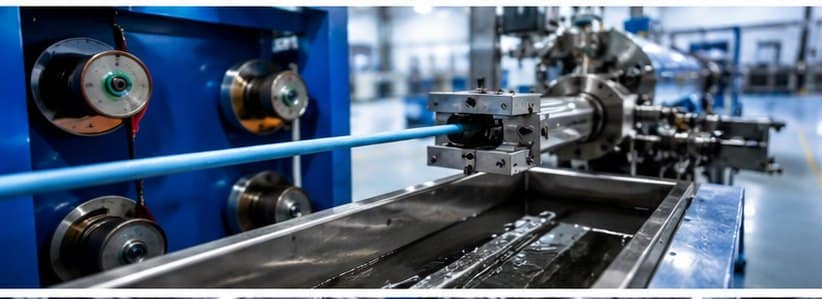
Both PVC and XLPE cables begin the same way: a conductor is drawn from a pay-off through an extruder and crosshead that applies the insulation, then through a cooling trough, haul-off and take-up. The key difference is the cross-linking step for XLPE.
PVC Extrusion
PVC insulation is applied by melting the compound and extruding it around the conductor through the crosshead, then cooling it in a water trough. It is a single- or dual-layer extrusion process with no curing stage — simple, fast and cost-effective.
XLPE Extrusion & Cross-Linking
XLPE requires an extra step to cross-link the polyethylene. The three main methods are Sioplas and Monosil (silane grafting, moisture-cured) and CCV/CV (peroxide, continuously vulcanised) for medium and high voltage. Our Sioplas triple-layer lines apply the semiconducting screens and XLPE insulation in one pass for MV cables up to 33 kV — see our comparison of the Sioplas vs Monosil process for details.
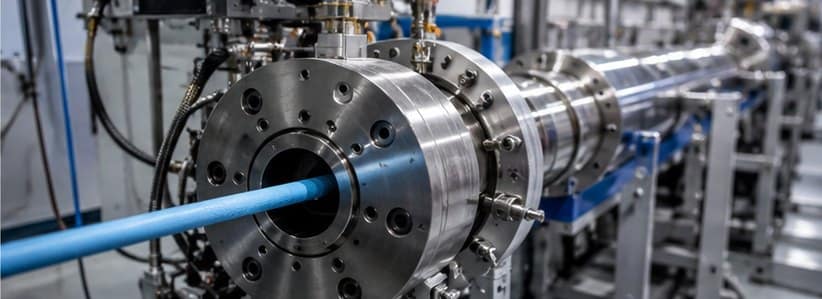
Both processes depend on precise crossheads, matched screws and barrels, and good insulation concentricity. Explore the full range from Sai Extrumech, extrusion machine manufacturers in India, or see all our cable extrusion lines.
Cable Standards for PVC and XLPE
- PVC: IS 694 (up to 1100 V), IS 1554 (heavy-duty PVC cables) — Bureau of Indian Standards
- XLPE: IS 7098 (XLPE insulated cables), IEC 60502 (power cables with extruded insulation)
PVC vs XLPE Cables: Key Takeaways
The choice of PVC vs XLPE cables comes down to temperature, voltage and cost. In short, PVC vs XLPE cables is decided by the job: PVC for low-voltage building wire, XLPE for higher-temperature power, solar and MV cables. For the insulation chemistry behind the difference, see cross-linked polyethylene (XLPE).
Frequently Asked Questions
Which is better, PVC or XLPE?
Neither is universally better — it depends on the application. PVC is better for low-voltage building wire where cost and flexibility matter. XLPE is better for power, medium- and high-voltage, solar and industrial cables that need higher temperature and current capacity.
Is XLPE more expensive than PVC?
Yes. XLPE compound costs more and requires an extra cross-linking step in manufacturing, so XLPE cable is more expensive than PVC. The higher current capacity and temperature rating often justify the cost in power applications.
Can XLPE handle higher temperatures than PVC?
Yes. XLPE is rated for 90°C continuous operation and up to 250°C under short-circuit, versus 70°C for standard PVC. Because it is cross-linked (thermoset), XLPE does not soften and re-melt like thermoplastic PVC.
What voltage can XLPE cables handle?
XLPE is used across low, medium and high voltage — from 1.1 kV building wire up to 33 kV and well beyond for utility transmission. PVC is limited to low voltage, typically up to 1.1 kV.
How is XLPE cable made?
XLPE cable is extruded like any cable, then the polyethylene is cross-linked so it becomes a thermoset. Common methods are Sioplas and Monosil (silane, moisture-cured) and CCV/CV (peroxide, continuously vulcanised) for medium and high voltage.
Which insulation is used for solar cables?
Solar (PV) cables use cross-linked insulation such as XLPE or XLPO because they must withstand high temperatures, UV and weather for 25+ years — conditions standard PVC cannot meet.
Conclusion
PVC and XLPE each win in their own domain: PVC for affordable, flexible low-voltage wiring, and XLPE for higher-temperature, higher-voltage power, solar and industrial cables. Whichever you produce, the quality comes down to the extrusion line and tooling. Sai Extrumech builds custom PVC and XLPE (Sioplas) cable extrusion lines up to 33 kV — share your cable specification and our team will recommend the right line.
For market context, see our India wire & cable industry statistics.

Add a Comment