
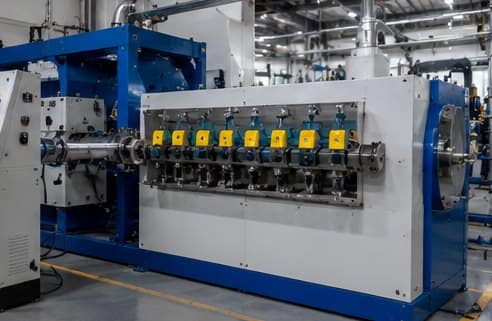
Single screw extruder machine for wire and cable

Extruder Screw Design Explained: Zones, L/D Ratio and Compression

Good extruder screw design is the single biggest factor in how well an extrusion line runs. The screw does three jobs at once – convey, melt and pump – and its geometry decides the output rate, the melt quality and how long the machine lasts. This guide explains how an extruder screw is designed: the three zones, the key parameters (L/D ratio, compression ratio, flight geometry), and how the design changes with the polymer you run.
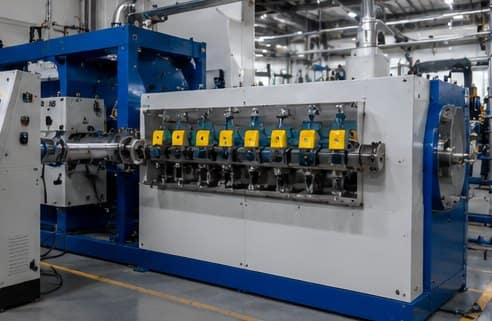
Single screw extruder machine for wire and cable

Why Extruder Screw Design Matters

The screw is the heart of any extruder. A screw designed for the wrong polymer will surge, melt unevenly, overheat or under-melt, and quietly waste energy and material. Because the screw sets the process window, getting the design right is far cheaper than compensating for a poor screw with temperature and speed tweaks later. For the wider context, see how plastic extrusion works end to end, and for a neutral overview of the process see Wikipedia.

The Three Zones of an Extruder Screw

Almost every single-screw design is divided into three zones along its length, each doing a distinct job:

  • Feed zone — deep flights grab cool pellets from the hopper and convey them forward. Depth here is greatest so the screw can move a large volume of solid material.
  • Compression (transition) zone — the channel depth shrinks gradually, compressing the polymer, squeezing out trapped air and generating the shear heat that melts it. Most melting happens here.
  • Metering zone — shallow, constant-depth flights build steady pressure and homogenise the melt so it leaves the screw at a uniform rate and temperature.

How much each zone contributes depends on the polymer. A screw for a slow-melting compound needs a longer transition zone; a screw for a heat-sensitive material keeps residence time short.

Key Screw Design Parameters

  • L/D ratio — barrel length divided by screw diameter, usually 20:1 to 33:1. A higher L/D ratio gives more residence time, better mixing and a more stable melt; a lower L/D suits heat-sensitive polymers.
  • Compression ratio — feed-zone channel volume divided by metering-zone volume, typically 2:1 to 4:1. It controls how hard the polymer is compressed as it melts.
  • Channel depth — deep in the feed zone for throughput, shallow in the metering zone for pressure and mixing.
  • Flight pitch and helix angle — a square-pitch screw (pitch equal to diameter, ~17.7° helix) is the common default; changing pitch tunes conveying and shear.
  • Mixing and barrier sections — barrier flights or Maddock-type mixers improve melt homogeneity for demanding compounds such as XLPE and masterbatch.

Screw Design by Material

There is no universal screw. The design has to follow the polymer’s melt behaviour:

  • Rigid PVC — heat-sensitive, so a low compression ratio (~2:1–2.5:1) and moderate L/D keep residence time and shear down to avoid degradation.
  • Polyethylene & polypropylene — tolerate a higher compression ratio (~3:1–4:1) and higher L/D for strong melting and output.
  • XLPE and filled compounds — benefit from barrier or mixing sections for melt uniformity; abrasive or filled materials call for hard-wearing construction.
  • Rubber and silicone — use dedicated cold-feed screw geometries quite different from thermoplastic designs.
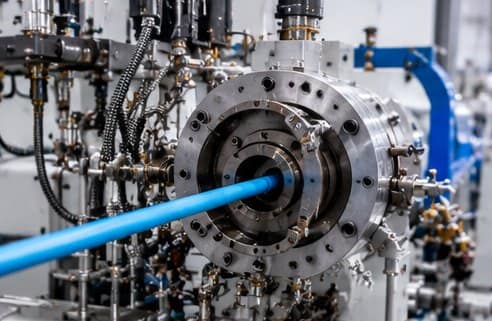
Extruder crosshead die forming cable insulation

Screw Metallurgy: Nitrided vs Bimetallic

Geometry decides how a screw performs; metallurgy decides how long it lasts. Nitrided screws (nitriding steel case-hardened to around 900–1000 HV) are the economical choice for PVC, PE and most unfilled thermoplastics. Bimetallic construction, with a wear-resistant alloy layer around 60–65 HRC, is the answer for abrasive, glass-filled and flame-retardant compounds. We cover this in depth on our screw and barrel manufacturing page.

Single-Screw vs Twin-Screw Design

Single-screw design relies on drag flow and is ideal for straightforward extrusion of pipe, sheet, profile and cable insulation. Twin-screw design uses two intermeshing screws built from modular elements for far stronger, controllable mixing, which is why it dominates compounding and reactive extrusion. See our single-screw vs twin-screw comparison for how to choose.

Signs of a Poorly Designed Screw

  • Surging or pulsing output and fluctuating melt pressure
  • Unmelted particles or poor colour and additive dispersion
  • Overheating (excessive shear) or under-melting (insufficient shear)
  • High motor load and energy use for the output achieved
  • Rapid, uneven wear — often a sign the screw is fighting the material; see screw wear causes and prevention

How Sai Extrumech Designs Screws

We design and manufacture screws around your exact compound, output target and extruder. That means choosing the L/D ratio, compression ratio, zone lengths and any mixing section for your material, then building the screw in nitrided or bimetallic construction to match the wear it will see. If you are unsure which geometry fits, our guide to selecting the right screw and barrel walks through it, or talk to our engineers with your material and machine details.

Frequently Asked Questions

What is extruder screw design?

Extruder screw design is the engineering of a screw’s geometry – its length-to-diameter (L/D) ratio, compression ratio, channel depth, flight pitch and any mixing sections – so it melts and pumps a specific polymer at the required output and melt quality. The right screw design is matched to the material, not one-size-fits-all.

What are the three zones of an extruder screw?

An extruder screw has a feed zone with deep flights that convey cool pellets, a compression (transition) zone where the channel gets shallower to melt the polymer and squeeze out air, and a metering zone with shallow flights that builds uniform pressure so the melt leaves at a steady rate.

What is a good compression ratio for an extruder screw?

Compression ratio is the ratio of feed-zone channel volume to metering-zone channel volume, typically 2:1 to 4:1. Heat-sensitive polymers like rigid PVC use a lower ratio (around 2:1 to 2.5:1), while polyethylene and polypropylene use higher ratios (around 3:1 to 4:1).

How does L/D ratio affect screw design?

The L/D ratio sets how much barrel length the polymer travels through. A higher L/D (25:1 to 33:1) gives more residence time for better melting and mixing and a more stable melt temperature; a lower L/D (20:1 to 24:1) suits heat-sensitive materials that should not stay hot for long.

How do you match a screw to the material?

Match compression ratio, L/D and any mixing section to the polymer’s melt behaviour: low compression and moderate L/D for PVC, higher compression for PE and PP, barrier or mixing sections for XLPE and hard-to-melt compounds, and bimetallic construction for abrasive or filled materials.

What happens if the screw design is wrong?

A mismatched screw causes unstable output (surging), poor melt homogeneity, overheating or under-melting, and higher scrap. It also wastes energy and accelerates wear, so correcting screw design is one of the cheapest ways to improve an extrusion line’s output and quality.

Conclusion

Extruder screw design comes down to matching geometry to the polymer: the three zones, the L/D and compression ratios, and any mixing section all have to suit the material you run. Get that match right and output, melt quality and machine life all improve together. If you are specifying a new screw or troubleshooting an old one, tell us your material and extruder and we will design the right screw for the job.

Single screw extruder machine for wire and cable

Optimizing Cable Extrusion: The Critical Role of Precision Screws and Barrels

Optimizing Cable Extrusion: The Critical Role of Precision Screws and Barrels

In the intricate world of wire and cable manufacturing, achieving superior product quality and operational efficiency hinges on the performance of every component within the extrusion line. Among these, the screw and barrel assembly stands out as the heart of the extruder. Its design, material, and precision engineering directly influence the melt quality, output consistency, and overall profitability of the extrusion process. This article delves into the paramount importance of precision screws and barrels in modern cable extrusion, exploring how their optimized design contributes to enhanced performance across various cable types.

The Core Function of Screws and Barrels in Extrusion

The primary role of the screw and barrel is to convey, melt, mix, and homogenize polymer raw materials before they are extruded through a die to form the cable insulation or sheath. This seemingly straightforward process involves complex thermodynamic and rheological principles. The screw’s geometry—including its flight depth, pitch, and compression ratio—is meticulously designed to handle specific polymer characteristics, ensuring efficient heat transfer and uniform melting without degradation. The barrel, which encases the screw, provides the necessary heating and cooling zones to control the polymer’s temperature profile. The interaction between the rotating screw and the stationary barrel generates shear forces crucial for melting and mixing. Any deviation in the precision of these components can lead to inconsistencies in melt temperature, pressure fluctuations, and poor material homogenization, ultimately compromising the final product’s electrical and mechanical properties.

Precision Engineering: A Game Changer for Cable Quality

The demands of the cable industry—from high-speed data transmission to robust power distribution—necessitate unparalleled precision. For instance, in optical fibre cable extrusion lines, even microscopic variations in insulation thickness can significantly impact signal integrity. Similarly, for solar cables and XLPE cables, consistent material distribution is vital for long-term durability and safety under harsh environmental conditions.

Optimized Screw Design for Diverse Polymers

Different cable types utilize a wide array of polymer compounds, each with unique melting points, viscosities, and shear sensitivities. A “one-size-fits-all” approach to screw design is therefore inadequate. Precision screw manufacturers like Sai Extrumech specialize in designing application-specific screws that cater to the rheological properties of materials such as PVC, PE, XLPE, LSZH, and fluoropolymers. This customization ensures:
  • Efficient Melting: Proper flight design and compression ratios ensure gradual and uniform melting, preventing localized overheating and polymer degradation.
  • Superior Mixing: Specialized mixing sections, such as Maddock or barrier sections, enhance homogenization, distributing additives and colorants evenly throughout the melt.
  • Consistent Output: Optimized screw geometry minimizes pressure and temperature fluctuations, leading to a stable melt flow and consistent cable dimensions.

The Role of Barrel Integrity and Material Science

The barrel’s construction is equally critical. It must withstand high pressures, abrasive wear from fillers, and corrosive effects from certain polymers and their byproducts. Modern barrels are often constructed from specialized alloys and treated with advanced coatings (e.g., bimetallic linings) to enhance wear resistance and extend operational life. The precision of the barrel’s internal diameter and its concentricity with the screw are paramount for maintaining consistent shear rates and preventing material hang-ups.

Impact on Operational Efficiency and Cost Savings

Investing in high-quality, precision-engineered screws and barrels translates directly into significant operational benefits and cost savings for cable manufacturers:
  • Reduced Scrap Rates: Consistent melt quality and dimensional stability minimize product defects, leading to lower scrap generation and material waste.
  • Increased Throughput: Optimized designs allow for higher screw speeds and greater output without compromising quality, boosting productivity.
  • Lower Energy Consumption: Efficient melting and conveying reduce the energy required to process polymers, contributing to lower operational costs.
  • Extended Lifespan of Components: Superior materials and manufacturing precision reduce wear and tear, extending the service life of both the screw and barrel and minimizing downtime for replacements.
  • Faster Changeovers: Well-designed components facilitate quicker cleaning and material changeovers, enhancing production flexibility.
For manufacturers looking to upgrade or maintain their extrusion lines, partnering with a specialized screw and barrel manufacturer is crucial. Companies like Sai Extrumech offer comprehensive solutions, from custom design to manufacturing and refurbishment, ensuring that each component is perfectly matched to the specific application and polymer.

Advanced Technologies in Screw and Barrel Manufacturing

The evolution of cable extrusion technology is closely tied to advancements in screw and barrel manufacturing. Modern techniques include:
  • Computational Fluid Dynamics (CFD): Used to simulate polymer flow and heat transfer within the screw and barrel, allowing for virtual optimization of designs before physical prototyping.
  • Advanced Material Alloys: Development of new alloys and bimetallic constructions that offer superior resistance to wear, corrosion, and high temperatures.
  • Precision Machining: State-of-the-art CNC machining and grinding techniques ensure extremely tight tolerances and smooth surface finishes, critical for consistent performance.
These technological advancements enable the production of screws and barrels that can handle increasingly complex polymer formulations and meet the stringent quality requirements of next-generation cables, including those for 5G infrastructure, electric vehicles, and renewable energy systems.

Conclusion

The screw and barrel assembly is undeniably a cornerstone of the cable extrusion process. Its precision engineering and optimized design are not merely desirable features but essential prerequisites for achieving high-quality cable products, maximizing operational efficiency, and ensuring long-term profitability. As the cable industry continues to innovate, the role of specialized manufacturers in providing bespoke screw and barrel solutions will only grow in importance, driving forward the capabilities of extrusion technology worldwide. For more information on high-quality extrusion components and complete extrusion lines, visit Sai Extrumech.
By Sai Extrumech Editorial Team  |  Published: March 24, 2026  |  Last Updated: April 10, 2026

Precision screws and barrels are the core mechanical components of a cable extrusion machine — the screw rotates inside the barrel to melt, homogenise, and push thermoplastic compound through the die at controlled pressure and temperature. Their geometry (L/D ratio, compression ratio, flight depth) directly determines melt quality, output rate, and insulation consistency.

Industry Data:
  • Worn screws and barrels account for up to 35% of unplanned downtime in cable extrusion plants (Plastics Technology, 2023)
  • Bi-metallic barrel liners extend service life by 3–5× compared to standard nitrided steel in abrasive compound applications (SPE ANTEC, 2022)

Frequently Asked Questions

How often should extrusion screws and barrels be replaced?

Under normal conditions with standard PVC, quality hardened screws and barrels typically last 3–7 years. Processing abrasive compounds (glass-filled, flame retardant) or high-temperature materials like XLPE accelerates wear. Signs of wear include reduced output at the same RPM, increased pressure variation, and inconsistent melt quality.

What materials require bi-metallic screw and barrel construction?

Bi-metallic construction is recommended for processing abrasive compounds including HFFR, glass-filled materials, highly filled flame retardants, and mineral-based compounds. The hardened inner lining of bi-metallic barrels significantly extends service life compared to standard nitrided steel construction.

What is the ideal L/D ratio for a cable extrusion screw?

For PVC cable extrusion, L/D ratios of 20:1 to 25:1 are standard. For XLPE and HFFR compounds requiring more homogeneous mixing, ratios of 25:1 to 30:1 are preferred. Higher L/D ratios improve melt homogeneity but require longer screws and barrels.

What is the difference between PVC and XLPE insulation in cable extrusion?

PVC is cost-effective and suited for low-voltage applications up to 70°C. XLPE offers superior performance at higher temperatures (up to 90°C continuous) and is required for medium and high-voltage power cables above 1 kV.

Can a cable extrusion line be customized for specific applications?

Yes. Sai Extrumech configures lines for specific cable types, conductor sizes, insulation materials, and line speeds — for automotive, power, solar, optical fibre, and building wire applications.