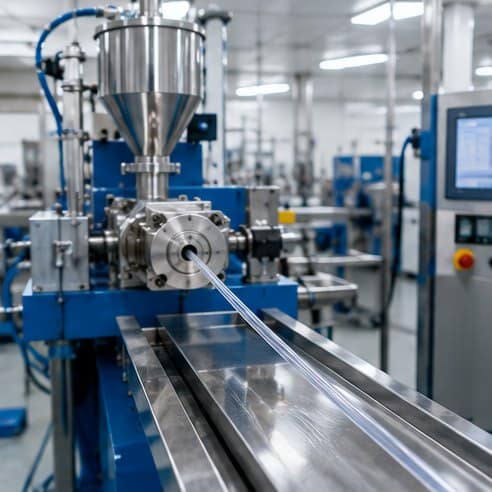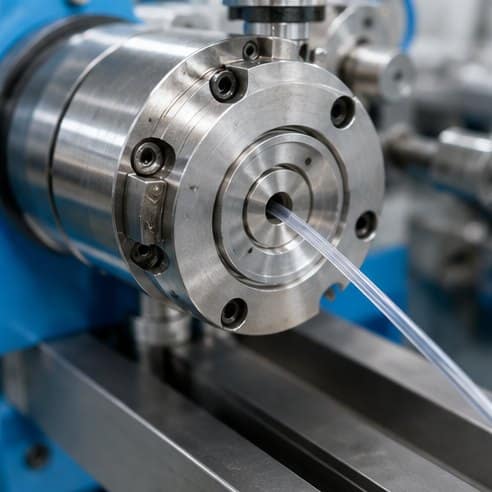

Medical tubing inspection and measurement is what proves a tube meets its specification. In medical manufacturing the tube is only half the deliverable; the other half is proof that every metre met specification. That proof comes from measurement — continuous, non-contact, and logged. Here is how medical tubing is inspected on the line and why the evidence matters as much as the product.
In-line measurement: catching drift as it happens
Because tubing is produced continuously, inspection has to be continuous too. The workhorses are non-contact:
- Laser micrometers read outer diameter hundreds of times per second as the tube leaves the sizing trough.
- Ultrasonic wall gauges measure wall thickness and concentricity without touching the product.
- Vision systems watch for surface defects, gels and specks.
Crucially these are not just alarms. Their signals feed the line’s closed-loop control, nudging haul-off, vacuum and output to keep dimensions centred. A well-tuned medical tubing extrusion line spends its run correcting tiny drifts before they ever become scrap.
Concentricity: the measurement that matters most
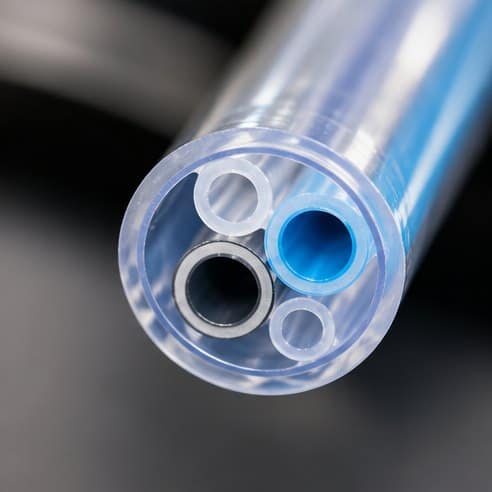
For tubing, the wall must be even around the lumen. Off-centre walls mean a thin, weak side and wasted material on the other. Ultrasonic and laser wall gauges compute concentricity live, so an operator can see immediately which way the wall has drifted and correct it. This is the same quality axis that governs catheter tubing, where an even wall is a safety requirement.
Validation and traceability
A medical process is qualified (IQ/OQ/PQ), not merely set up, and once qualified the recipe is locked. Every run logs its parameters and raw-material lot so a finished batch can be traced back to exactly how and when it was made. A beautifully extruded tube with no evidence behind it is, from a regulatory standpoint, unusable.
Our Medical Tubing Inspection Capabilities
Medical tubing is only as good as its measurement. On our medical tubing extrusion lines we combine in-line and off-line inspection: laser micrometers track outer diameter continuously, ultrasonic and capacitance gauges check wall thickness and inner diameter, and vision systems flag surface defects. Off-line, we verify concentricity, ovality, tensile strength and burst pressure against your specification.
Every result can be documented for batch traceability, supporting quality systems such as ISO 13485 — so you can prove each length of tubing met spec before it ships.
What We Measure
- Outer diameter — continuous in-line laser measurement
- Wall thickness and inner diameter — ultrasonic and capacitance gauges
- Concentricity and ovality
- Tensile strength and burst pressure
- Surface and defect inspection
- Documented, batch-level traceability
Related: see catheter tubing extrusion, bump & tapered tubing and choosing a tubing material.
Medical Tubing Inspection: Key Takeaways
Reliable medical tubing inspection combines continuous in-line laser and ultrasonic measurement with documented, batch-level traceability. Because medical devices are regulated, the goal of medical tubing inspection is not only to catch defects as they happen but to prove that every metre of tube met its specification before it ships. Getting the measurement and dimensional metrology right up front is far cheaper than discovering an out-of-spec dimension after a full batch has been produced, packed and delivered to a device maker.
Frequently asked questions
How is medical tubing measured during production?
Medical tubing is measured continuously by non-contact laser micrometers (outer diameter) and ultrasonic gauges (wall thickness and concentricity), whose readings feed the line’s closed-loop control to hold dimensions in real time.
What is concentricity in medical tubing?
Concentricity describes how evenly the wall is distributed around the lumen. Good concentricity means uniform wall thickness; poor concentricity leaves a thin, weaker side and wastes material on the thick side.