Screw Wear in Extrusion: Causes, Symptoms, and Prevention
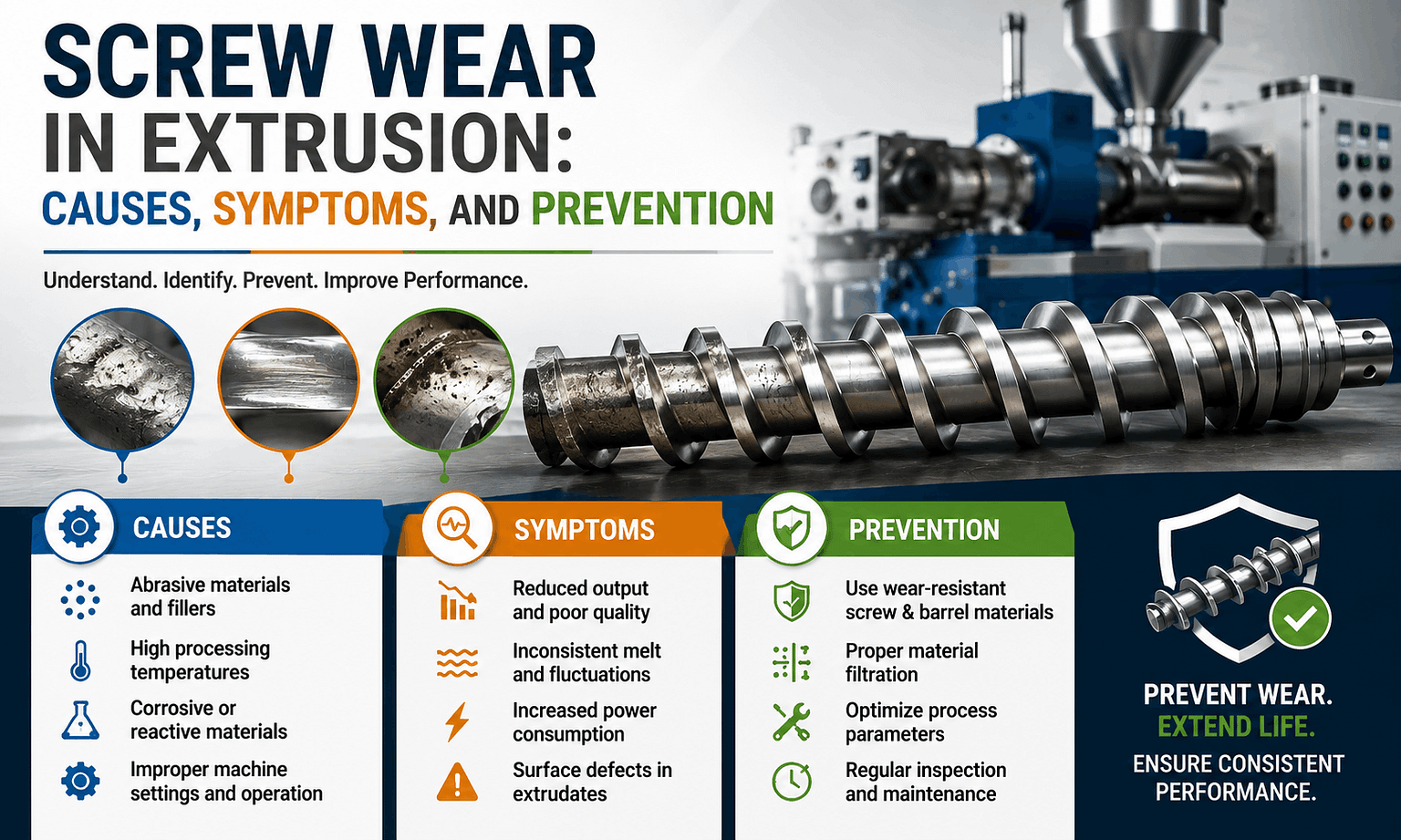
In most extrusion plants, screw wear is a silent killer. All you see on the outside is lower output, jumpy melt quality, or a sudden spike in power consumption—while the actual root cause stays hidden deep inside the barrel.
Because this wear happens gradually over months of continuous friction, it’s easy for maintenance teams to miss it until production performance takes a serious hit. But waiting until a complete failure happens means facing massive downtime and spiked operating costs. Let’s review the key technical aspects to identify early warning signs, measure damage accurately, and protect your extrusion line.
What Is Screw Wear?
In simple terms, screw wear is the progressive loss of metal from the screw’s surface due to the intense mechanical, chemical, and thermal stress it undergoes during normal operation.
This erosion primarily happens in three critical areas:
-
- The Flight Tips (The outermost edge of the screw)
-
- The Flight Flanks (The sides of the screw flights)
-
- The Screw Root (The main inner shaft or core of the screw)
The New Machine Baseline
On a brand-new extruder, the clearance between the screw flight tips and the barrel bore is incredibly tight—typically just 0.1 to 0.25 mm radially, depending on the screw’s diameter. During normal production, this tiny gap stays filled with a thin film of molten plastic. This film acts as a hydraulic cushion, preventing dangerous metal-to-metal contact and ensuring that the polymer is pumped forward efficiently.
3 Types of Screw Wear and How They Affect Extrusion Performance
In reality, every single wear problem you face in an extruder traces back to one of three mechanisms—or a nasty combination of all three.
Abrasive Wear:
Abrasive wear is the most common form of extrusion screw wear. It’s caused by hard particles in the polymer compound grinding against the metal surfaces of the screw and barrel as the material flows through the channels under pressure.
Common abrasive fillers include:
-
- Glass fiber — the most aggressive. Angular particles at high loading in PA-GF or PP-GF compounds can devastate a standard screw within a few thousand hours
-
- Calcium carbonate (CaCO₃)— heavily used in PVC pipe and PE film; highly abrasive at elevated loadings
-
- Talc and mica — moderate abrasion, common in PP automotive compounds
-
- Titanium dioxide (TiO₂) — aggressive even at low percentages due to particle hardness
-
- Flame retardants— especially mineral-based types like ATH and magnesium hydroxide
-
- Wood flour and natural fiber — common in WPC profile applications
-
- Contaminated regrind or recycled material — unpredictable particle content; always a wear risk
What Actually Determines the Damage?
How fast a filler destroys your screw comes down to four things: its hardness, shape, size, and loading percentage. If the particles are harder than your screw’s metal, or have sharp, angular shapes—think of them like tiny knives—they will cut into the metal much faster than rounded ones. Bigger particles apply higher pressure, and the more filler you load into the mix, the worse the friction gets. The hard truth is that you can’t change your recipe without ruining your final product. Since you’re stuck with the material compound, your only real option is upgrading to high-performance Bimetallic Screws, which offer enhanced durability and maximum wear resistance for these challenging applications.
Where Does Your Screw Get Hit First?
Abrasion hits hardest in the high-pressure transition and metering zones. However, if you run heavy glass fiber, severe wear also strikes the feed zone because the unmelted plastic pellets act like pure sandpaper against the flights. Identifying these high-risk areas early is the only way to prevent sudden production shutdowns.
Corrosive Wear:
Unlike abrasive wear, corrosive wear is caused by chemical reactions that attack the screw and barrel. Because this damage happens hidden inside the barrel, many operators don’t notice the problem until the wear becomes severe.
-
- PVC processing: PVC is one of the most common causes of corrosive wear. When it overheats beyond its recommended processing temperature, it can release hydrochloric acid (HCl), which attacks the screw and barrel surface. Over time, this can lead to pitting, surface roughness, and premature Screw wear.
-
- Halogenated Flame Retardants: Overheating materials that contain brominated flame retardants can release corrosive gases, which may damage the screw and barrel surface over time.
Moisture in Hygroscopic Resins: Materials like nylon, PC, and PET absorb moisture from the air. If they are not properly dried before processing, the moisture turns into steam inside the barrel and causes hydrolysis. This produces acidic byproducts that gradually lead to corrosive screw wear, along with product defects like bubbles and weak parts.
- Halogenated Flame Retardants: Overheating materials that contain brominated flame retardants can release corrosive gases, which may damage the screw and barrel surface over time.
-
- Any Degraded Polymer: When any thermoplastic is exposed to excessive temperature or held in the barrel for too long, it begins to degrade. This breakdown generates acidic byproducts that can attack the metal surface, resulting in accelerated screw wear, especially in dead zones or worn areas where material tends to stagnate.
Corrosive wear often becomes a self-feeding process in the plastic extrusion process. Once the screw surface starts getting damaged, it turns rough, and this roughness starts holding more degraded material. That trapped material breaks down further and produces more acidic byproducts, which then speed up the corrosion even more. This creates a cycle where screw wear keeps increasing over time. Because of this chain reaction, small initial damage can quickly turn into serious screw and barrel wear, especially in materials like PVC used in polymer processing equipment.
Adhesive Wear (Metal-to-Metal Contact)
Adhesive wear happens in the plastic extrusion process when the protective polymer film between the screw and barrel breaks down, and the screw flight tips start touching the barrel surface directly. At the microscopic level, the two metal surfaces can temporarily “stick” together under heat and pressure, then tear apart as the screw continues to rotateAt the microscopic level, the two metal surfaces can temporarily “stick” together under heat and pressure, then tear apart as the screw continues to rotate. This slowly removes metal from both the screw and barrel, leading to screw and barrel wear.
This usually happens in situations like:
-
- Cold starts without proper warm-up — when the barrel hasn’t reached stable processing temperature, the polymer stays too stiff to form a proper protective film. This is a very common and avoidable cause of screw wear.
-
- Running the screw empty — without material inside, there is no lubrication layer between metal surfaces.
-
- Screw misalignment or bent screw — causes uneven contact between screw and barrel.
-
- Worn gearbox or bearings — allows the screw to move slightly off-centre under load, increasing metal contact.
You can usually identify adhesive wear by smooth, shiny or smeared marks on the screw flight tips, along with matching marks inside the barrel. In severe cases, you may even see straight scoring lines along the length of the screw. Unlike other types of wear, adhesive wear is mostly preventable with proper startup practice, correct alignment, and regular maintenance.
Where Wear Concentrates on the Screw
Knowing where wear happens most helps you quickly identify problem areas during inspection.
-
- Feed Zone: This is usually the least affected area. However, when running abrasive fillers like glass fiber, severe wear can appear here. Since the plastic hasn’t melted yet, the solid particles act like sandpaper against the screw flights. Any cold start issues also show up in this zone first.
-
- Transition (Compression) Zone: This is the primary wear area for flight tips. Here, the polymer starts melting and pressure builds up, forcing abrasive particles strongly against the screw and barrel surfaces. As a result, this zone shows the most noticeable wear in abrasive applications.
-
- Metering Zone: Wear is common here because pressure and melt temperature peak near the die. In materials like PVC, this is where corrosive wear concentrates. Over time, root wear can also develop, creating small pockets where degraded material collects.
-
- Mixing Sections & Barrier Flights: These parts are designed to actively mix and shear the material, so they naturally experience higher wear. As they wear out, performance drops—mixing becomes less effective, and melting efficiency reduces.
Early Signs of Screw Wear in Extrusion Machines
A screw doesn’t suddenly fail — it gives you clear early signals if you know what to look for. Catching these signs early can help prevent serious screw wear.
-
- On the HMI / Controller:
-
- Motor amperage slowly increasing at the same screw speed and output, meaning the machine is working harder for the same production
-
- Melt temperature gradually rising over time even when setpoints stay the same
-
- Screw speed needing small increases to maintain the same output
-
- Higher back pressure required to keep melt quality stable
-
- Fluctuating or unstable head pressure (surging)
-
- On the HMI / Controller:
-
- At the die and downstream:
-
- Reduction in line speed or haul-off rate at the same RPM
-
- Dimensional variation in the final product
-
- Black specks or dark streaks caused by degraded material from worn areas
-
- Poor color dispersion or inconsistency due to worn mixing elements
-
- Yellowing in natural materials due to higher melt temperature and degradation
-
- At the die and downstream:
-
- Process trend monitoring:
-
- Tracking specific energy consumption (kWh per kg of output) is one of the most reliable indicators. If this value slowly increases (even 5–8% over a few months), it usually points to developing wear long before output drops become visible.
-
- Process trend monitoring:
How Screw Wear Affects Extrusion Performance
Screw wear directly affects extrusion output, melt temperature, energy consumption, and product quality.
For more detailed information on prevention and solutions, read our complete guide on Stop Screw and Barrel Wear in Extrusion
Extrusion Screw Inspection and Measurement
Regular screw wear inspections help identify issues before they affect your extrusion line and cause costly downtime.
When Should You Pull the Screw?
Preventive maintenance timing depends heavily on the materials you process:
-
- Emergency Situations: Immediate inspection is recommended after overheating, dry running, or improper cold starts.
-
- Standard Polymers: Inspect every 3,000–4,000 hours.
-
- Abrasive Materials (Glass-filled/Recycled): Inspect every 1,000–2,000 hours.
Pro-Tip before removal: Always record key process parameters like screw speed, melt temperature, head pressure, motor load, and throughput. Also, ensure you purge the machine thoroughly before pulling the screw. (For detailed steps, check out our Extrusion Screw and Barrel Preventive Maintenance Guide).
Cleaning and Visual Inspection
After removing the screw, clean it with a brass or copper brush and inspect it for common signs of wear, including:
-
- Worn or polished flight tips
-
- Rounded flight edges
-
- Corrosion or pitting
-
- Material build-up
-
- Scoring marks along the screw
Pro-Tip: Taking photos during each screw wear inspection provides a useful reference for future maintenance and helps track wear over time.
Measuring Screw Wear Accurately
Accurate screw wear measurements help you decide whether the screw needs rebuilding or replacement. Measure the screw flight diameter and barrel bore at multiple locations and compare the readings with the original OEM dimensions.
Flight OD Wear = Original OD − Measured OD
As a general guideline, when radial clearance reaches three to four times the original design value, output and efficiency start to decline. Low-viscosity materials tend to show performance losses sooner, while high-viscosity materials can tolerate slightly more wear. Also, don’t overlook the screw root diameter. Excessive screw wear in this area is often a sign of severe abrasive or corrosive damage and may affect the possibility of rebuilding the screw.
Screw Wear Repair vs. Replacement: Which Option Makes Sense?
Finding screw wear doesn’t always mean you need a brand-new screw. In many cases, a worn screw can be restored to original tolerances through professional refurbishment at a significantly lower cost than replacement.
Refurbishment is usually a good option when:
-
- Wear Limits: Wear remains within acceptable limits.
-
- Substrate Integrity: Sufficient base material remains to support hardfacing.
-
- Design Compatibility: The existing screw geometry still suits the application.
-
- Lead Times: New screw delivery times are too long.
Replacement is often the better choice when:
-
- Severe Wear: Wear is too extensive for reliable reconditioning.
-
- Multiple Repairs: The screw has already undergone several refurbishment cycles.
-
- Material Changes: The current application requires a different screw design.
-
- Performance Gains: Improved geometry or metallurgy can enhance process efficiency.
The right choice ultimately depends on the severity of the screw wear, the condition of the base material, and the demands of your application. A careful evaluation helps ensure you get the most reliable and cost-effective solution.
Not Sure Whether Your Extruder Screw Needs Repair or Replacement?
Making the wrong decision can result in unnecessary costs and production losses. Connect with the experienced engineering team at Sai Extrumech for an accurate assessment of your screw wear condition. We’ll evaluate the damage and recommend the most cost-effective, long-term solution for your extrusion process.
Preventive Maintenance Tips to Reduce Screw Wear
Preventing heavy screw wear is significantly more cost-effective than dealing with sudden downtime and expensive repairs. A simple routine can add years to your extruder screw and barrel life.
-
- Daily Monitoring: Record motor amps, melt temperature, head pressure, and throughput to catch performance drops early.
-
- Monthly Review: Analyze your data logs and double-check that all heater zones and thermocouples are working perfectly.
-
- Every 2,000 Hours: Pull the screw for a wear inspection. Measure flight OD and barrel bore, then compare them to past records.
-
- After Process Upsets: Inspect the screw immediately after overheating, dry running, a rushed warm-up, or handling contaminated material.
-
- Proper Warm-Up: Give the machine enough “soak time” before rotating the screw to avoid cold-start-induced damage.
-
- Avoid Dry Running: Remember, polymer acts as a lubricant. Running without material causes instant, aggressive metal-to-metal contact.
-
- Regular Purging: Clean the machine regularly to stop degraded polymer buildup, cutting down both corrosive and abrasive wear.
Regular preventive maintenance doesn’t just cut down screw wear—it stabilizes your whole process, boosts product quality, and extends overall equipment life.
The Bottom Line: Proactive Screw Wear Management
Screw wear doesn’t fix itself, and once it starts, it doesn’t stay stable. The good news is—it can be managed. With the right process monitoring, regular inspections, and proper matching of equipment to the materials being processed, its impact can be controlled effectively.
The plants that manage screw wear well don’t treat it as an emergency. They treat it as part of routine maintenance. Simple practices like maintaining a screw log, recording daily operating data, and following a fixed inspection schedule require very little effort but go a long way in preventing unexpected breakdowns.
Waiting until throughput drops or scrap levels increase usually means the damage has already become costly. A proactive approach always delivers better performance and lower overall operating cost.
Need Expert Support?
At Sai Extrumech, we deliver precision-engineered extrusion screws and barrels tailored to the exact requirements of various polymers and processing applications. For expert guidance on screw specification, wear analysis, or maintenance planning, our engineering team is ready to assist you. Connect with us at saiextrumech.com.
