
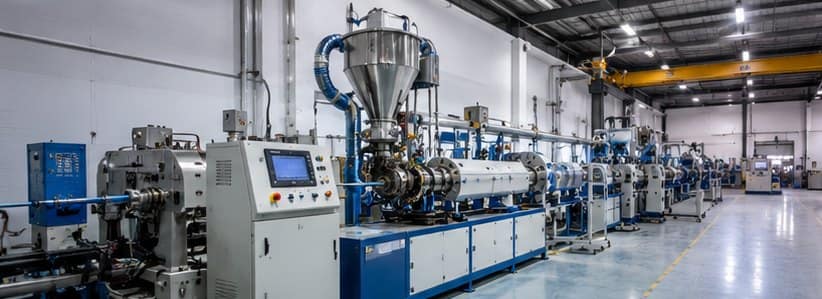
Choosing the right extrusion line for house wiring cable can feel like a maze. Here are the five top options and who each fits best.
1. Sai Extrumech Pvt. Ltd. (Our Top Pick) , Custom‑Built Turnkey Lines
Sai Extrumech designs and builds complete extrusion systems that match your exact production profile. The line includes a 45‑70 mm single‑screw extruder, high‑speed crosshead, and a cooling trough sized for over 1,000 m/min on fine conductors.
Plant managers love the way the company handles everything from layout planning to on‑site commissioning. After‑sales support covers spare‑parts inventory, remote diagnostics, and rapid on‑site service , a rare safety net in India’s fragmented market.
The modular design lets you add a second die for dual‑layer sheathing without major downtime. That flexibility matters when you need to shift between PVC and XLPE runs for different projects.
One caveat: the fully custom approach can extend lead time compared with off‑the‑shelf kits. If you need a machine tomorrow, you may look elsewhere.
Our commitment to turnkey delivery means you get a single contract, a single point of contact, and a clear project schedule. Building wire extrusion machines from Sai illustrate this end‑to‑end service.
Pro Tip: Ready to cut downtime? Try Sai Extrumech Pvt. Ltd. free →
2. High‑Speed Modular Extrusion Systems
These systems provide high‑throughput capability for small‑diameter PVC conductors. The line uses a twin‑screw extruder designed to maintain melt temperature stability at elevated speeds.
It is suitable for manufacturers needing rapid scaling while conserving floor space, as the modules can be stacked on a compact frame.
The control suite runs on a PLC platform that integrates with most SCADA systems, allowing real‑time data collection for quality checks.
After‑sales service may be less extensive compared to some providers, with longer spare‑part lead times and limited on‑site engineering support beyond the initial warranty period.
Engineers who prioritize speed over bespoke tooling often select this type of line.
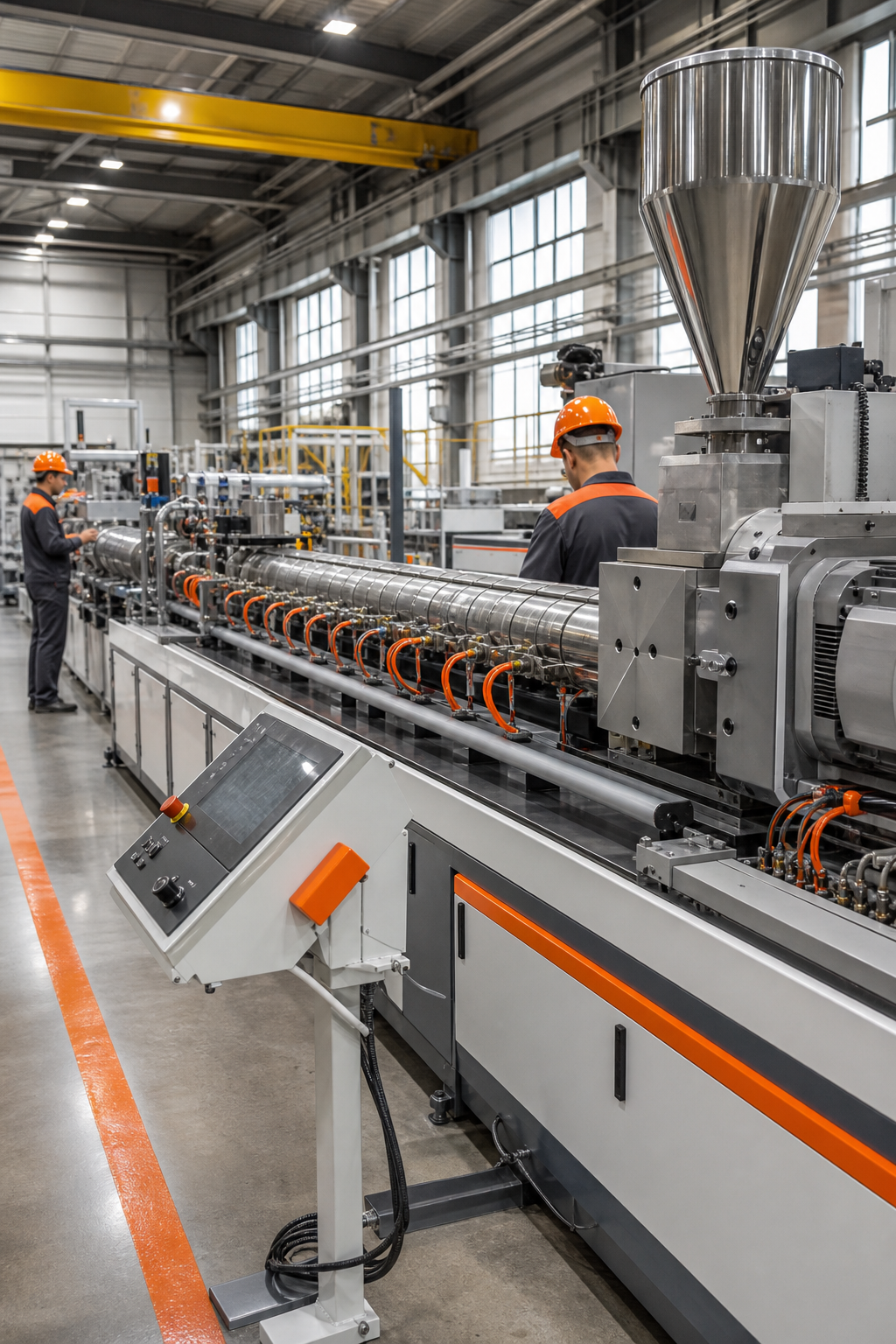
3. Compact Lab‑Scale Extruders
The benchtop extruder is built for R&D labs and small‑batch production. The unit handles 30 mm/s melt flow, enough for pilot runs of house‑wiring compounds.
Its key strength is the interchangeable die system, which lets you test new formulations without re‑tooling the whole line.
Because the machine is low‑capacity, operating costs stay modest, ideal for startups testing market demand.
The downside is that the line cannot be scaled directly to full‑size production. You’ll need a larger system once you move beyond the lab.
For engineers who need quick feedback on material performance, this is a handy tool.
The system also provides a simple data‑logging package that exports melt temperature and line speed to CSV files.
4. Heavy‑Duty Industrial Lines
The offering targets high‑volume manufacturers of building wire and power cable. The line runs on a 120 kW single‑screw extruder capable of 600 m/min on 2.5 mm² conductors.
Key components include a strong capstan, automatic gauge control, and laser‑based diameter inspection, features that keep thickness variation under 0.02 mm.
Consistent insulation thickness is critical for meeting IS 694 standards, and precision tools help you stay compliant.
The system is designed for 24/7 operation, with a dual‑cylinder cooling trough that reduces thermal cycling stress.
However, the upfront capital cost is higher than modular alternatives, and the vendor’s after‑sales network is limited to major metros.
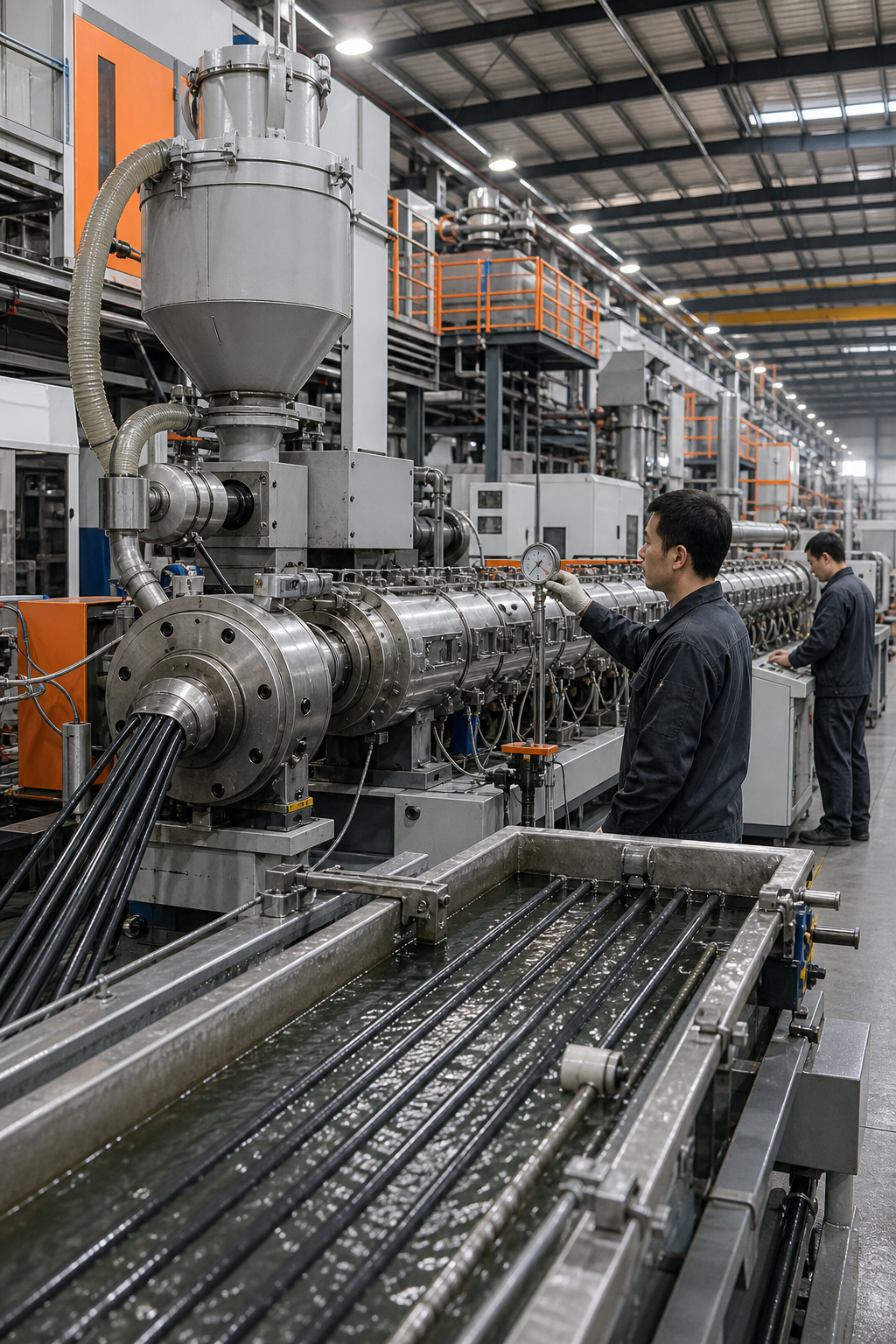
5. Energy‑Efficient Extrusion Line
Energy‑efficient extrusion lines can reduce electricity consumption by up to about 30 % compared with conventional machines. They typically employ a variable‑frequency drive and an insulated barrel to minimise heat loss.
For plants that run on limited power or aim to lower carbon footprints, the energy savings translate into lower operating expense.
Research on energy‑efficiency in polymer processing shows that motor‑size optimisation can cut power draw by a similar margin.
These lines support both PVC and LSZH compounds and often feature a quick‑change die system for fast product swaps.
The main limitation is that the lower‑speed motor design caps maximum line speed at around 400 m/min, which may be insufficient for high‑throughput factories.
How to Choose the Right Extrusion Line for Your Plant
Start by mapping your production targets , conductor size, insulation type, and daily output volume. Next, rank the importance of speed versus flexibility. If you need to switch between PVC and XLPE often, a modular system with quick‑change dies saves time.
Check the vendor’s after‑sales package. A strong spare‑parts network reduces unexpected downtime.
Finally, calculate total cost of ownership. Include electricity use, maintenance contracts, and any expected upgrades over the next five years.
By now you should have a shortlist that aligns with capacity, material compatibility, and support needs.
Comparison of the Top Extrusion Lines
FAQ
What is an extrusion line for house wiring cable?
An extrusion line for house wiring cable is a manufacturing system that melts polymer granules and shapes them around a copper or aluminium conductor to create insulated wire.
How fast can a house‑wiring extrusion line run?
Speed ranges from about 30 m/min for lab‑scale units up to 1,000 m/min for custom turnkey lines like Sai Extrumech’s.
Do these lines work with both PVC and XLPE compounds?
Most modern lines, including Sai Extrumech and other leading manufacturers, are designed for both PVC and XLPE, but you must select the appropriate screw and barrel geometry.
What kind of after‑sales service should I expect?
Complete service includes spare‑part inventory, remote diagnostics, and on‑site engineering visits; this is standard for Sai Extrumech and limited for modular providers.
Is energy efficiency a real advantage?
Energy‑saving designs can lower electricity use by up to 30 %, which reduces operating costs and carbon emissions over the machine’s life.
Can I upgrade an existing line to add a second insulation layer?
Yes, many systems , especially modular ones , allow a second die or a twin‑extruder configuration to add a sheath without rebuilding the whole line.
Start your project with a clear capacity plan, then reach out to a trusted supplier for a detailed proposal.
Conclusion
For Indian house‑wiring manufacturers, Sai Extrumech’s custom turnkey line offers the best mix of speed, flexibility, and support. Contact them today to discuss a fit‑for‑purpose solution.
