
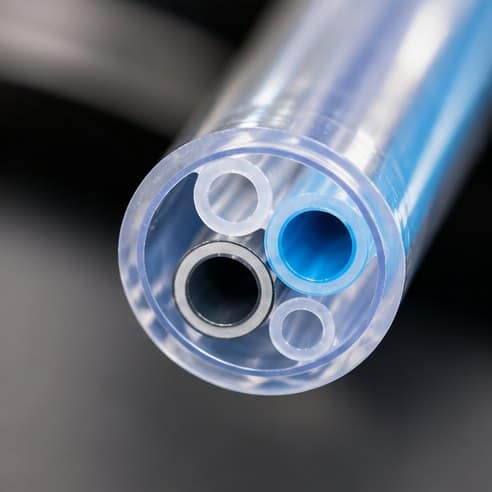
Multi-lumen medical tubing packs several separate channels into a single shaft. A multi-lumen tube carries two or more separate channels inside a single outer wall. It is what lets one catheter do several jobs at once — infuse incompatible drugs without mixing, run a guidewire alongside an inflation channel, or carry sensor wiring beside a working lumen. Producing it cleanly is a genuine test of tooling design and melt control.
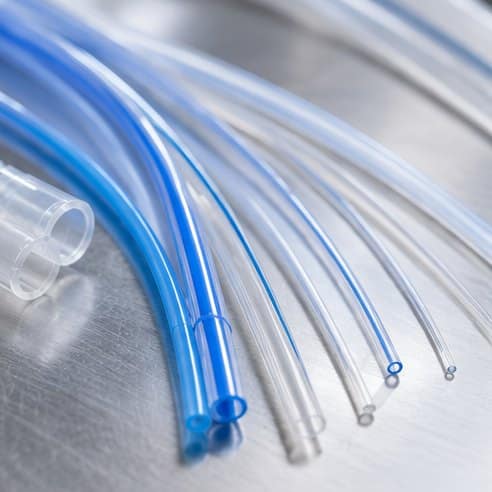
Where multi-lumen tubing is used
A triple-lumen central venous catheter lets clinicians deliver multiple therapies simultaneously through one device. Other designs pair a large working lumen with smaller channels for guidewires, balloon inflation or fibre-optic sensors. The common thread is doing more through a single, small cross-section.
The challenge is in the tooling
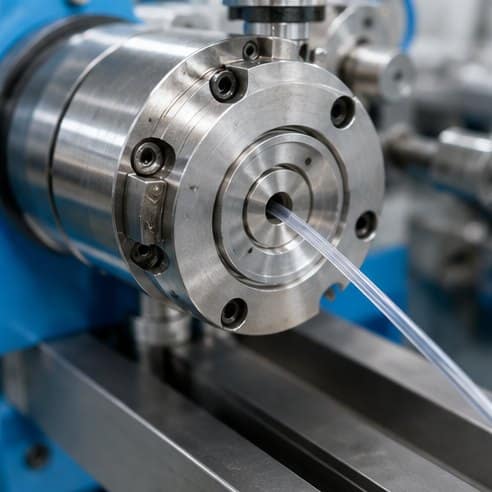
The difficulty is almost entirely in the die and flow balance:
- The die contains fixed pins that form each lumen; melt must distribute evenly around every pin or the walls come out uneven.
- The thin internal walls between channels (septa) are fragile in the melt and easy to distort, so draw-down must be tuned to keep them straight and centred.
- Because the pins are held from one side, any pressure imbalance shifts them and throws off lumen position.
Getting a clean, symmetric multi-lumen cross-section repeatably depends on both die design and a stable melt, which is why this work runs on a precision medical tubing extrusion line with tight pressure control.
How it relates to catheter design
Multi-lumen construction is frequently combined with the other catheter geometries — reinforcement, tapering and bump zones — in one shaft. The material choice matters too; the polymer you select affects how cleanly the septa form and hold their shape. See our overview of catheter tubing extrusion for how these constructions fit together.
How Sai Extrumech Extrudes Multi-Lumen Tubing
Multi-lumen tubing is formed by a crosshead fitted with a separate pin for each lumen and a matching die. The real difficulty is holding every lumen at the right size and in the right position as the melt flows around the pins — it takes even flow balancing, precise pin alignment and independent vacuum on each lumen to keep them open and consistent. Our medical tubing crossheads are machined for two, three or more lumens and matched to your compound and wall specification.
We extrude multi-lumen tubing in PVC, PU, nylon, Pebax-type and TPU on precision medical tubing extrusion lines, with in-line laser measurement holding each dimension to tight tolerance.
Applications of Multi-Lumen Tubing
- Catheters combining irrigation, inflation and a guidewire channel in one shaft
- Dual and triple-lumen drainage catheters
- Feeding and delivery tubes
- Devices needing separate gas and fluid paths
Related: see catheter tubing extrusion, bump & tapered tubing and choosing a tubing material.
Multi-Lumen Medical Tubing: Key Takeaways
Multi-lumen medical tubing places several independent channels inside a single shaft, which makes it powerful for advanced catheters but demanding to produce. The difference between usable and unusable multi-lumen medical tubing comes down to precise multi-pin tooling, perfectly balanced melt flow and independent vacuum on each lumen, verified by continuous laser measurement. For background on the devices that rely on it, see catheters — where variable lumens carry fluid, gas and guidewires through one tube.
Frequently asked questions
What is multi-lumen tubing?
Multi-lumen tubing is a single tube containing two or more separate internal channels, letting one catheter carry multiple fluids, a guidewire, or inflation media without them mixing.
Why is multi-lumen tubing hard to extrude?
The internal dividing walls (septa) are thin and fragile in the melt, and the die pins that form each lumen shift if melt flow is unbalanced, so it demands precise tooling and a very stable melt to hold lumen position and wall thickness.

Add a Comment