
Grooved Feed Extruder: Working Principle, Applications & Selection Guide
Walk through a modern HDPE pipe plant in Europe, and you’ll notice that grooved feed extruders are often the standard choice. Visit many wire, cable, or pipe extrusion facilities in South Asia or North America, and smooth-bore extruders are still widely used. Both designs are proven technologies capable of producing high-quality products. The real question isn’t which one is “better”—it’s which one is better suited to your material, product, and production goals.
A grooved feed extruder wasn’t developed to replace every smooth-bore machine. It was designed to solve specific process limitations that become noticeable when processing high-viscosity polymers or applications requiring stable output under high die pressure. Understanding where this technology excels—and where it doesn’t—is far more valuable than simply comparing throughput figures.
In this guide, we’ll explain how a grooved feed extruder works, why feed grooves improve solids conveying, which materials benefit the most, where smooth-bore machines still make more sense, and the practical engineering factors you should evaluate before selecting either design.
What Is a Grooved Feed Extruder?
A grooved feed extruder is a single-screw extruder that uses axial grooves machined inside the feed section of the barrel, just below the hopper. These grooves prevent polymer pellets from rotating together with the screw, allowing the screw flights to push the material forward more efficiently. The result is higher solids conveying efficiency, improved throughput, and output that is far
Why Standard Extruders Struggle with High-Viscosity Polymers
To understand why grooved feed technology was developed, it’s important to first understand how a conventional smooth-bore extruder feeds material.
In a standard single-screw extruder, polymer pellets enter through the hopper and fall into the feed section of the barrel. The inside surface of this section is smooth, so the pellets move forward mainly because of the difference in friction between the barrel wall and the rotating screw.
When the pellets grip the barrel wall more strongly than the screw surface, the screw flights can push them forward into the compression zone. This friction-based conveying system works well for many common thermoplastics and has been the industry standard for decades.
However, this approach has practical limitations.
Reduced Solids Conveying with High-Viscosity Polymers
High-viscosity materials such as HMW-HDPE offer lower friction in the feed zone than standard polyethylene grades. Instead of moving efficiently towards the screw, some pellets begin rotating with it.
As a result:
- Solids conveying becomes less efficient.
- Throughput decreases.
- Output becomes less consistent.
- Operators often need to increase screw speed to maintain production.
Although increasing screw speed raises output, it also increases shear heating and energy consumption, making process control more difficult.
Output Drops as Die Pressure Increases
Another limitation of smooth-bore extruders is their sensitivity to back pressure.
During extrusion, the polymer melt encounters resistance while passing through the screen pack, breaker plate, crosshead, or die. As this resistance increases, pressure builds inside the screw channel.
Part of this pressure works against the forward movement of the material.
In practical terms, higher die pressure often results in:
- Reduced throughput
- Higher melt temperature
- Increased motor load
- Less stable production
This effect becomes more noticeable in applications such as:
- HDPE pressure pipe
- Thick-wall power cable insulation
- Building wire insulation
- Large conduit extrusion
- Products requiring fine filtration through multiple screen packs
For manufacturers producing these products, maintaining stable output becomes increasingly challenging as production speeds increase.
How Grooved Feed Technology Actually Works
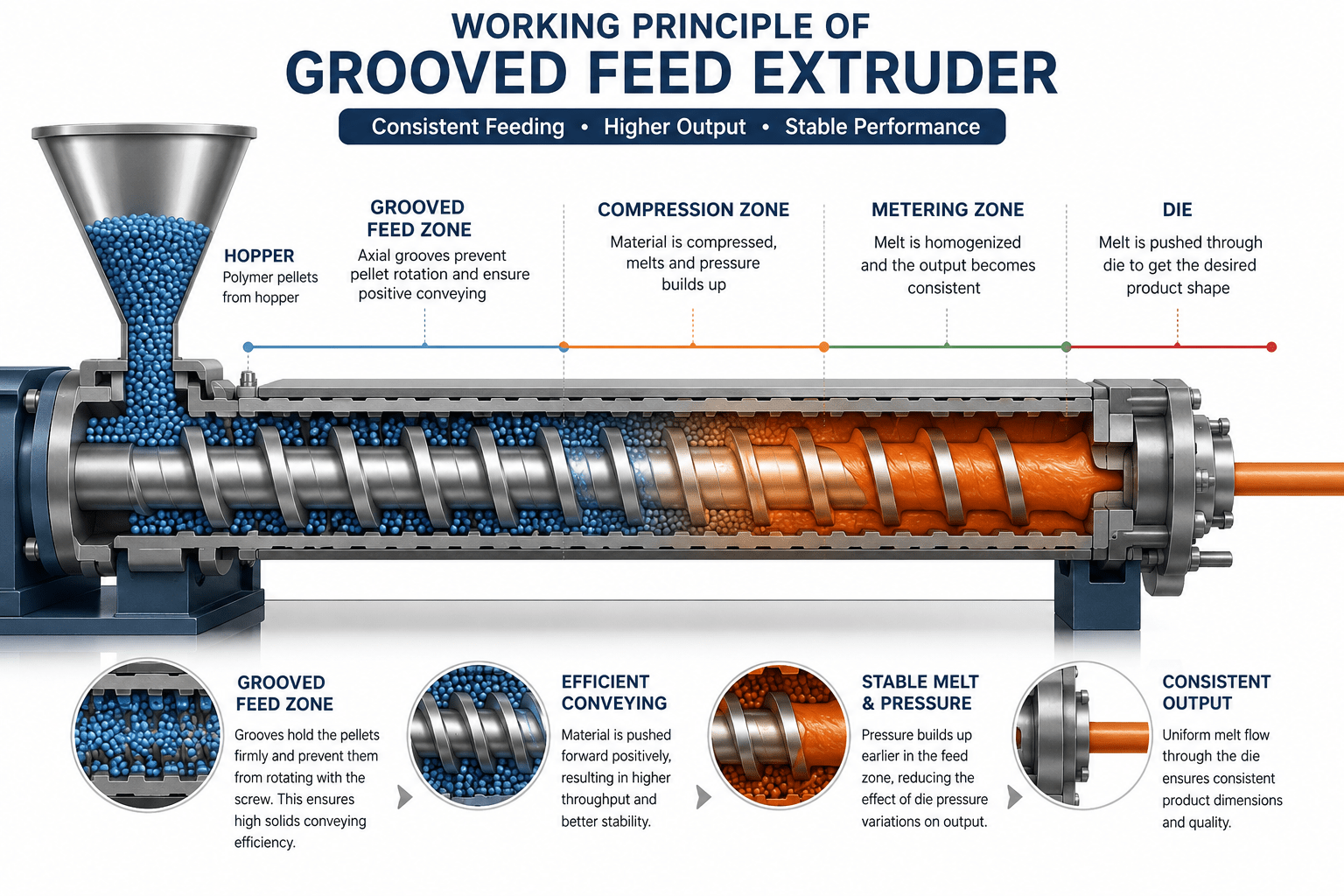
The main difference between a grooved feed extruder and a smooth-bore machine starts in the feed section of the barrel.
In a smooth-bore design, polymer pellets are free to rotate along with the screw if friction is not sufficient. This makes the feeding process dependent on material behavior, temperature, and surface interaction — all of which can vary during production.
In a grooved feed extruder, the feed section of the barrel is machined with multiple axial grooves. These grooves grip the polymer pellets and prevent them from rotating with the screw.
Instead of slipping and rotating, the material is held in place while the screw continues to rotate underneath it. This creates a more direct, mechanical pushing action that forces the polymer forward into the compression zone.
A simple way to understand this is:
instead of trying to move loose, rotating particles, the system pushes a locked mass of material forward.
This change turns the feeding process from friction-based movement into positive mechanical conveying.
Because of this, the performance of the extruder becomes much less dependent on material friction or changing process conditions.
One of the biggest advantages of this mechanism is that pressure begins building much earlier — directly in the feed zone — instead of gradually developing along the screw length.
As a result, variations in die pressure have far less impact on output stability. This is why grooved feed systems are widely used in applications where consistent production is more important than flexibility.
Applications Where Grooved Feed Extruders Work Best
Grooved feed extruders deliver the best performance in applications where material viscosity is high and process stability is critical.
One of the most common uses is in HDPE pressure pipe extrusion. In this application, the die creates significant back pressure, and even small fluctuations can affect wall thickness. Grooved feed systems help maintain a steady output, which improves dimensional consistency over long production runs.
They are also widely used in power cable and building wire insulation lines. In these processes, maintaining uniform insulation thickness is extremely important. Because grooved feed extruders reduce output variation caused by pressure changes, they help achieve better product consistency and lower material waste.
In conduit and duct manufacturing, where continuous extrusion is required for long lengths, stable output plays a key role in maintaining uniform product dimensions. Grooved feed technology helps ensure that production remains smooth even when operating conditions vary.
For high-viscosity polyethylene grades such as HMW-HDPE, grooved feed systems offer a clear advantage because they improve solids conveying efficiency in the feed zone. This results in more stable melting behavior and better overall process control.
In simple terms, grooved feed extruders are most effective in applications where:
stable output, consistent product quality, and high production efficiency are more important than material flexibility.
Grooved Feed vs Smooth Bore (Practical Difference in Real Production)
At a practical production level, the difference between grooved feed and smooth-bore extruders comes down to how consistently they handle changing process conditions.
A smooth-bore extruder relies mainly on friction between the polymer, screw, and barrel to move material forward. Because of this, its performance can vary when material properties, temperature, or die resistance change during production. In stable conditions, it works reliably, but its output is more sensitive to small variations in the process.
A grooved feed extruder, on the other hand, uses mechanical gripping in the feed section to control material movement. The grooves prevent pellet rotation and ensure that material is pushed forward more consistently by the screw. This makes the feeding process more stable and less dependent on friction or material behavior.
In real production terms, this means grooved feed systems are better suited for high-output, continuous processes where consistency is critical — such as pipe extrusion or cable insulation. Smooth-bore machines are more flexible and handle a wider range of materials, including regrind, blends, and compounds, where process conditions are not always consistent.
Another key difference is sensitivity to pressure changes. In smooth-bore machines, changes in die pressure directly affect output. In grooved feed systems, this effect is significantly reduced, which helps maintain stable product dimensions over long production runs.
In simple terms, grooved feed extruders prioritize stability and output efficiency, while smooth-bore extruders prioritize flexibility and material versatility.
When Smooth-Bore Extruders Are Still the Better Choice
Although grooved feed extruders offer clear advantages in high-output and high-viscosity applications, they are not the right solution for every process. In many real-world extrusion setups, smooth-bore machines still deliver better overall performance depending on the material and production requirements.
Smooth-bore extruders are generally preferred when processing mixed materials or regrind. Since their feeding system is based on friction rather than mechanical gripping, they handle variations in pellet shape, size, and density more effectively. This makes them more stable in processes where raw material consistency is not fully controlled.
They are also widely used in compounding and masterbatch production. In these applications, proper mixing and dispersion of additives are more important than pure throughput. Smooth-bore designs allow better melting balance and longer residence time, which helps achieve uniform blending of materials.
For soft polymers and elastomers, smooth-bore machines perform more predictably because the material does not rely on groove-based mechanical feeding. Instead, it moves steadily under controlled friction conditions without risk of feeding instability.
In low back-pressure applications, where the die resistance is minimal, grooved feed systems do not provide a significant performance advantage. In such cases, the higher energy requirement of grooved feed machines may not be justified.
Flexible production environments also favor smooth-bore extruders. When a plant needs to switch frequently between different polymers or product types, smooth-bore systems offer better adaptability and easier process control.
In summary, smooth-bore extruders remain the better choice when material flexibility, mixing quality, and process versatility are more important than maximum output and feed stability.
Is Grooved Feed Right for Your Process? (Final Decision Guide)
Choosing between a grooved feed and a smooth-bore extruder ultimately depends on your material behavior and production priorities rather than just output numbers.
A simple way to evaluate this is to ask two key questions.
First, are you processing a high-viscosity polyolefin such as HMW-HDPE in a consistent, well-controlled pellet form?
Second, does your application involve significant die pressure where output stability directly affects product quality?
If the answer to both questions is yes, then a grooved feed extruder is likely to deliver better performance. It will offer more stable output, lower melt temperature, and improved process efficiency in continuous production environments. In such cases, the higher investment in drive power, cooling systems, and machine design is generally justified by long-term production benefits.
However, if your process involves mixed materials, regrind usage, frequent grade changes, or compounding operations, a smooth-bore extruder will usually be the more practical choice. Its flexibility and tolerance to material variation make it better suited for dynamic production environments where consistency of raw material cannot always be guaranteed.
The most common mistake in extrusion system selection is focusing only on theoretical output gains without considering real production conditions. A grooved feed system performs exceptionally well only when the material and process align with its design principles.
At Sai Extrumech, extrusion systems are not selected in isolation. Feed system design, screw geometry, barrel configuration, and cooling systems are engineered as a complete matched solution based on the polymer type and application requirement. This ensures stable performance across industries such as power cable, building wire, and industrial extrusion lines.
If you’re evaluating a new extrusion line or troubleshooting an existing process, the right system selection can significantly improve efficiency, reduce waste, and stabilize production output.
Need Expert Help Selecting the Right Grooved Feed Extruder?
Choosing the right extrusion system requires more than comparing machine specifications. Factors such as polymer type, throughput requirements, screw geometry, feed system design, die pressure, and cooling configuration all influence long-term production efficiency and product quality.
At Sai Extrumech, we design and manufacture customized extrusion solutions for wire & cable, HDPE pipe, medical tubing, and industrial plastic extrusion applications. Our engineering team works closely with manufacturers to recommend the most suitable extrusion system based on their production goals and material requirements.
Whether you’re planning a new extrusion line or upgrading an existing one, our experts can help you select the right grooved feed extruder, screw & barrel configuration, and extrusion tooling for consistent, high-performance production.
👉 Explore Our Extrusion Solutions
👉 Contact Our Engineering Team for Expert Consultation

Add a Comment