
Extrusion Dies: A Complete Guide to Design, Performance & Selection 2026
Plastic extrusion is a precision manufacturing process where every component plays a vital role in determining product quality. While processors often focus on the extrusion machine, Extrusion Screw & Barrel, or polymer selection, one component has the greatest influence on the final profile—the extrusion die.
Whether you’re manufacturing PVC pipes, plastic profiles, medical tubing, cables, sheets, or industrial components, the extrusion die controls how molten polymer flows before it takes its final shape. Even a perfectly functioning extrusion line can produce inconsistent products if the die is not engineered for the specific application.
Many processors believe a single die can handle different polymers, production rates, and applications with only minor adjustments. In reality, this approach often leads to dimensional variation, poor surface finish, higher scrap rates, and unstable production.
This guide explains how extrusion dies work, why proper die design matters, and how selecting the right die improves productivity, product quality, and long-term manufacturing efficiency.
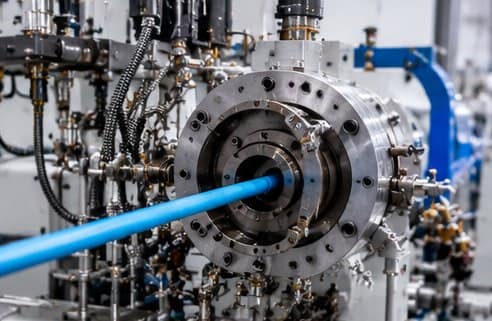
What Are Extrusion Dies?
An extrusion die is a precision-engineered tooling component installed at the end of an extrusion machine. Its primary function is to shape molten polymer into the required cross-section before the material enters the cooling and calibration stage.
As molten plastic passes through the die, the internal flow channels distribute the material evenly across the entire profile. The objective is simple:
- Maintain uniform pressure distribution
- Deliver equal melt flow across the complete cross-section
- Produce accurate dimensions
- Achieve consistent wall thickness
- Ensure excellent surface finish
Because every plastic material behaves differently under heat and pressure, extrusion dies are designed specifically for the polymer being processed and the product being manufactured.
For this reason, manufacturers producing PVC pipes require different die designs than companies producing PE tubing, PP sheets, cable insulation, or complex industrial profiles.
How Do Extrusion Dies Work?
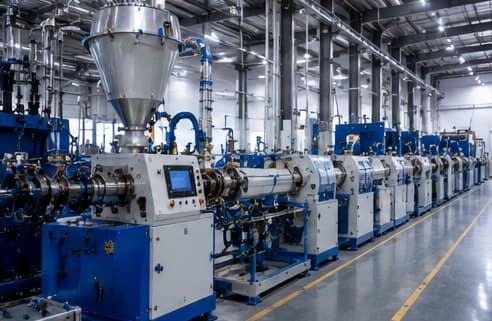

The performance of an extrusion die depends on how effectively it controls the movement of molten polymer.
Once plastic leaves the screw and barrel assembly, it enters the die under controlled pressure. Inside the die, specially designed flow channels guide the material toward the exit opening.
A well-designed die ensures that every portion of the polymer experiences nearly identical pressure loss from the die entrance to the exit. This balanced flow allows the material to leave the die at a uniform velocity, producing a stable profile with consistent dimensions.
When flow becomes uneven, different sections of the product leave the die at different speeds. This imbalance can lead to manufacturing defects such as:
- Uneven wall thickness
- Dimensional inaccuracies
- Poor gauge control
- Surface imperfections
- Warpage after cooling
- Rippled or distorted edges
This is why modern extrusion die design relies on engineering calculations, polymer flow analysis, and precision machining rather than trial-and-error adjustments.
Why Proper Extrusion Die Design Matters
Many extrusion problems are incorrectly blamed on machine settings, raw material quality, or operator error. While these factors influence production, the die itself often determines whether a process remains stable.
An accurately engineered die offers several advantages:
- Consistent product dimensions
- Improved surface quality
- Better pressure balance
- Reduced material waste
- Higher production efficiency
- Lower rejection rates
- Stable performance over long production runs
For manufacturers producing high-precision plastic products, investing in the right extrusion die is often more cost-effective than repeatedly adjusting machine parameters to compensate for an unsuitable design.
Types of Extrusion Dies
Different products require different die configurations. Selecting the correct die depends on the polymer, product geometry, production speed, and application.
Some of the most common extrusion dies include:
Profile Extrusion Dies
Designed for manufacturing window profiles, door frames, automotive trims, cable ducts, and industrial sections with complex cross-sectional shapes.
Pipe and Tubing Dies
Used to manufacture PVC, HDPE, LDPE, PP, and CPVC pipes and tubing with accurate wall thickness and concentricity.
Why General-Purpose Extrusion Dies Don't Exist
One of the biggest misconceptions in plastic extrusion is the belief that a single die can efficiently process different polymers at different production rates. While some extrusion dies offer limited adjustment features, no die can deliver optimum performance across every material and operating condition.
Every extrusion die is engineered around three critical factors:
- The polymer being processed
- The required product profile
- The planned production output
These parameters determine the internal flow channels, pressure distribution, and melt velocity throughout the die.
When any of these variables change, the flow behaviour inside the die changes as well. Even if the die looks identical from the outside, its performance can vary significantly.
This is why a die that produces an excellent PVC profile may not perform equally well with PP or PE. Likewise, a die designed for one production rate may produce inconsistent dimensions if the output is increased beyond its intended operating range.
Rather than treating extrusion dies as universal tooling, manufacturers should select or design dies according to their specific production requirements.
How Polymer Properties Affect Die Performance
Different polymers respond differently during extrusion.
Materials such as PVC, HDPE, LDPE, PP, PET, PC, and ABS all have unique melt characteristics. Their viscosity changes differently when temperature, pressure, or shear rate changes.
Because of this behaviour, polymer flow inside the die is never identical for every material.
For example, PVC generally requires tighter flow balancing because its viscosity changes more rapidly with processing conditions. Engineering plastics such as PC and PET often provide a slightly wider processing window, but they still require properly designed extrusion dies for consistent results.
Selecting the correct die geometry according to the polymer helps maintain:
- Stable melt flow
- Uniform wall thickness
- Better dimensional accuracy
- Improved surface finish
- Lower rejection rates
Common Problems Caused by the Wrong Extrusion Die
Using an unsuitable extrusion die often creates quality problems that operators mistakenly blame on machine settings or raw materials.
Some of the most common issues include:
Uneven Wall Thickness
Poor flow balancing causes different sections of the profile to fill at different speeds, resulting in inconsistent wall thickness.
Warpage After Cooling
Uneven polymer distribution creates different cooling rates, causing the product to bend or distort after exiting the line.
Surface Defects
Flow imbalance may lead to rough surfaces, die lines, ripples, or visible marks on the finished product.
Poor Gauge Control
When melt exits the die unevenly, maintaining accurate dimensions becomes difficult, especially in sheet, film, and pipe extrusion.
Higher Scrap and Downtime
Manufacturers often spend valuable production time adjusting temperatures, screw speed, or haul-off settings when the actual problem originates from the die itself.
How to Choose the Right Extrusion Die
Selecting the correct extrusion die involves much more than matching the product shape.
Before designing or purchasing a die, manufacturers should evaluate:
- Polymer type
- Melt flow characteristics
- Required production output
- Product dimensions
- Wall thickness requirements
- Surface finish expectations
- Production tolerances
- Future scalability
Partnering with an experienced Plastic Extrusion Die Manufacturer in India ensures that every critical factor—including polymer type, product profile, melt flow characteristics, and production output—is carefully evaluated before the die is manufactured. This engineering-driven approach helps improve product quality, reduce material waste, and achieve consistent long-term production performance.
How SAI Extrumech Designs High-Performance Extrusion Dies
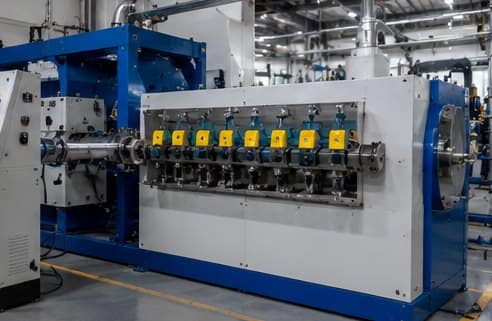
At SAI Extrumech, every extrusion die is designed around the customer’s actual production process rather than a standard template.
Our engineering team evaluates the polymer, product profile, production output, and application before designing the internal flow channels. Using precision machining and engineering calculations, we manufacture custom extrusion dies that deliver balanced melt flow, consistent dimensions, and reliable long-term performance.
Our extrusion die solutions support a wide range of applications, including:
- PVC Pipe Extrusion
- HDPE & PP Pipe Extrusion
- Plastic Profiles
- Cable & Wire Insulation
- Medical Tubing
- Industrial Plastic Components
- Custom Extrusion Applications
Whether you require a new die or a custom-engineered solution for a challenging application, our goal remains the same—delivering tooling that improves productivity, minimizes material waste, and maintains consistent product quality.
Conclusion
Extrusion dies are not universal tools. They are precision-engineered components designed for specific polymers, product profiles, and production outputs.
Choosing the right extrusion die improves melt flow, dimensional accuracy, surface finish, and production efficiency while reducing scrap and machine downtime.
Instead of relying on a “general-purpose” approach, manufacturers should invest in properly engineered dies that match their actual processing requirements. This not only improves product quality but also delivers better long-term manufacturing performance.
If you’re looking for reliable extrusion dies or custom-engineered tooling for your plastic extrusion application, SAI Extrumech offers precision manufacturing solutions tailored to your production needs.
FAQ
What are extrusion dies used for?
Can one extrusion die be used for different polymers?
Why is extrusion die design important?
What causes uneven flow in extrusion dies?
Does SAI Extrumech manufacture custom extrusion dies?
Related Products
Related from Sai Extrumech: extruder tips & dies, crossheads, screws & barrels, and complete extrusion machines. See all products.
Plastic Extrusion Dies: Key Takeaways
Plastic extrusion dies shape molten polymer into its final profile, and no single die suits every material or output. Choosing the right plastic extrusion dies means engineering the flow channels around your polymer, product and production rate. For the tooling family, see dies (manufacturing).

Add a Comment