
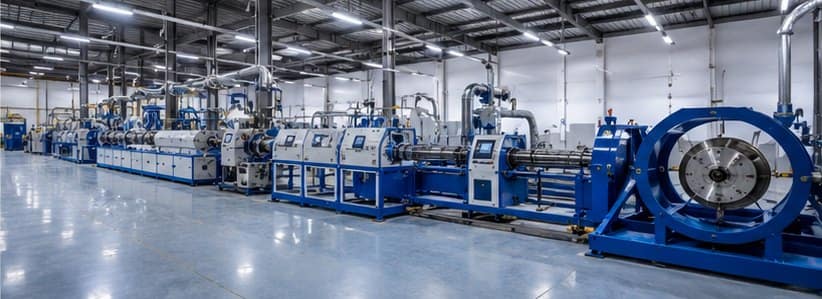
A caterpillar haul-off is a motorised pulling unit in a cable extrusion line that draws the cable away from the crosshead at a controlled, consistent speed. It directly governs line speed, draw-down ratio, and therefore wall thickness. Without a properly calibrated haul-off, even a well-set extruder will produce out-of-spec cable.
How a Caterpillar Haul-Off Works
The unit grips the cable between two or more continuous rubber or polyurethane belt tracks — the “caterpillar” tracks — and drives it forward using synchronised motors. Grip pressure is adjustable to accommodate different cable diameters without deforming insulation or jacket material during transit.
Three parameters are controlled at this stage:
- Line speed — typically 10–200 m/min depending on cable type and OD
- Draw-down ratio (DDR) — ratio of haul-off speed to extruder screw output; this determines wall thickness
- Tension — must remain consistent to prevent stretching or sag between the cooling trough and take-up
Types of Caterpillar Haul-Off Units
Single-Belt Haul-Off
Used for smaller cables up to approximately 10 mm OD. Simpler construction and lower cost, but less grip stability for heavier or stiffer cables.
Dual-Belt (Twin-Caterpillar) Haul-Off
The most common configuration for building wire, control cable, and medium-voltage power cable lines. Two opposing belt tracks clamp the cable from both sides, providing balanced tension without inducing ovality distortion.
Three-Belt and Four-Belt Units
Used for large-diameter cables — 33 kV and above, armoured cables, and submarine cables. Multiple belt contact points distribute pulling force evenly around the cable circumference, which is critical when pulling cables above 50 mm OD at low line speeds.
Drive and Speed Control
Modern haul-off units use AC servo motors or vector-controlled AC drives with encoder feedback. This allows line speed to be synchronised precisely with the extruder screw RPM — a closed-loop arrangement that keeps wall thickness within ±5% tolerance across a full production run.
The haul-off speed is set relative to extruder output using the draw-down ratio. A higher DDR thins the wall; a lower DDR builds it up. Operators fine-tune this relationship during startup to bring the cable within specification before committing to full production speed.
For more on how screw geometry influences throughput — and therefore the baseline output the haul-off must match — see our post on L/D ratio in extruders.
Grip Force and Cable Surface Damage
Grip force must be set with care. Too little, and the cable slips — causing speed variation and wall thickness fluctuation. Too much, and the belts deform soft insulation like XLPE or LSZH compounds that are still warm when they reach the haul-off.
Belt material selection follows the cable type. Rubber belts are standard for PVC and XLPE cables. Silicone-faced belts are specified where the cable surface must remain unmarked — common in automotive wire and aerospace harness production.
Position in the Extrusion Line
The caterpillar haul-off sits downstream of the cooling trough and spark tester, just before the take-up or capstan. The typical sequence for an insulation or sheathing line is:
- Pay-off → Extruder → Crosshead → Water cooling trough → Diameter gauge → Spark tester → Haul-off → Take-up
Its position after cooling is intentional. The cable must be dimensionally stable and sufficiently solidified before the belt tracks grip it. Soft cable exiting the crosshead directly under belt pressure would deform and produce non-round cross-sections.
The crosshead plays a defining role in concentrically applying insulation before the haul-off takes control of speed. Our guide on what is a crosshead in cable extrusion explains that relationship in detail.
Common Haul-Off Problems and How to Diagnose Them
Speed Instability
Symptoms: wall thickness variation and eccentricity drift on the gauge. Common causes: worn belt surface, drive encoder fault, or speed reference signal noise from the control panel. Check belt wear first — it accounts for the majority of field cases.
Belt Slippage on Heavy Cables
Increase pneumatic grip pressure gradually. If slippage persists at maximum grip, the belt material or track contact length is undersized for the cable OD and required pulling load. Upgrading to a longer-bed unit or a three-belt configuration resolves this structurally.
Periodic Marks on the Cable Surface
Marks appearing at regular intervals equal to the belt circumference indicate belt surface damage or embedded debris. Replace belt tracks and inspect the belt channel for trapped material before restarting.
Selecting the Right Haul-Off for Your Line
Key selection criteria engineers should specify:
- Cable OD range — the belt gap adjustment range must cover your full product mix without requiring belt-track replacement between jobs
- Maximum pulling force — rated in kg or N; heavy armoured cables typically need 500–2,000 kg pulling capacity
- Speed range — must match the extruder throughput at your target wall thickness and DDR
- Motor type — servo drives offer tighter speed synchronisation than standard AC inverter drives, which matters most on high-speed fine-wire lines
- Belt contact length — longer contact spreads grip force over a greater area, reducing surface pressure per unit length
For fine-wire lines with conductors in the 0.1–1.0 mm range, the haul-off must handle 400–800 m/min with very low drive inertia. For power cable lines running at 5–20 m/min, the priority shifts to high pulling force and stable tension under load variations.
If your plant runs multiple cable constructions, consider a haul-off with quick-change belt cassettes. This significantly reduces changeover time and is now a standard specification on flexible extrusion lines.
For context on how the upstream extruder type affects downstream equipment requirements — including haul-off sizing — our comparison of single screw vs twin screw extruders for cable extrusion covers the key differences.
Frequently Asked Questions
What is the difference between a caterpillar haul-off and a capstan puller?
A caterpillar haul-off grips the cable linearly between belt tracks and pulls it in a straight line — no winding occurs. A capstan puller wraps the cable around a rotating drum to generate pulling tension through friction. Caterpillar units are standard on insulation and sheathing lines where maintaining a straight cable path is critical. Capstans are used on drawing lines and some bare conductor applications.
How do you calculate draw-down ratio for a cable extrusion haul-off?
Draw-down ratio (DDR) = haul-off line speed ÷ extruder melt output speed. In practice, operators set a target DDR at the control panel and adjust haul-off speed relative to extruder screw RPM until the measured wall thickness matches the specification. A DDR of 1.0 means no draw-down; values above 1.0 progressively thin the wall.
What causes periodic surface marks on cable from the haul-off?
Marks repeating at a fixed interval equal to the belt circumference are caused by belt surface damage, hardened deposits, or embedded particles on the belt track. Replace belt tracks and clean the belt channel thoroughly. If marks persist after belt replacement, check whether the cable is reaching the haul-off still warm enough to deform under belt pressure, and adjust the cooling trough length or water temperature.
What pulling force does a cable haul-off need?
Pulling force requirements depend on cable weight per metre, line speed, and any back-tension from the cooling trough. Building wire lines (1.5–16 mm²) typically require 50–200 kg. Medium-voltage power cables (35–150 mm² Cu) require 300–800 kg. Large armoured cables and submarine cables can require 1,000–3,000 kg. Always size the haul-off with a margin of at least 30% above the calculated maximum pulling load.
Sai Extrumech has designed and manufactured wire and cable extrusion lines for over 25 years, supplying plants across India and export markets including the UAE, Bangladesh, and South Africa. If you are specifying a new line or upgrading existing equipment, contact us to discuss your application requirements.

[…] For deeper detail, see our guide to caterpillar haul-off in cable extrusion. […]